

Summary: bar stools and sun loungers on a beach fail first at the frame and then at the fabric. Aluminum and 316 stainless outlast plated steel, and seat height has to match the bar table to the centimeter.
Walk a beach terrace at the end of September and the furniture tells you what it was made of. The chromed stool bases have an orange ring where they touch the deck. The swivel seats grind when you turn them, because sand has worked into the bearing. Fabric that was navy in May is a soft gray-blue, and the one set of bar stools still looking new is the cheapest in the row: a plain frame with a molded seat and nothing to rust, peel or fade.
Commercial bar stools and outdoor furniture are bought on looks in the showroom and judged on survival in the sun. This guide works backward from the ways they die, then matches stool height to table height, and ends with what to stack, fold or store when the season closes.
What do salt air and sun actually do to furniture?
Salt corrodes metal, ultraviolet light breaks down plastics and dyes, and sand grinds every moving part. Each one attacks a different component, so a piece of furniture can pass two tests and fail the third within one summer.
Salt is the slow one. Airborne spray settles as a fine film that stays wet longer than rain, because salt pulls moisture from humid air. On bare or plated steel that film starts rust at welds and at the feet, where the protective layer is thinnest and water sits longest. Stainless steel resists it according to grade; aluminum forms its own oxide skin and does not rust at all, though untreated aluminum can pit and turn chalky white.
Sun works on everything that is not metal. UV exposure makes cheap polypropylene brittle, fades dyed fabric, and cracks the surface of PU leather within a season or two.
Sand is the mechanical enemy. It gets into gas-lift cylinders and swivel plates and acts as grinding paste every time the part moves. Outdoors a stool with a fixed height and no swivel or gas lift outlives the clever ones by years.
Which materials last outdoors near the sea?
Powder-coated aluminum and 316 stainless steel hold up best on the coast, with HDPE resin and wood-plastic composite close behind. Teak works if someone oils or cleans it on a schedule. Chrome plating and 201 stainless belong under a roof, as does indoor upholstery.
| Material | How it fails near the sea | Where it fits | Care it needs |
|---|---|---|---|
| Powder-coated aluminum | Corrosion creeps under chips in the coating; the metal itself does not rust | Stool and lounger frames on open sand | Fresh-water rinse; touch up chips before winter |
| 316 / 316L stainless steel | Light surface tea-staining if never rinsed | Frames and fasteners in the spray zone | Rinse and wipe; passivating cleaner once a season |
| 304 stainless steel | Tea-staining and pitting within a few hundred meters of breaking surf | Covered bars and terraces set back from the water | More frequent rinsing than 316 |
| 201 stainless, chrome-plated or painted steel | Rust at welds and feet, often in the first season | Indoors only | Keep it inside |
| Teak and hardwoods | Grays and checks in the sun; stays sound for years | Tables and loungers where the silver-gray look is welcome | Oil or clean twice a season, or accept the gray |
| HDPE / resin | Slow chalking of the surface after years of UV | Seats, tabletops, stackable chairs | Wash with soapy water |
| Wood-plastic composite (WPC) | Surface fading; no rot | Bar tables and high tops | Wash; no oiling |
| PE rattan on an aluminum frame | Weave loosens at cut ends if the frame flexes | Daybeds and lounge sets | Hose off sand; covers in the off-season |
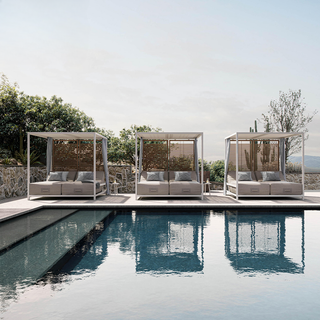
For a sunbed that sits on open sand all day, aluminum with a weatherproof cushion is the safe specification. The two-person sunbed in our range pairs an aluminum frame with 1.2 to 2.0 mm walls and waterproof, UV-resistant cushions, carries EN 581 (the European standard for outdoor furniture) and a five-year warranty from the manufacturer, which tells you how long they expect it to last outside.
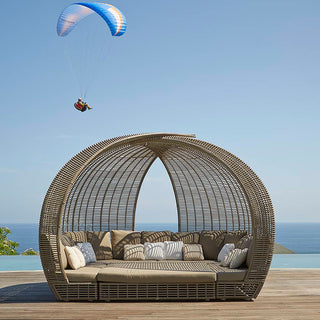
A PE rattan daybed gives a hotel pool or a beach club's front row the lounge look without timber upkeep. Ours is woven over an aluminum alloy frame with olefin cushion covers and a waterproof foam fill, so the cushions dry after a shower instead of holding water for a day.
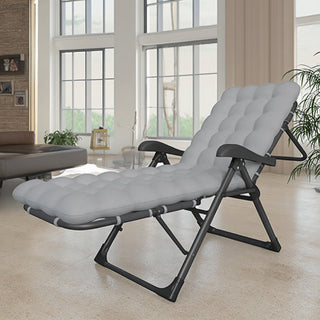
The folding recliners are a different job: a chair that goes out for the afternoon and comes back in. Our zero-gravity chair folds flat on a stainless steel tube frame (25 mm, 1.0 mm wall) with an adjustable headrest and a polyester cushion that should come inside at night.
The S-shaped folding lounger in the same poolside furniture range has a Textilene sling on a steel frame treated against rust. It suits a hotel pool deck on hard paving, where it stacks and folds away easily; right at the water's edge, an aluminum frame is the safer buy.
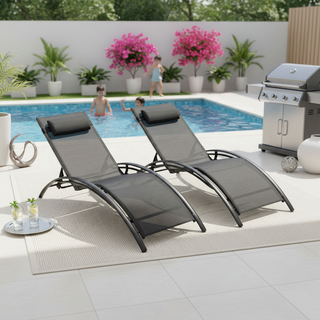
Fabric: what the seat is covered in
Textilene (PVC-coated polyester mesh) drains instantly and is the standard sling for loungers. Solution-dyed acrylic and olefin hold color because the pigment is in the fiber rather than printed on it, which is why they cost more than plain polyester and fade far more slowly. PU leather and velvet are indoor coverings, and so is printed polyester. Under a roof they are fine; in direct sun, expect cracking or fading within a season.
Which bar stools can go outside?
Outdoors, pick bar stools with a molded or slatted seat on an aluminum or 316 frame, and skip upholstery and gas lifts. Most commercial bar stools, including most of the range we stock, are made for indoor counters, and it is worth being honest about that before ordering fifty.
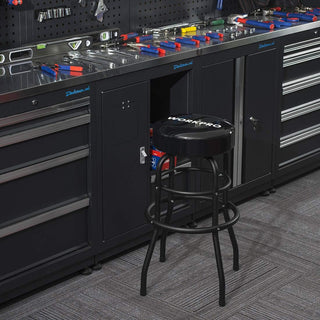
For a beach bar with a solid roof over the counter, a steel-frame stool with a hard plastic seat is the realistic choice from our bar stools collection. It has nothing to absorb water, the seat wipes dry, and the logo can be printed on it. Keep it under cover, rinse the frame weekly and check the feet for rust, because the frame is painted steel rather than stainless.
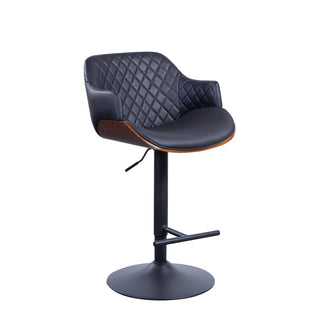
The stools with PU leather, velvet or mesh backs and gas-lift columns belong inside the bar: the lounge, the air-conditioned lobby bar of a beach hotel, the indoor counter that stays open when the terrace closes. There the adjustable seat is useful. The mesh-back swivel model, for example, runs from 63.5 to 83.5 cm seat height, which covers both counter and bar tables with one stock item.
Counter height or bar height: which bar stools go with which table?
Leave 25 to 30 cm between the seat and the underside of the tabletop. A counter-height table (about 90 to 95 cm) takes a stool with a 61 to 66 cm seat; a bar-height table (about 105 to 110 cm) takes a 74 to 81 cm seat. Guests notice a mismatch within a minute of sitting down.
| Surface | Surface height | Seat height | Example from our range |
|---|---|---|---|
| Dining table | 72–76 cm | 43–48 cm (a chair, not a stool) | Banquet chair, dining sets |
| Counter height | 90–95 cm | 61–66 cm | 63-inch counter table at 95 cm |
| Bar height | 105–110 cm | 74–81 cm | WPC outdoor high table at 105 cm; solid wood set with 75 cm stools |
| Extra-tall / standing rail | 110–120 cm | 81–86 cm, or no seat at all | Standing rails along a railing |
Outdoors the table matters as much as the stool, because it takes the same weather. The wood-plastic composite high table in our range stands at 105 cm, is 60 cm deep, and comes in lengths from 120 to 200 cm. That height calls for bar-height stools, not counter stools.

The counter-height tables in the tables and chairs collection stand at 95 cm and are built from MDF with metal footrests, so they belong indoors. The 63-inch model's maker recommends 24 to 30 inch stools; in practice the lower half of that range (61 to 66 cm) is the comfortable one.
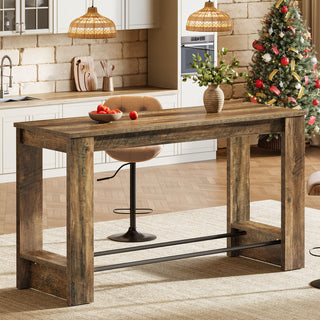
If you want tables and stools that match by design, the solid wood bar set pairs a 105 cm table with 75 cm stools, a 30 cm gap that sits right on the rule. It is solid timber in finishes from natural oak to aged driftwood, better suited to a covered beach house bar than to open sand.
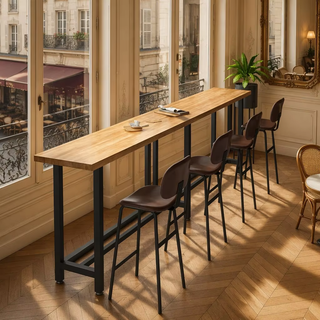
How many stools fit along a bar?
Allow about 60 cm of counter per stool, measured center to center. Swivel stools and stools with arms need 65 to 70 cm, because guests turn sideways to talk. A 4 m beach bar counter therefore seats six or seven comfortably; squeeze in eight and guests leave every other stool empty rather than sit elbow to elbow. A footrest at about 45 to 50 cm below the seat keeps people sitting longer, and on a high table it is worth checking before you buy.
Should outdoor furniture stack, fold or stay out?
Buy furniture that stacks if the beach closes for winter, furniture that folds if it moves every day, and leave out only what is made of aluminum, stainless, resin or composite. The storage room is usually smaller than the terrace, and that decides more than the catalog does.
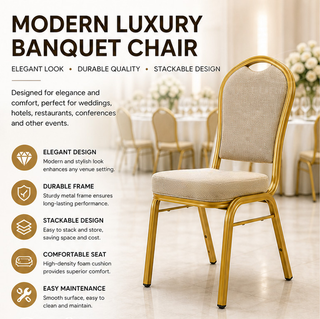
Stacking changes the arithmetic. Eighty loungers laid flat take a room; stacked ten high they take a corner. Event seating works the same way, and the upholstered banquet chair in our range stacks 15 high, is rated for more than 400 kg, and comes on an aluminum or steel frame, marked for indoor and outdoor use. For an event on the sand, order the aluminum frame and bring the fabric seats in at night.
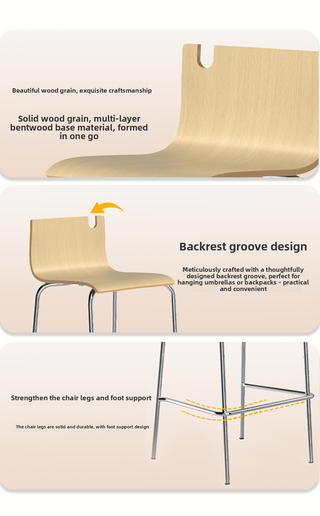
Among bar stools, the metal-frame model with a wood seat and a bag cut-out in the backrest also stacks, which matters in a venue that clears the floor for dancing after dinner.
Before anything goes into storage, rinse it with fresh water and let it dry completely. Salt left on a frame over the winter keeps working, and a damp cushion stacked in a closed room mildews by spring. Cushions and covers go in breathable bags, frames go off the floor, and anything with a hinge or swivel gets a look for sand in the joint. Stackable aluminum loungers such as the aluminum Textilene chaise make this a job for an afternoon.
What to ask the supplier before ordering outdoor furniture
- Which stainless grade, exactly? "Stainless" can mean 201, 304 or 316. Within sight of the sea, ask for 316 on anything exposed, including the screws.
- How was the aluminum treated before powder coating? A pretreatment step before coating is what stops corrosion creeping under a chip. Ask whether the coating is rated for outdoor or coastal use.
- Is it certified for outdoor use? EN 581 covers outdoor furniture for public spaces; EN 12520 and EN 16139 cover indoor seating strength. An indoor certificate says nothing about UV or salt.
- Which fabric, and how is it dyed? Solution-dyed acrylic or olefin keeps its color; printed polyester fades.
- Can you buy spare parts? Feet caps and cushion covers wear out first. A range where you can reorder them outlives one where you replace the whole piece.
- What is the minimum order? Several stools in our range ship in lots of 40 to 100, sized for a restaurant chain rather than a single bar. Check before you plan around a model.
Furnishing a terrace that sits in salt air all summer? Send us the counter length, the table heights you have in mind and how far you are from the water, and we will put together seating and tables in materials that will still look right in September.


