

A champagne bar earns its margin on bottles that are finished while they still sparkle. How to open a champagne bar comes down to a glass list sized to your nightly sales, cold at every step, and a use for the last glass.
A bottle of non-vintage champagne holds six glasses at 125 ml. Open one at half past ten on a quiet Tuesday for a single guest, sell a second pour before closing, and the other four have until roughly tomorrow night before the bubbles fade and the wine turns dull.
So the plan for how to open a champagne bar begins with that bottle. The room and the cabinets matter, but the thing that decides whether the business makes money is how many opened bottles are finished while they still sparkle. A cocktail bar loses a few centiliters of spirit when it over-pours; a champagne bar can lose most of a bottle when a Tuesday is slow.
If you are still weighing the wider bar format, our guide to how to open a bar covers the full build zone by zone. This one stays with the bottle.
What does an open bottle of champagne cost a bar?
Everything that is not sold before it goes flat. A 750 ml bottle gives six pours at 125 ml, or five at 150 ml, and under a good hinged stopper in the fridge it keeps a pleasant mousse for about a day, sometimes two. After that, each remaining glass is either served to a guest who notices or poured away.
That turns the pricing of a glass into a bet on how many pours the bottle will sell. Many bars set the glass price so that the first two or three pours recover what the bottle cost them. The rest of the bottle is margin, but only if it sells, and on a slow night it is the margin that goes down the sink.
Magnums change the numbers in both directions. A 1.5 liter bottle pours twelve glasses and looks spectacular on the bar, which suits a busy Friday or a private party. On a quiet night it doubles the amount of wine at risk, so a magnum by the glass belongs on nights when you know it will empty.
The equipment in a champagne bar exists to widen that window. Cold storage keeps unopened bottles ready without waste, preservation stretches the life of an opened one, and the right glass keeps the bubbles in the drink rather than in the air. None of them removes the rule that an open bottle has to sell.
How many champagnes should a bar pour by the glass?
Two or three at opening, for most new champagne bars, usually a house non-vintage and a rosé plus one step up, with everything else sold by the bottle. Each open bottle needs to sell about three glasses a night to finish within two services, so a three-champagne glass list needs nine or more glasses sold every night just to stay fresh.
The table below scales that up. It is the main planning tool in this guide, because the length of the by-the-glass list decides the fridge space at the bar, the preservation you need and the number of glasses you should expect to sell before anything else.
| By-the-glass list | Typical line-up | Glasses to sell nightly to keep every bottle fresh | Preservation | Cold storage at the pour point |
|---|---|---|---|---|
| 2–3 champagnes | House non-vintage, rosé, one step-up cuvée | About 6–9 | Hinged stoppers and a cold fridge | One small cabinet or a zone of a dual-zone unit |
| 5–8 champagnes | Adds blanc de blancs, a grower champagne, a vintage and other sparkling wines | About 15–24 | Stoppers for the fast sellers; a pressurized system for the slow, expensive ones | A dedicated cabinet within reach of the bartender |
| 10 or more, rotating | Prestige cuvées, magnums and a weekly guest bottle | 30 and up | A dispenser rated for sparkling, plus a plan for the tail of each bottle | Service cabinets at the bar plus reserve storage behind |
The bottom row is where new bars tend to overreach. A long glass list looks generous, but every bottle on it is a small clock, and with ten of them running at once a slow week can cost more than a busy week earns.
A better way to grow is to watch the numbers. If the house champagne empties every night and guests keep asking what else is open, add one bottle to the glass list and watch it for a month before adding the next. The bottle list can be as long as your storage and cash allow, because sealed bottles do not go flat.
Half bottles are worth a place on the list for the same reason. A 375 ml bottle is roughly three glasses, sealed until the guest orders it, and it lets a couple drink something better than the house pour without the bar opening a full bottle it may not finish.
How long can a bar keep an open bottle sparkling?
A day or two with a stopper, longer only with a system built for sparkling wine. Champagne holds its carbon dioxide under pressure of around six atmospheres, and once the cork is out the gas starts to leave. A stopper slows that loss, and cold slows it further, but neither stops it.
For a short glass list, hinged champagne stoppers are enough. They clamp onto the lip of the bottle and hold pressure overnight, they cost little, and staff learn them in a minute. Keep several more than the number of bottles you expect to have open, because they get lost with the empties.
Inert-gas dispensers need more care in a champagne bar. Most argon and nitrogen units were designed for still wine, where the gas simply keeps oxygen off the surface. Sparkling wine needs its pressure held as well, so check with the supplier whether a dispenser supports sparkling, and for how long, before building a glass list around it.
The six-tap unit below is one where the maker lists sparkling among the wines it pours. It holds six bottles at 5–28 °C behind a tempered glass door and uses nitrogen or argon with adjustable pressure, rated at up to 30 days for opened wine. Ask how long it holds the mousse on your house champagne and test it on a bottle before relying on it.

A dispenser still earns its place in a champagne bar even where the sparkling stays under stoppers, because most champagne bars also pour still wine. The Chablis or white Burgundy for guests who want something still, and the red for the one guest who always asks, are exactly the slow-selling bottles that argon protects well.
This four-bottle unit is sized for that job. Each bottle has its own spout, argon from a single cylinder covers the open wine, and the touch screen and app set both the pour size and the temperature, anywhere from 5 to 22 °C.
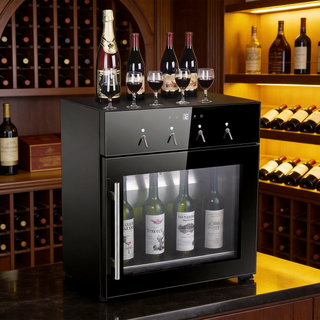
The full range, from two-bottle countertop units to built-in cabinets, is in our wine dispensers and preservation collection.
The cold chain, from delivery to the flute
Serve most champagne at about 8–10 °C, and vintage or prestige bottles a degree or two warmer. Colder than that and the wine tastes of little; warmer and it foams out of the glass and loses its bubble faster, because warm wine holds less dissolved carbon dioxide.
Warm bottles are also a safety problem. A champagne bottle opened at room temperature can gush and throw its cork hard, so a bottle should never go from the delivery box to a guest's table without time in the cold.
Plan the cold in two stages. Reserve stock sits in a cabinet at a steady temperature, away from the heat of the bar, and a service cabinet at the pour point holds the next night's bottles at drinking temperature. A dual-zone cabinet can do both in one footprint, with one zone at service temperature and the other set warmer for still wine or longer storage.
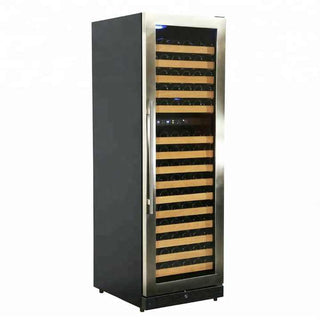
This one holds 166 bottles across two zones, each adjustable from 5 to 18 °C, in a stainless steel cabinet 600 mm wide. A champagne bar with a list of forty bottles could keep three of each in it and still have room for the still wines.
At the bar itself, display matters. Guests order champagne they can see, and a lit cabinet with the labels facing out sells the step-up cuvée better than any menu description. The slim double-door cabinet below adds a built-in ice bar for chilling bottles alongside the display, which suits a counter where bottles are opened in front of guests.
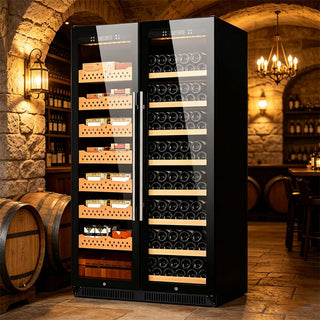
Browse the rest in our wine cabinets and coolers collection, and see our guide to commercial refrigeration for how cabinet types differ.
The last link in the chain is the ice bucket. A bottle sold to a table needs to stay cold for the hour it takes to drink, and the bucket should be half ice and half water, because water touches the whole bottle and chills it far faster than ice alone. The rule of thumb is about twenty minutes in ice and water against several hours in a fridge, which is why a bucket can rescue a bottle that missed the cabinet, and a fridge cannot.
That makes ice a daily consumable, not a garnish. Every bottle sold to a table takes a bucket, every bucket is topped up during the evening, and cocktails and water glasses draw on the same bin. Size the ice machine to your busiest night, not an average one.
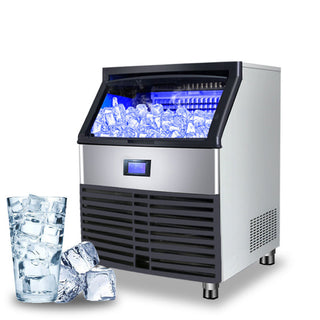
This machine makes 80, 100 or 120 kg of cube ice a day depending on the model, runs on a standard 220 V supply and is air-cooled, so it needs clearance rather than a water loop. Our guide to choosing a commercial ice machine covers output and ice shape in detail.
Where the last glass in the bottle goes
Into a cocktail, in the best-run champagne bars. A Kir Royale, a French 75 or a Bellini needs sparkling wine that is cold and still lively, but it does not need the first glass from a fresh bottle. A bottle opened yesterday that no longer tastes right on its own can still make a good cocktail today.
Building the cocktail list around the house champagne gives every open bottle a second route to the till. It also gives the bar a lower-priced entry point for guests who want the room and the occasion without the price of a glass of prestige cuvée.
Staff training closes the loop. Bartenders who know which bottle is open longest pour from it first, suggest it by name, and move it into cocktails before it tips over. A simple board or note behind the bar, showing when each bottle was opened, does more for waste than any piece of equipment.
Food helps too. Oysters and a few small cold plates keep guests in their seats for a second glass. A short cold menu needs only a fridge and a counter, but anything cooked brings extraction and a much larger fit-out, so keep the kitchen simple unless food is the plan.
Which glasses, and how many, behind a champagne bar?
A tulip or a flute for the list, and a coupe if you serve champagne cocktails or build towers for parties. The shape debate is covered in our guide to choosing champagne glasses; for a bar, the practical points are how many you need and whether they survive the washer.
The coupe below is hand-blown from lead-free crystal, holds 240 ml and is sold in a quantity that matches a bar's opening order, with clear or pink glass and a logo option.

For the house pour, the tall champagne version of our hourglass glasses holds 200–300 ml and pairs with a matching red-wine glass for the still list. The rest of the range is in our wine and champagne glasses collection.
Stemware breaks, and in a champagne bar most of it breaks in the wash. A glasswasher under the counter keeps the route from table to shelf short, and a short route means fewer glasses in circulation. Check that the rack clearance fits your tallest flute before you buy either.
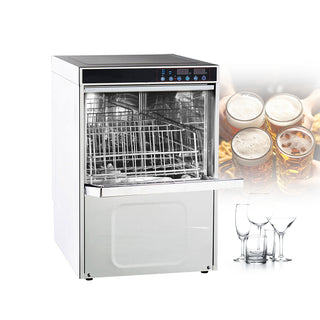
This front-loading unit washes up to 30 baskets an hour and sits in a 550 mm wide footprint. A glass dryer and polisher finishes stemware without anyone twisting a cloth around the stem, which is where many flutes snap.
What to buy before opening a champagne bar, and what can wait
Start with the wine, because it outweighs the kit. Champagne costs more per bottle than almost anything else a bar stocks, and thirty or forty references with a backup of each can tie up more cash than the cabinets that hold them.
Among the equipment, cold storage is the big-ticket item and the one to buy properly from day one. Every bottle on the list passes through it, and a unit that cannot hold its setting through a hot July puts the whole opening stock at risk. The ice machine and the glasswasher also belong on the opening list, because the bar cannot trade a night without either.
A dispenser is the purchase to hold back. Open with stoppers and a glass list of two or three, record which bottles sell by the glass and which are poured away, and buy a dispenser once the numbers show a problem it would solve. That also tells you whether you need a sparkling-capable unit or one for the still wines.
Stemware keeps costing money after launch, since flutes break every week, so put replacements in the monthly budget rather than the opening one. A POS system that tracks glass and bottle sales separately is worth more here than in most bars, because the numbers from the glass list drive every other decision in this guide; see the POS systems collection for options. Each product card carries its live price.
Licenses for a champagne bar in France, the UK, the UAE and the US
Every market asks for an alcohol license for on-premises sales, a food business registration or permit, and fire and premises approvals. The alcohol license takes longest almost everywhere, so apply for it before the fit-out rather than after.
In France, anyone running a venue that serves alcohol completes the permis d'exploitation, a training course of about three days. A bar serving fermented drinks such as champagne and beer needs a Licence III, while spirits require the scarce Licence IV, which is usually bought from an existing holder. That gives a champagne bar without spirits a real advantage, though a French 75 made with gin moves it into Licence IV territory. Food service adds a declaration and a HACCP plan.
In the United Kingdom, the local council grants a Premises Licence for the venue, and a Personal Licence holder has to act as Designated Premises Supervisor. The Personal Licence needs an accredited Level 2 Award for Personal Licence Holders and a basic DBS check. Register as a food business with the council at least 28 days before opening, expect a food hygiene inspection, and complete a fire risk assessment. If you play recorded music, you also need TheMusicLicence from PPL PRS.
In the United Arab Emirates, alcohol service is tightly controlled and generally limited to hotels and licensed venues, which is why most champagne bars there sit inside a hotel. In Dubai, licensing runs through Dubai Police GHQ with the Department of Economy and Tourism, and in Abu Dhabi through the Department of Culture and Tourism. Minimum-distance rules apply near mosques and schools, and Dubai Municipality inspections and Civil Defence clearance cover fire and food handling.
In the United States, liquor licensing is handled by the state Alcohol Beverage Control board and often at county level too. It is usually the slowest step, sometimes capped by quota, and a beer-and-wine license can be easier to get than a full liquor license, which suits a bar that keeps spirits off the menu. Add federal TTB registration, a health department permit with food-handler certification such as ServSafe, and a certificate of occupancy.
This is an overview, not legal advice. Confirm the current requirements with your local licensing authority before you sign a lease, because the documents and timelines differ by country and region.
Where champagne bars lose money
- A glass list longer than the nightly sales. Ten champagnes by the glass need thirty or more glasses sold every night to stay fresh. Start with two or three and add one when the numbers support it.
- Trusting a still-wine dispenser with sparkling. Argon keeps oxygen out, but sparkling wine also needs its pressure held. Check what the unit is rated for before putting champagne in it.
- No plan for the tail of the bottle. A cocktail list built on the house champagne turns yesterday's bottle into today's Kir Royale instead of waste.
- Bottles that go straight from the box to the table. A warm bottle gushes, foams in the glass and tastes flat. Stage the next night's stock in the service cabinet a day ahead.
- Running out of ice before the last tables. Buckets and cocktails draw on the same ice bin, and a champagne bar without ice at eleven has nothing to keep open bottles cold.
- Not recording what is poured away. A simple waste log at the bar is the only way to know whether the glass list is working.
Planning a glass list and the cold behind it? Send us the number of champagnes you want to pour, how many seats you have and the space behind the bar, and we will size the cold storage and ice around your list, with a dispenser if it needs one.


