
Start with the steam source. A commercial kitchen steamer either boils its own water under the food, seals trays in a heated cabinet, or runs off a separate steam generator. That choice sets the power and water you need. Rice gets its own pot.
A basket of har gow needs about as much steam as a kettle makes. Forty kilos of jasmine rice for a banquet needs a cabinet that holds a sealed chamber at temperature for most of an hour. Both jobs are sold under the heading of commercial kitchen steamer, and the machines that do them have almost nothing in common apart from the water.
The useful way to sort them is by where the steam is made and how the food sits in it. Once that is settled, the capacity is simple to work out. A separate question covers rice, since many kitchens that steam dumplings still cook their rice in a dedicated pot, and the two decisions interact.
Where the steam comes from in a commercial kitchen steamer
Every commercial kitchen steamer falls into one of three setups: a water tank directly under the food, a closed cabinet with its own heating, or an external generator that pipes steam to the appliances. The table compares them with the rice cooker, which works differently again.
| Setup | Where steam is made | How food sits | Capacity is measured by | Suits |
|---|---|---|---|---|
| Countertop basket base | Heated water tray under the baskets | Stacked bamboo or steel baskets | Number and diameter of baskets | Dim sum to order, small bao counters |
| Floor-standing bun steamer | Large plumbed water tank, gas or induction heat | Several stacks side by side | Number of stack positions | Dim sum houses, breakfast bun service, canteens |
| Steam cabinet | Built-in heater inside a sealed chamber | Trays on shelves, door closed | Tray count and kilos per load | Rice, vegetables and fish in batches |
| Steam generator | Separate boiler | Feeds other steamers through a pipe | Kilos of steam per hour | Central kitchens running several steam appliances |
| Gas rice cooker | Direct flame under a closed pot | Rice and water in the pot | Pot volume in liters | Any kitchen that serves rice with most dishes |
Combi ovens also steam, and a kitchen that already runs one can do vegetables and fish in it. They are slower to turn around between batches and cost oven time you may need for roasting. Our comparison of combi and convection ovens covers that trade.
Which steamer suits dim sum and bao?
For dumplings and buns cooked to order, a basket steamer beats a cabinet. The baskets go from steamer to table, the cook can see each stack, and a single basket can come off while the rest keep cooking.
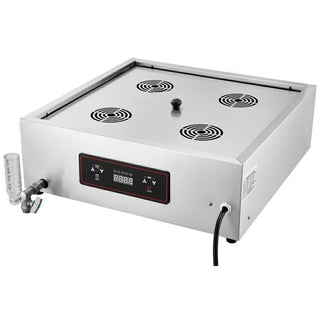
The smaller version sits on a counter. This base takes up to four baskets from 12 to 24 cm across on a 5,000 W element and holds a set temperature between 30 and 110 °C. It switches the heat off at the set point and back on when the temperature drops, so finished baskets can wait for a runner without drying out. It occupies 55 × 55 cm, has dry-burn protection, and is wired to a breaker rather than a plug, so plan an electrician's visit.
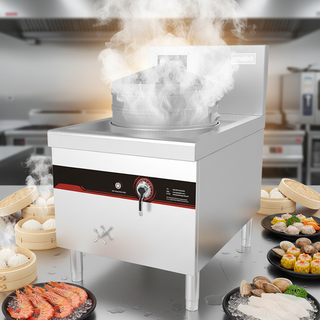
A busy dim sum house or a canteen serving buns at breakfast outgrows a countertop base quickly. A floor-standing bun steamer runs several stacks side by side from one large tank. This one has seven steaming holes, an 18 kW induction element on 380 V three-phase power and a 25 L tank filled through a 1/2-inch plumbed inlet, so staff are not topping it up by hand in the middle of service. The frame measures 1,100 × 750 mm and stands 1,200 mm high overall.
Three things decide the size. Count how many baskets are cooking at the same moment during your busiest half-hour, not how many you sell in a day. Check the basket diameter your menu uses, because a base that takes 24 cm baskets will not hold a 30 cm stack. Finally, watch the steam path, because tall stacks cook unevenly if the bottom tier is doing all the work, so rotate baskets or keep stacks short.
Is a steam cabinet the right commercial kitchen steamer for rice and vegetables?
A steam cabinet is the right choice when food goes in by the tray and comes out by the tray. Close the door, set the time, and the cabinet steams every shelf at once without anyone watching it. That suits rice cooked in trays and steamed vegetables for a buffet, as well as whole fish or banquet-sized batches of buns.
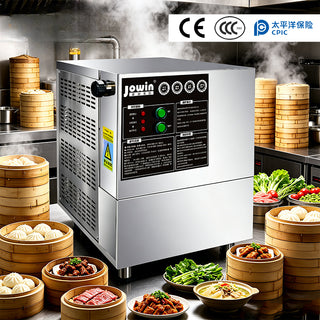
This six-tray cabinet takes a load of 20 to 30 kg and, according to the maker, cooks a full load of rice in about 45 minutes. It is rated at 8 kW, runs on 380 V or 220 V, and measures 625 × 710 mm with a height of 945 mm, which fits under most hoods without special height.

Cabinets are slower to respond than basket steamers. Opening the door lets out steam that takes a few minutes to rebuild, so they suit batch cooking to a schedule better than à la carte cooking. They also produce a lot of vapor when opened, which is one reason the cabinet should sit under extraction.
Once the rice or vegetables are done, holding matters as much as cooking. Our guide to hot holding equipment covers keeping trays at a safe temperature until service.
Running several steamers off one steam generator
A steam generator makes sense when a kitchen has more than one steam appliance, or when a batch line needs steam that no single appliance can make on its own. It is a small boiler that produces steam and sends it through piping to cabinets, bun steamers or kettles, so each appliance does not need its own heater.
This electric generator is rated at 12 kW and produces about 17 kg of steam per hour at a working pressure of up to 0.08 MPa. It holds 22 L of water, reaches working steam in about 12 minutes from cold, and tops itself up automatically with a low-water alarm and overheat protection. It needs 380 V and 6 mm² cable. The maker builds the same platform from 6 kW up to 36 kW.
To size a generator, add up the steam demand of every appliance that might run at the same time and leave a margin for startup, when cold appliances draw more. Ask the maker of each appliance for its steam use in kg/h. A generator also needs a blowdown point, a water supply at the right pressure and, in many countries, periodic inspection, so bring in the installer early.
Gas rice cooker or rice in the steamer?
A gas rice cooker is the simpler choice for a restaurant that serves plain rice with most dishes. It is a closed pot over its own burner, so it takes no space on the range, works wherever there is a gas line or propane, and holds its batch while the next one goes on. A steam cabinet is better when rice is one of several batch items or when you need several varieties ready at once in separate trays.
Many Thai and Chinese kitchens use both, with a rice cooker for everyday jasmine rice and trays in a cabinet or baskets for sticky rice, which is steamed rather than boiled.
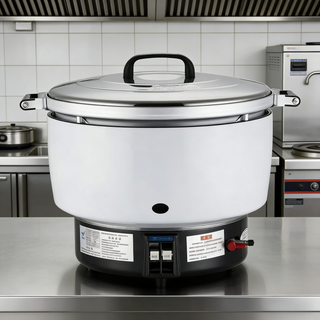
This gas rice cooker has a stainless steel exterior, an aluminum inner pot for even heat and an iron frame, with a removable pot for cleaning. It runs on piped gas or propane and needs no electrical connection.
How big should a commercial rice cooker be?
Size a commercial rice cooker by the cooked rice you serve in your busiest service, then divide by the number of batches you can cook in that time. The pot volume on the listing is not the same as the rice yield: a pot is only filled part way with rice and water, and the manufacturer's rated load in kilos of dry rice is the number to ask for.
The gas cooker above comes in pot sizes of 7, 10, 15, 23 and 30 liters. A smaller pot that finishes a batch quickly can serve more covers than a large pot left to cook once. For a room that turns tables fast, two medium cookers staggered by half a batch time keep fresh rice coming without a gap. For a banquet, one large pot started at a fixed time is easier to manage.
Rice cookers sit in our jacketed kettles and boiling pans range. Noodle and dumpling kitchens that boil as much as they steam can look at the six-basket boiling pot in the steamers and pasta cookers collection.
Utilities to confirm before a steamer is delivered
Steam equipment is heavy on utilities, and most delays come from a supply that was not ready on delivery day. Check these before placing the order:
- Electrical supply. Larger units need three-phase power, and the bun steamer and generator above both run on 380 V. Confirm the voltage and breaker size with an electrician.
- Gas. Gas rice cookers and gas steamers need the correct gas type and a fitted connection. Propane and natural gas use different jets.
- Water in and out. Plumbed steamers need a cold-water feed at the right pressure. Cabinets and generators need a drain or blowdown point nearby.
- Extraction. Every steamer vents vapor. Put it under a hood that covers the door or lid, not beside it.
The wider picture of what a kitchen needs is in our overview of commercial kitchen equipment, and caterers planning a batch line can read how to start a catering business.
Planning a steam section around a set menu? Tell us your peak basket count, daily rice volume and the power and gas on site, and we will put together a steamer and rice cooker setup that fits.


