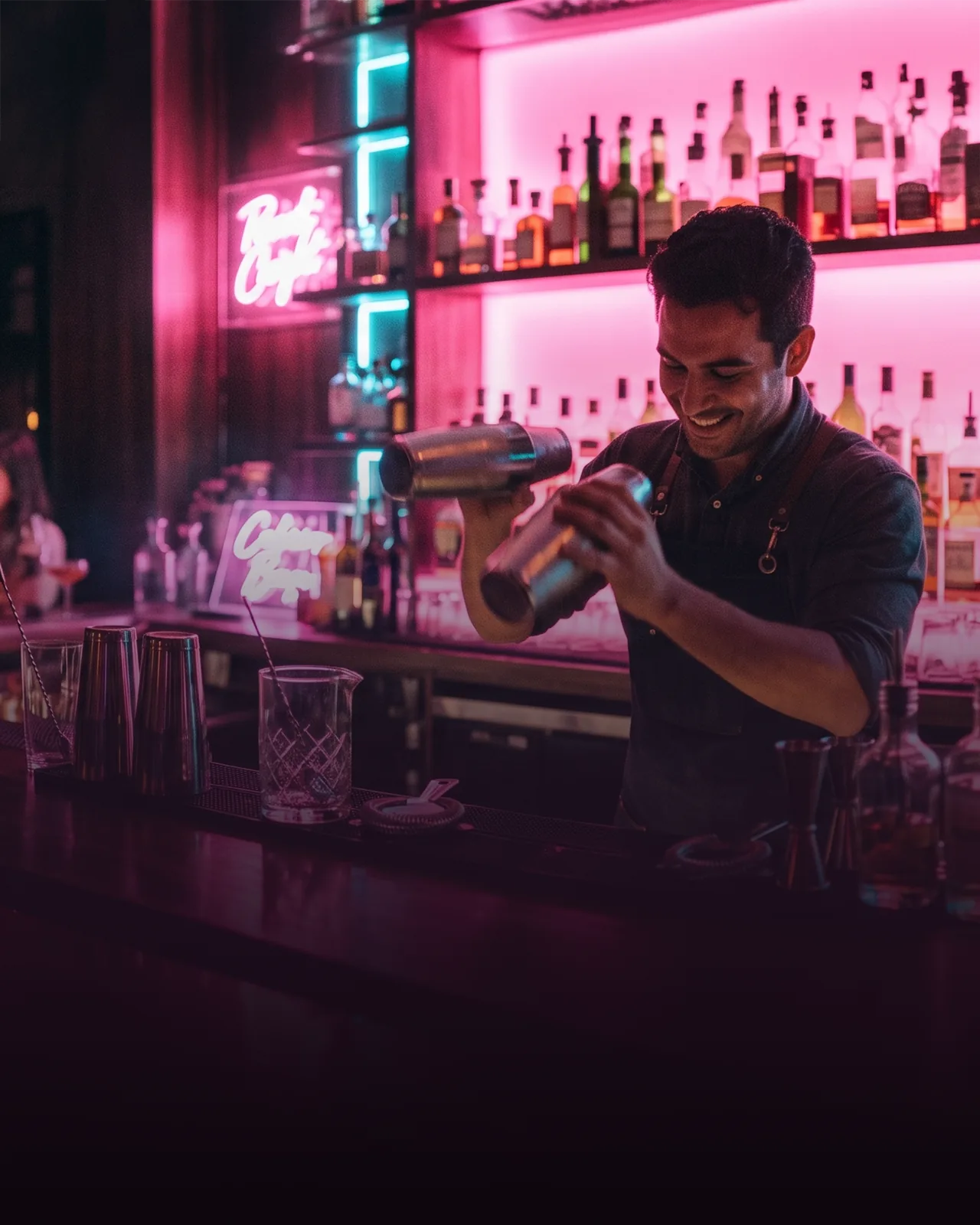


In short: a dessert bar earns most of its money after dinner. So how to open a dessert bar is mainly a question of a cold and frozen chain that keeps plated desserts ready until midnight, plus a license for late hours.
At 10:40 on a Friday the restaurants on the street are stacking chairs, and the dessert bar at the corner has a queue of eight. Couples who ate elsewhere, a table of friends from the cinema, two people who only wanted a coffee and are now splitting a warm cookie with ice cream. For most of the day the same room was half empty. This is the part of the week that pays the rent.
That shape is what how to open a dessert bar has to plan for. The format is a destination for the second half of an evening, and it lives or dies on whether the kitchen can still send a perfect frozen plate at 11:30 after six hours of service. That is mostly a refrigeration problem, with a licensing problem attached to the late hours.
Why a dessert bar makes its money after nine
A dessert bar sells an occasion that happens after dinner, so its busiest two hours sit where most food businesses are closing. People arrive already fed, they order one plate each or one to share, and they stay for a drink. Spend per head comes from the second item far more than from the first: a coffee, a glass of dessert wine, another plate for the table.
That changes the design brief compared with a café or a patisserie. A patisserie sells from the case in the morning and closes by early evening. A dessert bar plates to order in the evening, and a large part of its menu is frozen or chilled and assembled in minutes. Afternoons can still work with coffee and cake, and many dessert bars run the same counter as a café until six; our guide to opening a coffee shop covers the daytime side of that model. The evening is the part that needs its own plan.
Three decisions set the rest of the build, and they are worth making before looking at a single unit. The first is whether you make your own frozen desserts or buy them in. The second is whether you serve alcohol, which adds dessert wines and cocktails to the check but also adds a license and a small bar. The third is how late you actually stay open, because in some markets trading past a certain hour is a licensing question in its own right, even without alcohol.
How to open a dessert bar around the cold chain
Every component on a plated dessert menu passes through at least two temperatures before it reaches the table, and the cold chain is the equipment that manages those steps. A mousse is made warm, set fast and then held chilled until the pass. An ice cream is churned soft, then hardened and stored frozen, then brought up a few degrees so it can be scooped. Each step has a machine, and a gap in any of them shows on the plate.
The blast chiller sets the menu
The blast chiller is the piece that separates a dessert kitchen from a domestic one. Custards and set creams need to pass through the warm range quickly to set with a clean texture and stay safe, and baked components need to cool fast enough to portion the same afternoon. The model below takes cooked food from +75 °C to +3 °C in 90 minutes and freezes to −18 °C in 240, in 3, 5 or 10-tray builds.
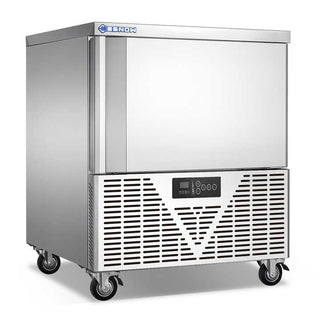
For a dessert bar the freezing cycle matters as much as the chilling one. Frozen components such as semifreddo or ice cream sandwiches are made days ahead and hardened in the chiller, which is how a two-person kitchen can offer eight plates without eight hours of prep each day. If you are deciding between a blast unit and an extra freezer, our article on blast freezers versus commercial freezers explains why one cannot do the other's job. The wider range is in blast chillers and freezers.
Chilled and frozen, side by side
After setting, components wait. A plated menu with eight desserts can easily mean thirty prepped elements (sauces, crumbs, set creams, fruit, garnishes), and most of them need to sit within arm's reach of the pass. A dual-temperature upright solves this in one footprint, with a chilled section at 0 to 5 °C and a frozen one at −18 to −8 °C behind two independent doors.
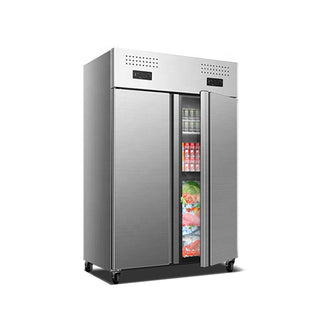
The frozen half of that unit is for service stock, which is different from bulk storage. Ice cream at −18 °C is too hard to scoop cleanly, so the working tubs live a few degrees warmer during service and go back to deep storage at close. Bulk stock, from cases of base to frozen fruit, belongs in a separate commercial freezer in the back. Our guide to commercial refrigeration covers how reach-in and chest freezers split that work.
Label everything with the date and time it was made. A component menu depends on first-in, first-out more than any other kitchen does, because a set cream that looks fine on day four can already taste of the fridge.
Should a dessert bar churn its own ice cream?
Churning your own ice cream is worth it when frozen desserts are a large share of the menu and when the making can be seen. Buying in is simpler and perfectly respectable for a menu where ice cream is an accompaniment rather than the main event.
Making it gives you flavor control and margin, since a base made in-house costs a fraction of branded tubs and can be matched to each plate. The case against is labor and space, since a traditional batch freezer needs a hardening freezer behind it and someone who knows how to run it. The unit below changes that trade by putting batch freezing, display and serving into one front-counter machine. Two 5 L pots each churn a 1–2 L batch in about 12 to 18 minutes, the maker rates it at around 200 cups an hour, and each pot runs an automatic clean cycle in under five minutes.
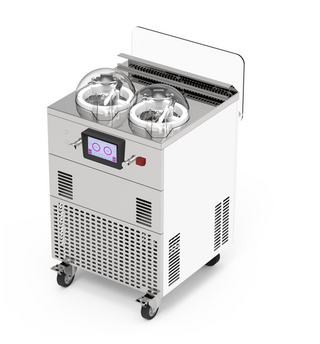
For a late-night room, the visibility is the point. Guests watch the gelato being made at 10 pm, which sells the plate before they have read the menu. For larger production, the ice cream and gelato machines collection covers floor-standing batch freezers and soft serve units.
Soft serve is the other in-house option, simpler to run and faster to serve, and our guide to soft serve machines covers the choice between countertop and floor models. Korean-style snow ice (bingsu) is a third, and it suits a dessert bar well because it is made to order in a sharing bowl; the machines behind it work differently from ice cream equipment, and the ice crushers and shavers range carries both snowflake machines and block shavers.
The warm plates that sell the cold ones
The most popular dessert bar plates are usually a contrast: something warm next to something frozen. A molten chocolate fondant with vanilla ice cream, a hot crêpe with sorbet, a warm cookie in a skillet under a scoop. The warm half needs its own equipment, and it has to be fast, because the frozen half starts melting the moment the two meet.
An oven with steam control carries most of the baked side. Fondants and baked cheesecake come out of it, and steam keeps sponges moist when they are reheated to order. The combi below is gas-fired with eight trays and a 0–350 °C range, which is enough to bake the day's components in the afternoon and finish plates at night from the same cavity.
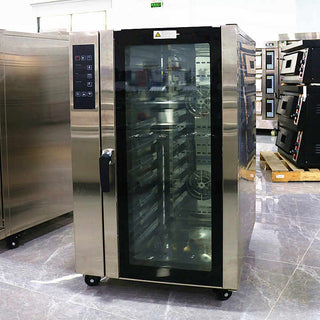
For a smaller menu, a combi can be more oven than you need, and our comparison of combi and convection ovens helps decide. The full oven range covers both.
Crêpes are the other warm item that suits late service, because the batter is made ahead and each crêpe cooks in about a minute in front of the guest. A single-plate electric griddle with 50–300 °C control fits on a counter at 45 × 45 cm and also makes the layers for a mille crêpe cake during the afternoon.

Then coffee. In a dessert bar, espresso is the second item on most checks, and decaf orders rise sharply after nine. A two-group machine rated at around 150 cups an hour covers a 40-seat evening comfortably, and dual boilers keep steam and brew temperature stable when the milk drinks come in a wave after the cinema lets out.
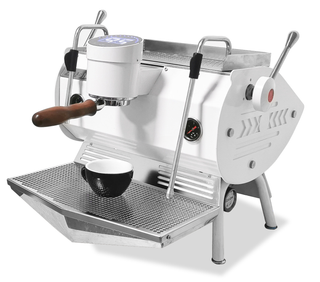
The rest of the espresso machines range includes three-group units for rooms where coffee carries more of the day.
What should the display case hold at ten o'clock?
The display case should hold the desserts that sell themselves on sight, and it should still look full at ten o'clock. Most guests decide at the door, so a case that has been picked over since the afternoon costs sales for the rest of the night.
A chilled cabinet for whole cakes and slices sits at the front. The one below has front and rear doors, so staff serve from behind while guests look from the other side, and it comes in floor-standing and countertop formats.
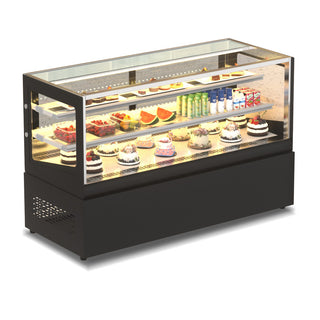
A small frozen case next to it does the same job for ice cream and frozen petits fours. The 20 L countertop model holds −18 to −23 °C behind a glass sliding door, with three baskets, which is enough for a short frozen menu without giving up floor space.

Plan the restock. A kitchen that makes all its cakes in the morning will have a thin case by evening, so hold back a second batch in the chiller and refill the case around eight, before the evening peak arrives. More cabinet formats are in the display fridges collection.
Plates are part of the same display, and in a dessert bar they get photographed more than anything else in the room. Angled or textured plates give a small dessert height and shadow that a flat white plate cannot.

Pair them with a proper dessert cutlery set, and if you pour dessert wine or cocktails, a crystal coupe works for both. The specialty plates collection has further shapes.
How many seats does a dessert bar need?
Most dessert bars work at 20 to 70 seats, and the right number depends on how much of the menu is made to order. Each plated dessert takes a few minutes at the pass, so seat count is capped by the plating speed at the peak hour, not by the floor area.
| Seats | What the room is | Frozen side | Cold display | Warm side | Staff on at 10 pm |
|---|---|---|---|---|---|
| About 20 | Counter plus a few tables, café by day | Bought-in ice cream, one countertop display freezer | One chilled cabinet | Crêpe griddle or a small oven | Two: one plating, one on coffee and the till |
| About 40 | Evening destination with table service | Front-counter gelato machine or soft serve; blast chiller for components | Chilled cabinet and frozen case | Combi oven, espresso machine | Three to four, with a dedicated pastry cook |
| About 70 | Full dessert restaurant, often with a bar | Batch freezer and hardening freezer; blast chiller | Long display at the entrance | Combi, crêpe station, two-group espresso | Five or more across the pass and the floor, plus the bar |
The 40-seat room is where most new dessert bars land, because it is small enough to fill on a weeknight and large enough for a blast chiller and a proper pastry cook to pay their way. At 70 seats the kitchen stops being one person at a pass; it becomes a small brigade, and the menu has to be designed so that two people can plate the same dessert identically.
Whatever the size, keep a few seats that suit a single guest or a couple ordering one plate. Late-evening traffic is dominated by pairs, and a room laid out only in fours will look empty while the queue waits for a table.
What licenses does a late-night dessert bar need?
A dessert bar needs food-business registration and a hygiene inspection like any kitchen, plus an alcohol license only if it serves alcohol. The late hours can add a requirement of their own. The specifics in four markets where the format is common:
United Kingdom. Register as a food business with your local council at least 28 days before opening and expect a Food Hygiene Rating inspection, plus a fire risk assessment for the premises. In England and Wales the late hours matter too. Selling hot food or hot drinks between 11 pm and 5 am is "late-night refreshment" and falls under a Premises Licence from the council, even if you never serve alcohol. If you do serve alcohol, the same Premises Licence covers it, and you also need a Personal Licence holder as Designated Premises Supervisor, qualified through the accredited APLH award. Recorded music needs TheMusicLicence from PPL PRS.
United States. Rules are set at state and county level. Expect a business license and an EIN, a health department permit with food-handler or ServSafe certification, and a certificate of occupancy with fire-code sign-off. Alcohol requires a state liquor license through the ABC board, often the slowest step and sometimes capped by quota, so many dessert bars open dry and apply later. Trading hours and noise limits are local; check your city's rules before designing around a midnight close.
United Arab Emirates. You need a trade license with a food-and-beverage activity and suitable zoning, Dubai Municipality inspections covering food handling and ventilation, and Civil Defence clearance. Food handlers need health cards. Alcohol is tightly controlled and largely confined to hotels and licensed venues, so most standalone dessert bars run dry, which suits a market where late-evening dessert is already popular. Entertainment such as live music needs a permit from the Department of Economy and Tourism.
Australia. You need council premises approval and a food-business notification or registration, a fire safety statement and, in most states, a nominated Food Safety Supervisor. If you serve alcohol, apply to the state or territory liquor regulator for an on-premises license; in New South Wales the Small Bar licence covers venues up to 120 patrons, and every staff member who serves alcohol needs a current RSA card, with stricter refresh rules for venues trading between midnight and 5 am.
Treat this as an overview, not legal advice, and confirm current requirements with your local authority. Two points apply everywhere. Decide your closing time before you apply, because the application describes the hours. And if alcohol is part of the plan, start that application first, because it takes longest.
What goes wrong at half past ten
The mistakes in this format show up late in the evening, when the kitchen has been running for hours and the peak arrives. Each one below is cheaper to fix in the plan than on the floor.
| Mistake | How it shows at 10:30 pm | The fix |
|---|---|---|
| No blast chiller, components set in a standard fridge | Set creams are soft, frozen elements are icy, and the kitchen has run out of the plate everybody orders | Blast chill and freeze components ahead, sized to a full day's prep |
| Ice cream stored and served at the same temperature | Scoops tear and service slows, while constant opening ruins the tubs | Separate deep storage from a service freezer set a few degrees warmer |
| Display filled once in the morning | A half-empty case at the door during the busiest hour | Hold a second batch back and restock before the evening peak |
| Plates cooked from scratch at the pass | Eight tickets arrive at once and the wait passes 25 minutes | Menu built from prepped components; the pass only assembles and finishes |
| Room designed for daytime café trade | Bright light and hard chairs at 11 pm, and guests leave after one plate | Dimmable lighting and seating designed for an hour-long stay |
| Closing time not settled before licensing | A license that stops hot drinks or alcohol at 11 pm, just as the queue forms | Apply for the hours you need from the start |
If the concept leans toward cakes and pastry sold over a counter, our guide to opening a patisserie covers that model, which trades in the morning and relies on the display case more than the pass.
Planning a dessert room for late evenings? Tell us your seat count, how much of the menu is frozen and whether you make ice cream in-house, and we will spec the cold chain from blast chiller to display case.


