


Rollers, a die or a set of blades: every commercial pasta machine shapes dough one of those three ways. Pick the method from the shapes on your menu, size it to a prep shift rather than a factory hour, and test your own dough before you order.
Read the spec sheets for most commercial noodle and pasta equipment and you will find ramen, udon and dumpling wrappers listed by name, with tagliatelle nowhere. The rollers may handle an Italian sheet perfectly well; the factory simply built and tested the machine for wheat noodles and left everything else for the buyer to find out. A commercial pasta machine is too large a purchase to make on that kind of assumption, and the way to avoid it is to know how each type forms dough before reading any listing.
Three ways a commercial pasta machine shapes dough
A sheeter rolls, an extruder pushes and a cutter slices. Most machines sold for restaurant kitchens combine two of those steps, often with a mixer bolted on the front, but the forming method underneath decides which shapes you can make and which dough the machine expects.
| Method | How it forms the dough | Shapes it makes | Dough it expects | Where it fits |
|---|---|---|---|---|
| Sheeter | Pairs of rollers press dough thinner pass by pass into a continuous sheet | Sheets for lasagna and filled pasta; ribbons once a cutter is added | Soft, pliable dough that can be folded and re-rolled | Kitchens whose menu starts from a sheet |
| Extruder | A screw or piston forces dough through a shaped die | Tubes, spirals, short cuts, round strands | Stiff, low-moisture dough that holds its shape as it leaves the die | Menus built on short shapes or thick round strands |
| Cutter | Grooved rollers or blades slice a finished sheet into strands | Flat noodles of fixed widths, knife-cut strips | Whatever the sheeter produced | Rarely bought alone; usually the last stage of a sheeter |
| Mixer-sheeter-cutter | Kneads and rolls the dough, then cuts it, in one enclosed unit | Strands and sheets from flour and water in one pass | Recipes the maker has tested; ask before assuming yours | Small kitchens that want one footprint instead of three |
The table hides one practical difference. A sheeter lets the cook see and touch the dough at every pass, adjust thickness by feel and dust with flour when it sticks. An extruder is closed. Dough goes in the hopper and shapes come out of the die, so the recipe has to be right before the machine starts.
When is a sheeter the right machine?
Choose a sheeter when the menu starts from a flat sheet. Filled pasta and lasagna both do, and so does any ribbon or noodle cut from rolled dough. Rolling also works the gluten in one direction, which gives sheeted noodles their firm, slightly springy bite.
Two numbers on a sheeter matter more than the motor. Roller length sets the widest sheet you can make, and the thickness range tells you whether the thinnest setting is thin enough for a delicate filled pasta. A sheet that tops out at a narrow width means more trimming and more offcuts for every tray of ravioli.
This all-in-one unit mixes the dough, rolls it through stainless rollers 168 mm across and 260 mm long, dusts it with flour automatically so layers do not stick, and cuts to a set length before a short belt carries the noodles out. The maker lists ramen, udon, alkaline noodles, dumpling wrappers and wonton skins as its products, rated at 80 to 100 kg an hour on a 2.32 kW motor.
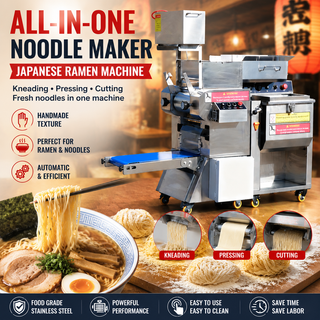
For a restaurant, that output is far beyond one service. What earns it a place is the forming parts that turn the same machine from noodles to wrapper sheets, and the casters that let it roll into a prep room and back out of the way.
What does the die do on a pasta extruder?
On a pasta extruder the die is the shape. Swap a disc and the same machine goes from round strands to a tube, so the list of dies that ship with the unit, and the ones available to order later, is the real menu of the machine.
The die material changes the pasta as well. Traditional Italian producers use bronze dies, which leave a rough, matte surface that holds sauce. Dies lined with a nonstick plastic give a smoother strand with more gloss, and they release dough more easily. Neither is wrong, but it is a question worth asking, because many spec sheets list "interchangeable molds" without saying what they are made of or what shapes they cut.
Extruders also want a different dough. Extrusion dough is dry and crumbly compared with a rolling dough, closer to damp sand than to a smooth ball, because a wetter mix sticks inside the die and comes out misshapen. Pressure through the die warms the dough, and on long runs that heat is one reason cooks rest the machine between batches.
This vertical extruder takes dough that has already been mixed and presses it through interchangeable molds, rated by the maker at 60 portions a minute on a 1 kW motor. It stands on casters in a 68 × 75 × 158 cm cabinet, and the touchscreen sets extrusion speed and strand thickness.

Its spec sheet stops at "interchangeable molds included", so request the full die list, with a photo of what each one extrudes, before ordering.
A second type mixes flour and water itself and then extrudes, so nobody has to prepare dough in a separate mixer. This one is rated at up to 30 kg an hour on 1.1 kW, stores recipes on a touchscreen, and swaps molds between flat and round noodles, vegetable-colored noodles, or dumpling wrappers. It measures 800 × 450 × 1100 mm.

Mixer-cutters: one box from flour to strands
A mixer-cutter kneads and presses the dough, then cuts it, in a single enclosed pass, so a kitchen without a pasta cook can still serve fresh strands. In exchange it gives up some control, since you cannot fold and re-roll the sheet by hand, and thickness is set by the machine rather than by feel.
This model is rated at 25 to 35 kg an hour, which the maker puts at about 200 servings, or 8 to 20 seconds each. The cutter swaps in around five seconds between round, flat or knife-cut noodles, and it can also turn out plain dough sheets. Water comes from a built-in 5 L or 18 L tank, or through a hose from a separate bottle, which keeps it running without a stop to refill during a busy service.

At 75 × 45 × 105 cm on a 220 V supply it fits where a large floor mixer would. It is the closest thing in the noodle and pasta machines range to a make-to-order station, where each portion is cut as the ticket arrives.
How many kilos an hour should a commercial pasta machine make?
Far fewer than the rating on the plate. A commercial pasta machine rated at 30 kg an hour will produce a day's pasta for most restaurants in well under an hour, so the useful questions are how long the machine takes to set up and clean, and whether output fits your prep window.
The arithmetic is short. A main course of fresh pasta usually weighs somewhere around 100 to 150 g before cooking, so ten kilos of dough covers roughly 70 to 100 plates. Multiply by the covers that order pasta and you have the daily figure. A dining room serving 180 covers a day, half of them ordering pasta, needs about 11 kg, which a 25 to 35 kg/h machine finishes in well under an hour of a morning session, with time left to wash down.
Cleaning time decides more than output. Dough dries fast on rollers and inside dies, and a machine that takes forty minutes to strip and wash costs more labor than one that is slower but opens in a minute. Look for parts that come apart without tools and inner surfaces without seams where flour collects.
Beyond restaurant scale there are complete lines. This one links a dough mixer, a lift conveyor and a multi-roller sheeter-cutter, producing 150 to 300 kg an hour from 3 to 4 kW with sheet thickness from 0.5 to 3 mm and width from 260 to 350 mm.

That belongs in a central kitchen supplying several sites, or a business that sells fresh pasta wholesale. For one dining room it is the wrong tool, however tempting the cost per kilo looks.
What to ask about egg dough and semolina before you order
Every machine in our noodle and pasta range is specified for wheat noodles and dumpling wrappers, and none of the listings names its extrusion dies or confirms that it runs Italian egg dough. That may well be possible, but it is not stated, so treat it as a question for the supplier rather than a feature.
Egg dough behaves differently from a flour-and-water noodle dough. It is softer and stickier, it tears if the rollers take too much off in one pass, and it can smear inside an extruder built for a drier mix. Semolina dough for extrusion sits at the other end, so dry that an automatic mixer tuned for noodle dough may under-hydrate or over-hydrate it.
Before placing an order, ask these questions and get the answers in writing:
- Which dies or cutter rollers ship with the machine, what shapes do they make, and which others can be ordered later?
- Are the dies bronze, stainless steel or a nonstick insert?
- Has the machine been run with egg dough, and at what egg-to-flour ratio?
- For machines with a built-in mixer, can the water ratio be set low enough for a semolina extrusion dough?
- What is the thinnest sheet setting that still holds together, and how wide is the finished sheet?
- Which parts come off for cleaning, and do any need tools?
If you can, send your own recipe and ask for a short video of the machine running it. That single test tells you more than the spec sheet does.
If you already mix dough in a planetary mixer, it can prepare dough for a sheeter or a separate extruder. Our comparison of planetary and spiral dough mixers covers which type handles stiff dough, and the commercial mixers collection lists both.
Cooking fresh pasta at the pace the machine makes it
Fresh pasta cooks in two to four minutes, so the bottleneck moves from the prep room to the pot. A multi-basket cooker lets each portion go in and come out on its own timer instead of sharing a stockpot with everything else on the board.
This six-basket cooker runs on gas or electric at 9 kW in a 304 stainless body, 850 × 610 × 1120 mm, with baskets that lift automatically at the end of their time.

For a larger water volume, the six-basket noodle and dumpling boiling pot comes with a 70 L or 107 L pot. Both sit in the steamers and pasta cookers collection.
Not sure a noodle machine will take your pasta dough? Send us the shapes on your menu and your recipe, and we will put the die and dough questions to the manufacturer before you commit.


