


An automatic cooking machine runs pre-programmed stir-fry cycles so a dish comes out the same on the fiftieth order as the first — without a cook standing over the wok. Here is what it is, how it works, whether it pays off, and what to check before buying.
In a busy kitchen, the wok station is often the tightest bottleneck: one trained cook, one pan, and a queue of tickets that only moves as fast as their hands and their focus. Late in a shift, the tenth fried rice rarely tastes like the first. An automatic cooking machine attacks that problem directly — it heats, stirs, times, and cooks a programmed dish on its own, so output stops depending on how tired the cook is. This guide covers what the device is, how it works, whether it earns its price, and what to check before buying one.
What is an automatic cooking machine, and how does it work?
An automatic cooking machine is a commercial appliance that cooks a programmed dish from start to finish — heating, stirring, and timing on its own. You load the ingredients, select a program, and the machine stir-fries, controls the temperature, and monitors the cook, so the result is the same every run rather than riding on who is at the station.
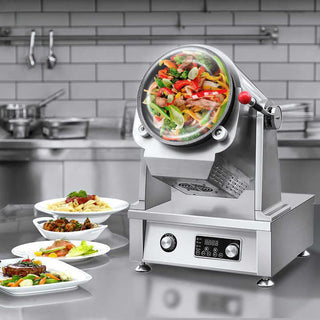
Our model is an automated stir-fry station driven by 5000W electromagnetic (induction) heating, which cooks fast and evenly while the machine handles the stirring hands-free. The 2.5L pot suits batch dishes — fried rice, stir-fries, and similar — for restaurants, hotels, and catering lines, and the stainless body is built for heavy daily use in a compact footprint that drops into an existing kitchen line. The core idea is simple: take the timing and the constant stirring off a person, and the dish stops drifting across a shift.
Who is it for?
An automatic cooking machine earns its place in kitchens that repeat the same dishes at volume. High-turnover restaurants use it to hold quality through a rush; hotels and catering lines use it for consistent batch output; multi-branch and franchise operators use it to make a dish taste identical in every location; and ghost or delivery-only kitchens use it to run a tight menu with a small team. It also lowers how dependent a new venue is on hiring a full brigade of skilled cooks from day one.
It earns least in a craft or à la carte kitchen where the chef's hand, improvisation, and plating are the product. The machine repeats a set dish perfectly; it does not invent or adjust on the fly. Match it to standardized, high-repeat menus — not to a kitchen built on a cook's craft.
Automatic cooking machine vs a line cook at the wok
The honest comparison is against how the same dish gets made now — a trained cook on a wok. Each wins on a different thing:
| Line cook at the wok | Automatic cooking machine | |
|---|---|---|
| Consistency | Varies with the cook and the hour | Same every batch — programmed |
| Labor | A cook tied to the station | Runs hands-free; frees the cook |
| Output at peak | Capped by hands and focus | Steady batch after batch |
| Skill needed | A trained wok cook | Set the program and load it |
| Best for | Signature and à la carte craft | Repeated high-volume dishes |
A skilled cook still wins on a bespoke, improvised plate. The machine wins where the same dish has to come out identically, dozens of times, through a rush — which is exactly where a tired hand starts to cost you.
Does an automatic cooking machine pay off?
At $2,131 an automatic cooking machine pays back through the kitchen rather than the dining room, and the return comes from four places: labor, since one machine takes a cook off the wok and frees them for prep or plating; consistency, because a programmed cook removes the shift-to-shift and branch-to-branch drift that quietly erodes a reputation; throughput, as the machine keeps producing batches at peak without slowing; and waste, since precise timing means fewer over- or under-cooked dishes thrown out.
We will not attach a single payback figure, because it depends on your menu, your covers, and local labor costs. But the pattern is clear: the more you repeat the same dishes at volume, the faster the machine earns back its price. A kitchen that fires the same ten stir-fries all night recovers it quickly; a low-volume craft kitchen may never need it.
What to look for when buying one
A few specs decide whether the machine fits your line:
- Heating type — electric or gas. Automatic cooking machines come in two heating styles. Electric induction — like our standard 5000W electromagnetic model — heats fast and evenly, runs clean with no open flame or gas line, and gives precise, repeatable temperature control. A gas-heated version leans on a high open flame for a more traditional wok feel but needs a gas supply and more ventilation. We can supply either: the induction unit is our standard build, and a gas automatic cooking machine is available on request — tell us your kitchen's utilities and cooking style and we'll match the heating to your line.
- Pot capacity. The 2.5L pot sets the batch size. Match it to how much of a dish you fire at once so you are not running tiny batches through a rush.
- Power and speed. Higher wattage (ours is 5000W) means faster heat-up and recovery between batches, which matters most at peak.
- Footprint. Confirm the compact body fits your existing line — it is built to slot in, but measure the station before ordering.
Tell us your menu and your covers, and we can confirm whether the pot size and output suit your line before you buy.
Not sure it fits your kitchen? Send us the dishes you repeat most and your peak covers, and we will confirm whether an automatic cooking machine — electric or gas, and the right pot size and power — matches your line.


