

Three beer dispensing systems, one decision: a bartender pulls every pint, guests pour their own, or a machine fills the glass from the base. Here is how traditional taps, self-serve, and bottoms-up compare — and which fits your bar.
Walk into any bar on a busy Friday and the bottleneck is rarely the beer list — it is how fast the pours can happen. One bartender, a queue three deep, and a keg of good beer that guests are waiting too long to drink. There are three ways to solve that, and they solve it very differently. Traditional staffed taps keep a person on every pour. Self-serve taps hand the glass to the guest. Bottoms-up dispensers fill from the base in seconds. This is a comparison of all three — what each costs, how fast it pours, what it does to your labor, and the kind of venue each one is built for.
What are the main beer dispensing systems?
There are three beer dispensing systems most bars actually choose between: traditional staffed taps, self-serve taps, and bottoms-up dispensers. They differ less on the beer and more on who does the pouring — a bartender, the guest, or the machine — and that single difference drives everything else: your labor at peak, your speed of service, and the experience at the glass.
| Traditional staffed taps | Self-serve taps | Bottoms-up dispenser | |
|---|---|---|---|
| Who pours | Bartender, every pint | Guest; the unit meters the flow | Glass fills from its base on the pad |
| Upfront cost (our kit) | $2,250–$2,750 (4/6/8 taps) | $2,200 per unit | $1,668–$3,680 (1/2/4-glass) |
| Ongoing consumables | Standard glassware | Standard glassware | Special magnetic-bottom glasses/cups (from $150 per 100) |
| Throughput at peak | Capped by staff on hand | Parallel self-pour, no bar queue | Fills 1, 2, or 4 glasses at once |
| Labor | One bartender tied to the taps | Frees staff for cocktails and tables | One operator serves a crowd fast |
| Pour cost / waste | Depends on the bartender's hand | Metered — every pour counted | Magnetic-valve fill; little foam |
| Guest experience | Personal, classic service | Interactive; less staff contact | Visual spectacle guests film |
| Best for | Neighborhood bar, cocktail-led venue | Taproom, high-volume bar, hotel | Festivals, stadiums, events |
None of them is the "right" answer on its own. The honest read of the table is that each one wins on a different axis — cost, contact, throughput — so the choice comes down to where your bar's real bottleneck sits. The three sections below take each system in turn.
Traditional staffed taps: when the pour should stay personal
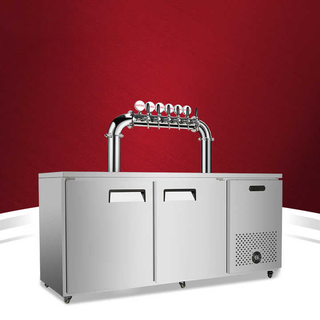
Traditional taps win wherever the bartender is part of the product. A person pulls every pint from a kegerator — the cabinet chills the kegs and the taps sit on top — and that pour comes with a conversation, a recommendation, and a check on who is drinking. It is the cheapest system to start, the most familiar to staff and guests, and the one with the fewest ways to go wrong on opening night.
Our commercial draft beer kegerator runs $2,250 to $2,750 depending on whether you take 4, 6, or 8 taps and the finish, and it pours into ordinary glassware with no special consumables to reorder. The trade-off is the ceiling: throughput is capped by how many hands are behind the bar, and pour quality rides on those hands too — a rushed or heavy pour means foam and waste that a metered system would have caught. In a moderate-volume room that ceiling never becomes a problem. In a Friday crush, it is the first thing to break.
Pick traditional taps for a neighborhood bar or pub with steady rather than spiking demand, for a cocktail-led venue where beer is a supporting act and the bartender's craft is the draw, or for any concept where a hand-pulled pint and a bit of banter are exactly the experience you are selling. If that is your room, the personal pour is a feature, not a limitation.
Self-serve taps: when labor and the queue are the bottleneck
Self-serve taps win when the thing slowing you down is the bar itself. The guest pours their own beer while the unit meters every fraction of a pour, so the queue moves off the bartender and onto the wall — and your staff shift to cocktails, tables, and everything that a self-pour can't do. At high volume that is the difference between a line that keeps flowing and one bartender who becomes the whole night's bottleneck.
The intelligent self-serve beer tap is a $2,200 stainless unit — 45 by 65 by 27 cm, electric, with a wipe-down body built for constant service — and because it counts every pour, it keeps pour cost honest in a way a free hand can't. Nothing walks out unmeasured, and over-pour stops quietly eroding your margin. It carries a 4.89-star rating across nine reviews, most of them from operators citing shorter lines and less waste on busy weekends.
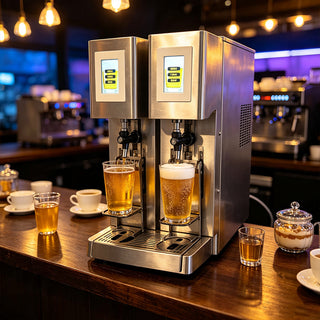
The honest catch is contact and control. A self-pour wall trades some of the bartender's presence for speed, and a busy venue may want a staff member nearby at first — to help new guests and to check ages before the tap is activated. Pick self-serve for a taproom with a wide lineup guests want to sample, a high-volume bar or club with a hard weekend peak, or a hotel, lounge, or stadium where pour speed and labor, not the beer, are what cost you money.
Bottoms-up dispensers: when raw speed wins
Bottoms-up dispensers win on pure throughput. Each glass has a magnet in its base; set it on the pad and the beer fills from the bottom through a magnetic valve, then reseals — no tap, almost no foam, and several glasses filling at once. When a crowd arrives all at the same moment, nothing else on this list fills trays as fast.
Our bottoms-up beer dispenser comes as a 1-, 2-, or 4-glass unit priced from $1,668 to $3,680, with a stainless housing and a 100–240V supply. Cooling is not built in, so budget for a keg cooler on the line. It fills from the base, so foam and spillage — the things that slow an ordinary pour — mostly disappear, and one operator can hand a full round straight across the bar. Reviewers running festival tents and stadium bars point to the same two things: the speed at peak and the show, since guests reliably stop to watch a glass fill from the bottom.
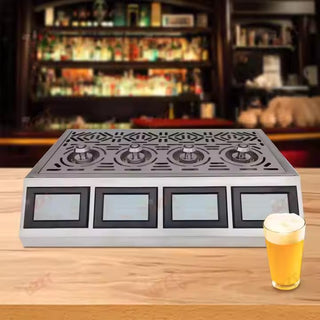
There is one real cost to plan for: the system only works with compatible magnetic-bottom glasses or cups — standard pints will not seal — so you carry that glassware as an ongoing consumable, from about $150 per 100 reusable cups up to $1,000 for a 50-pack of branded glasses. Pick bottoms-up for festivals, stadium concessions, pop-up and mobile bars, or any high-volume format where you serve in batches and raw speed decides how many people you can actually reach before they give up on the line.
How much do beer dispensing systems cost?
Upfront, all three land in a similar range: a kegerator is $2,250–$2,750, a self-serve unit is $2,200, and a bottoms-up dispenser is $1,668–$3,680 depending on how many glasses it fills at once. The sticker price is not where they separate. The real cost difference shows up over a year of service, and it runs in two directions.
On the running side, traditional taps and self-serve pour into ordinary glassware, while bottoms-up needs its special magnetic-bottom cups on every reorder — a genuine line item, offset by the speed and the low waste. On the return side, the two automated systems pay back through labor and pour control: metered self-serve stops over-pour eroding margin, and a bottoms-up unit lets one person serve a crowd that would otherwise need three. We are not going to put a single payback figure on that, because it depends entirely on your volume and your labor rates — but the pattern is consistent. The busier and more peak-driven your room, the faster an automated system earns back the gap.
Which beer dispensing system is right for your bar?
Match the system to your bottleneck, not to what sounds most modern. A short version:
- Moderate volume, personal service, or a cocktail-led room → traditional staffed taps. The hand-pulled pint is part of the experience, and you never hit the throughput ceiling.
- A hard peak where the queue and labor are the problem → self-serve taps. Guests pour, staff move to higher-value work, and every pour is metered.
- Events, festivals, stadiums, and batch serving where speed rules → the bottoms-up dispenser, as long as the special glassware fits your operation.
Plenty of venues run a blend — a kegerator on the everyday bar and a bottoms-up unit wheeled out for events — and that is often the smart answer rather than forcing one system to cover every situation. Start from what your bar actually does on its busiest night, and the right system usually picks itself.
Not sure which system your bar needs? Tell us your peak — how many people arrive at once, how the bar is laid out, and how much of the night is beer — and we will spec the traditional, self-serve, or bottoms-up setup that pays off for your room.


