


In short: a planetary mixer and a spiral mixer are not two sizes of the same machine. A planetary beats and aerates with an interchangeable tool; a spiral develops gluten with a fixed hook and a turning bowl. A bakery that runs bread on a planetary all day gets tired dough and a hot motor, in that order.
The confusion is understandable. Both are floor-standing machines with a bowl, both are sold by litres, and a planetary comes with a dough hook — which reads like permission to use it for dough.
It is permission for some dough, occasionally. It is not the same machine, and the difference is mechanical rather than a matter of quality.
Two machines, two mechanics
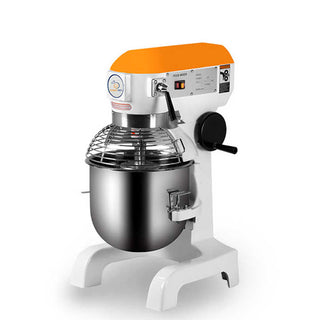
A planetary mixer holds the bowl still and moves the tool through it on two axes at once — the tool spins on its own centre while orbiting the bowl, which is why it is called planetary. That path reaches every part of the bowl and it is designed to fold air in.
A spiral mixer does the opposite. The bowl rotates, a fixed spiral hook turns in one place, and a central breaker bar splits the mass as it comes round. The dough is pulled and folded against itself continuously, which is exactly what builds a gluten network — and almost no air goes in.
That is the whole distinction, and every practical difference follows from it. Air is what you want in a cake and what you do not want in a baguette.
What a planetary mixer is actually for
Its strength is versatility. Change the tool and one machine creams butter and sugar, whips egg whites and cream, emulsifies a batter, mixes a meringue, blends a filling and — with the hook — handles enriched or small doughs.
That makes it the right first machine for a restaurant, a patisserie, a café doing pastry, or a bakery whose output is cakes, cookies and laminated goods rather than lean bread. Three speeds and a planetary action cover an enormous range of jobs that a spiral cannot do at all.
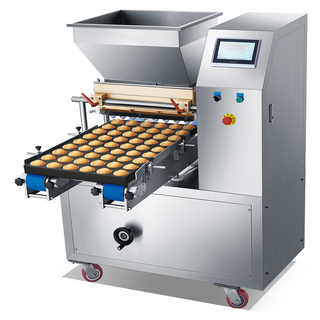
Where a pastry line runs at volume, the machine after the mixer matters as much as the mixer: a depositor turns batter and cookie dough into consistent portions without anyone scooping, which is where the labour actually sits in a cookie or cake operation.
What a spiral dough mixer is for
Bread, and anything that behaves like bread — pizza dough, ciabatta, sourdough, bagel dough, brioche at volume.
The spiral's advantage is not speed, it is friction. Because the bowl turns and the hook works one zone at a time, the dough develops with much less mechanical heating than a planetary hook dragging a whole mass around a static bowl. That matters more than it sounds, and it is the subject of the next section.
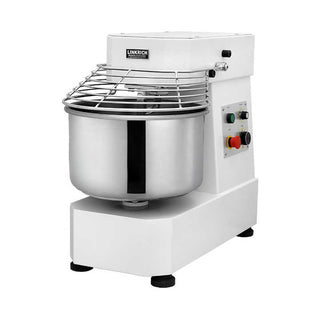
The trade is that a spiral does one thing. There is no whisk, no paddle, no beating a cake batter in it. A bakery that produces both bread and pastry needs both machines, and the usual mistake is buying one large planetary instead — which does the pastry well and the bread badly for as long as the motor lasts.
Dough temperature is the number both machines are judged on
Mixing puts energy into dough and energy comes out as heat. Bakers target a final dough temperature — commonly somewhere around 24–26 °C for lean bread — because fermentation speed depends on it, and dough that comes out of the mixer three degrees warm ferments faster than the schedule you built around it.
A planetary hook working a stiff dough raises temperature noticeably; a spiral raises it much less for the same development. On a single batch, either can be corrected with colder water. Across a whole morning, the planetary compounds — bowl, tool and dough all get warmer batch after batch — and by the fourth mix the schedule has drifted.
This is the practical reason bread bakeries use spirals, and it is worth measuring rather than assuming. A cheap probe thermometer and a note of the temperature out of the mixer tells you more about your bread than any spec sheet.
Bowl litres are not flour kilos
Both machine types are sold by bowl volume, and neither number is the one you need. What you need is flour capacity per batch, and the relationship between the two is not fixed.
As a working guide, a spiral takes flour weight of roughly half its bowl volume in litres — a 50-litre bowl handling something in the region of 20–25 kg of flour, with the dough weight then landing near 35–40 kg once water is in. A planetary of the same nominal litres handles substantially less dough than that, because the limit is the motor and the tool rather than the space.
Work back from a batch you actually make. If your standard bread mix is 20 kg of flour, that is the number to specify against — not the number of litres, and not your daily total.
Hydration is why the rated capacity lies
Rated capacities assume a middling dough. Two things break that assumption in opposite directions.
A stiff, low-hydration dough — bagels, some pizza, pasta — is far harder on the machine than its weight suggests. It is the load that burns out planetary motors and strips gears, and manufacturers usually derate for it explicitly. If bagels are the product, that derating is the specification, not a footnote.
A very wet dough — ciabatta, high-hydration sourdough — is easy on the motor and hard on the mixing action. A planetary hook tends to spin inside a wet mass without developing it; a spiral handles it well, which is one more reason bread-led bakeries land where they land.
What comes after the mixer decides whether it helps
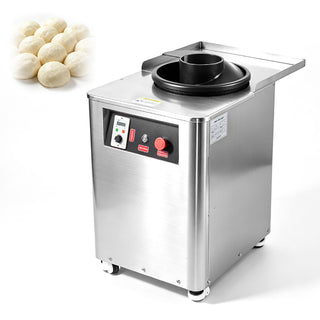
A mixer that outpaces the rest of the line just moves the queue. Dividing and rounding by hand is where a small bakery's morning actually goes, and it is slow, inconsistent and hard on wrists.
Proofing is the other half. A controlled cabinet gives repeatable heat and humidity so the prove takes the time the recipe says rather than the time the weather allows.
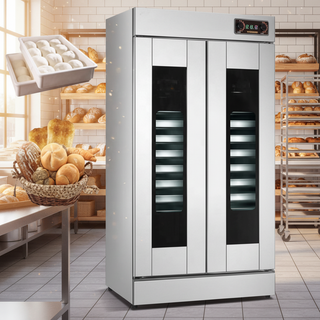
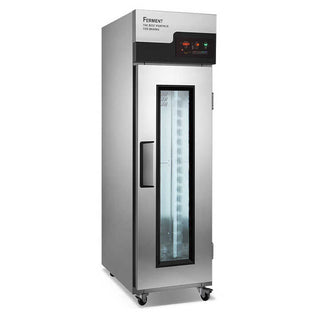
The version that changes staffing rather than throughput is retarding: shaped dough held cold overnight and brought up on a timer, so the dough is ready when the baker arrives instead of three hours later. On a bread-led operation that is usually a bigger operational win than upgrading the mixer.
Duty cycle: a bakery machine and a restaurant machine are different things
The specification nobody reads is how long the machine is designed to run without a rest. A restaurant planetary might mix six times a day, with hours between. A bakery machine mixes back to back for four hours.
Machines built for the second case have larger motors relative to their bowl, better cooling and gearboxes rather than belts. Machines built for the first, run the second way, overheat — and the failure is rarely dramatic. It shows up as a machine that trips on the fourth batch, then the third, until somebody replaces it a year early.
If the plan is continuous morning production, ask about duty cycle explicitly and treat the answer as more important than the litres.
Where kitchens buy the wrong dough mixer
- Buying one large planetary to cover bread as well. It works for a while. The dough is under-developed and warm, and the motor is doing a job it was not designed for.
- Specifying by bowl litres. Flour weight per batch is the number. Litres are how the machine is marketed, not how it is used.
- Ignoring hydration. A stiff bagel or pizza dough is dramatically harder on a machine than the same weight of standard dough, and most ratings are quietly derated for it.
- Sizing to the daily total. Two 20 kg batches an hour apart is a different machine from one 40 kg batch, and only the second one needs the bigger bowl.
- Forgetting dough temperature. If nobody measures it out of the mixer, nobody notices the schedule drifting warm across the morning.
- Upgrading the mixer while dividing by hand. The queue moves to the bench and the morning does not get shorter.
Not sure which machine your production actually needs? Tell us your standard batch in kilos of flour, what you bake and how many batches run back to back, and we will size the mixer and the bench around it.


