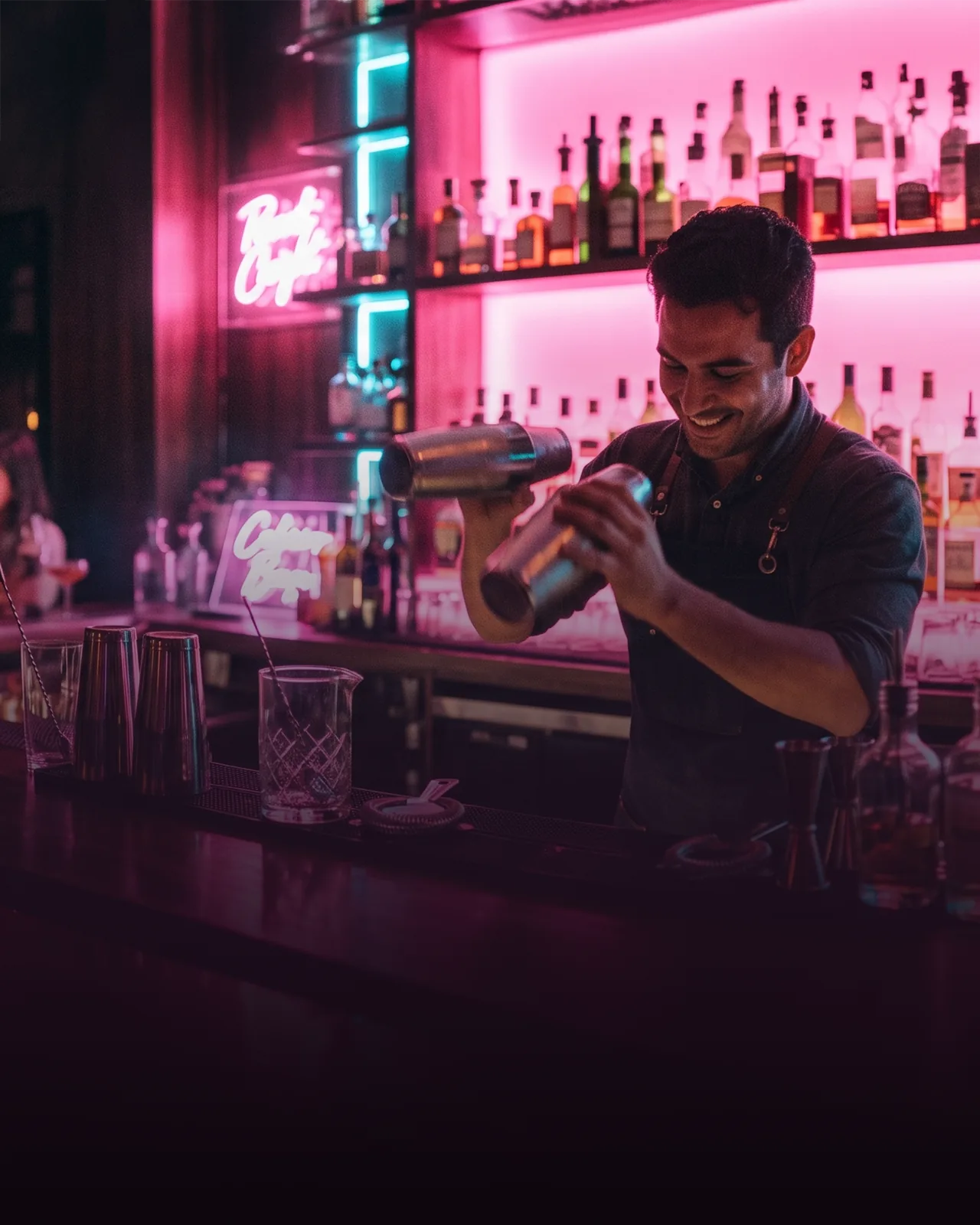


A draft beer system is a small cold chain — cooled keg, CO2, line, and tap. Setting one up for a new bar comes down to four choices: how you cool the kegs, how far the beer travels, how many taps you run, and how you keep the first pint cold.
Walk into any bar on its opening week and watch where the attention went. Weeks of thought on the beer list. A brand for the taps. A logo etched into the glassware. And almost nothing on the small refrigeration-and-gas system that actually pours every pint the place will ever sell. The list changes every season. The draft system pours every single night. Guess which one guests remember when the first pint lands warm and foaming.
This guide walks through the draft beer system end to end — what it is, the equipment you actually need, how to choose between a kegerator and a long-draw system, how to size your taps, and the unglamorous details that decide whether that first pour tastes right. It's written for operators kitting out a new bar, pub, or taproom who want the pour to be a reason people come back, not a reason they don't.
Is Draft Beer Worth It for a New Bar?
For most bars where beer is part of the identity, draft is worth the setup — it earns its keep three ways. Margin: a keg generally works out cheaper per serve than the equivalent in bottles, and that gap adds up fast over a busy week. Experience: a fresh pint with a proper head simply drinks better than the same beer from a bottle, and guests know it. Presence: a well-built tap wall is a visual anchor for the bar, the thing people photograph and point friends toward.
The trade-off is the upfront setup and the upkeep, which is exactly what the rest of this guide is about. If beer is a minor part of your list, a few bottles may be enough. If it's central to why people walk in, draft is almost always the right call — provided you build the system properly rather than treating it as an accessory bolted on at the end.
What Is a Draft Beer System?
Draft beer isn't a tap on a counter. It's a small system with four working parts, and any one of them can wreck the pour:
- A cooled keg — the beer has to stay cold from the moment it's tapped to the moment it leaves the faucet.
- A gas supply — CO2 pushes the beer up the line and keeps it carbonated.
- A beverage line — the tube that carries beer from keg to tap, sized and balanced to the run.
- A faucet and tap — where it finally pours into the glass.

When something goes wrong, the symptom is almost always the same: foam, flat beer, or a pint that's warm by the third glass. The cause is usually temperature, pressure, or a dirty line — not the beer. That's the mental shift a new operator needs to make. You're not buying 'a tap.' You're building a cold chain that ends at the glass.
The first real decision sets everything else: where do the kegs live relative to the taps? If they sit under or behind the bar, you run a direct-draw system. If they're in a cellar or back room metres away, you need a long-draw (remote) system that keeps the beer cold the whole distance. We'll come back to that choice — it's the one that shapes your budget.
What Equipment Do You Need for a Draft Beer System?
A complete draft beer system falls into four groups: keg cooling and dispensing, gas, serving hardware, and cold glassware. This is the core of the setup, and it's where your money should go.
1. Keg cooling and dispensing
For most new bars, a commercial draft beer kegerator does two jobs in one cabinet: it chills the kegs and pours from taps mounted on top. It's the simplest, most reliable way to get draft beer flowing at the bar, and it comes in 4, 6, and 8-tap builds so you can match it to the room. Plug it in, tap the kegs, pour — there's very little between you and a working line.
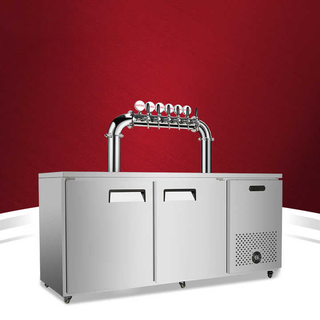
For a bar that has to keep its kegs in a back room or cellar, a single cabinet won't reach. That's where a 6-line beer cooler and dispensing system comes in: it cools and pushes beer across a longer run so it arrives at the tap as cold as it left the keg.
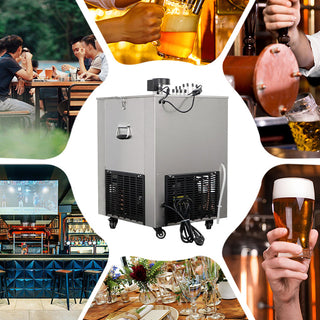
2. Gas and pressure
A CO2 supply pushes the beer up the line and holds its carbonation. In practice, most bars source the CO2 cylinder locally — it's a consumable you refill through a nearby gas supplier rather than ship in. What matters on the equipment side is the regulator that steps that gas down to the right serving pressure; we can supply one with your system on request so the whole setup is matched from day one. Set the pressure wrong and you get foam or a lifeless pour no matter how good the keg is.
Pressure is worth understanding at a basic level even if you never touch it after install. Too much and the beer arrives over-carbonated and foams at the faucet; too little and it pours slow and lifeless, losing its carbonation in the glass. On a short direct-draw run the regulator setting is straightforward. On a longer run, the pressure has to overcome the resistance of the line and any rise in height between keg and tap, which is part of why long-draw systems need balancing and direct-draw ones mostly don't. If you're buying a complete system from one supplier, this is the kind of thing that comes set up correctly rather than left for you to solve on opening morning.
3. Serving and pouring options
Standard taps cover the day-to-day, but two options widen what your bar can do:
A self-serve beer tap system lets guests pour their own by the fraction and meters exactly what they take. It turns the pour into a draw for the room, and it takes real pressure off the bar during a rush — no queue three deep waiting on one bartender.
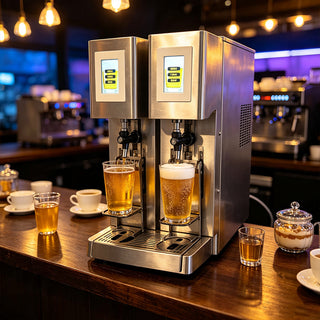
For events, festivals, and high-volume service, a bottoms-up dispenser fills glasses from the base in seconds. It's built for speed: rows of pints poured faster than a single tap could manage, with a bit of theatre built in.
4. Cold glassware
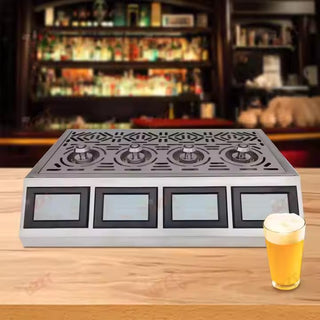
A warm glass warms the top of the pour and kills the head — the guest feels it before they can name it. A CO2 glass froster or an electric froster cube keeps glasses at pour temperature so the first sip is genuinely cold, not room-warm. It's the cheapest upgrade on this list and the one guests notice most — our glass froster guide covers the options.
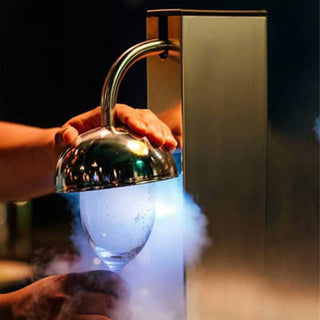
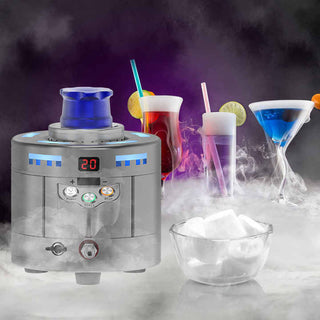
If your bar leans on presentation — cocktail-forward menus, a visible back bar people photograph — a glass froster with a built-in dry ice maker adds a layer of theatre: a cold glass plus a curl of vapour as the drink is served. It's a small touch, but the details guests film and share tend to be exactly this kind — the ones that make an ordinary order feel considered.
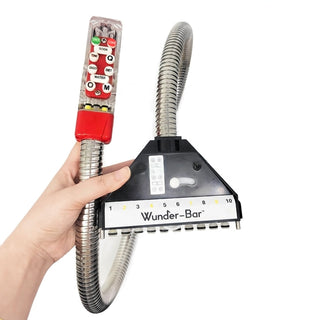
One more piece worth planning if your bar runs sodas and highballs alongside beer: a 10-button post-mix soda gun system dispenses mixers from the same cooled setup, so your non-beer drinks don't need a separate cooling solution bolted on later.
Kegerator or Long-Draw System: Which Does Your Bar Need?
The distance between keg and tap decides the system — and the budget. Here's how the two compare:
| Direct-draw (kegerator) | Long-draw (remote) | |
|---|---|---|
| Keg location | Under or behind the bar | Cellar or back room |
| Cooling | Cabinet chills kegs; taps on top | Chilled line the whole run |
| Best for | Most new bars and tap walls at the bar | Layouts with no keg space at the counter |
| Complexity | Plug-and-pour | Line balancing over distance |
| Our kit | Draft Beer Kegerator | 6-Line Cooler & Dispensing System |
If you can fit the kegs at the bar, a kegerator is almost always the simpler, cheaper, more reliable choice, and there are fewer ways for it to go wrong. Go long-draw only when your layout genuinely forces the kegs away from the taps. The moment beer has to travel several metres, keeping it cold the entire way — not just at the keg — becomes the whole game, and that's exactly what a proper remote system is built to do.
A common and expensive mistake is assuming a new bar needs a remote system because it sounds more 'professional.' Most don't. Buying complexity you don't need ties up cash you needed for the rest of the fit-out.
Where the Kegs, Gas, and Drainage Go
Three things need a permanent home in your floor plan: the kegs, the CO2, and drainage for cleaning. The draft system touches more of the layout than a spec sheet suggests, and the cheapest time to sort it out is before the fit-out is built — not after.
- The kegs. Whether they sit under the bar in a kegerator or in a back room feeding a long-draw line, they need cold space and access for changeovers. A keg is heavy and awkward; if staff have to wrestle it through a crowded service area mid-shift, that's a design problem you built in.
- The gas. The CO2 cylinder needs a secure, upright spot, ideally close to the regulator and out of the way of foot traffic. Plan the run from cylinder to keg so it isn't an afterthought taped along a wall.
- Drainage and cleaning access. Draft lines get cleaned regularly, and drip trays and glass rinsing need somewhere for water to go. A drainage point near the taps saves your team carrying buckets across the bar every fortnight.
Getting these three right on paper costs nothing. Getting them wrong means retrofitting plumbing or moving a keg fridge once the bar is already trading — the most expensive time to change anything. If you're speccing the system and the fit-out together, share your floor plan early so the equipment is sized and placed to the room from the start.
How Many Taps Does a New Bar Need?
Tap count is a bet on your busiest hour, not your average one. Too few taps and Friday's queue backs up while people wait on a single line. Too many and you're tying up cash and cellar space in lines you clean but rarely pour.
A useful starting frame: give dedicated taps to your core lagers and your best-selling ale — the beers that pour all night — and rotate seasonals and guest beers through the rest. That way your permanent lineup stays consistent and you keep a few taps flexible for what's new. Our kegerator's 4, 6, and 8-tap builds let you size to the room rather than guessing.
Self-pour is the other lever, and it's worth thinking about early rather than retrofitting later. A self-serve beer tap system works well in taprooms and busy bars where you want guests moving through pours without a bottleneck at the bar. It meters every fraction poured, so nothing walks out unaccounted for. For one-off events and high-volume days, the bottoms-up dispenser is the fastest way to get a lot of full glasses onto a tray at once. For a side-by-side look at how traditional taps, self-serve, and bottoms-up compare, see our guide to beer dispensing systems.
Customizing Draft Equipment to Your Bar
Yes — draft equipment can be built to fit the bar you're designing rather than forcing your design around a stock unit. A draft setup isn't just a spec sheet; it's a piece of furniture your guests look at all night.
Depending on the product, that can mean the style of the beer tower (from clean modern columns to statement pieces that anchor the back bar), the number of taps to match your lineup and your peak, and the finish and materials so the unit sits with your fit-out instead of fighting it. If you have a design in mind — a specific metal, a tower shape, a tap count tied to your menu — tell us and we'll build the system to it. The goal is equipment that looks like it was always part of the room.
This matters more than it sounds. The tap wall is one of the most photographed spots in a bar. A tower that matches your concept earns its keep in the room's look as well as in the pour.
Matching the Draft Setup to Your Type of Venue
There's no single 'right' draft setup — the sensible spec depends on what kind of place you're opening. A few common starting points:
- Neighbourhood bar or pub. A kegerator with 4 to 6 taps handles most of these comfortably: two or three core beers that always pour, a couple of rotating lines to keep regulars curious. Simple, reliable, and easy to run with a small team.
- Taproom or craft-led bar. Here the tap count is the draw. Go wider — 8 taps or more — and consider a self-serve wall so guests can sample small pours across a big range without tying up staff. The variety is the concept, so the system should show it off.
- Cocktail-forward bar or restaurant. Beer is a supporting act, so fewer taps make sense, paired with a post-mix soda gun for the mixers your cocktails lean on. A froster with dry ice earns its place on presentation alone.
- Events, festivals, and mobile bars. Speed is everything when a queue forms all at once. A bottoms-up dispenser fills rows of glasses far faster than a standard tap, which is the difference between serving a crowd and losing it.
Most real bars are a blend of these, and that's fine — the point is to start from what your venue actually does night to night, then spec the system to it rather than to a generic 'bar setup' that fits no one in particular.
Why Does Draft Beer Foam or Taste Flat?
Draft beer foams or tastes flat for three reasons, and none of them are the beer itself: temperature, dirty lines, and a warm glass. This is where new bars quietly lose — the equipment pours fine, but the details slip.
- Temperature. Draft beer is served cold, around 38–40 °F (3–4 °C), and the keg has to stay there from cellar to faucet. A couple of degrees too warm and it foams; the guest reads that as 'flat' and doesn't order a second.
- Clean lines. Beer lines grow yeast and bacteria over time. Cleaning them on a schedule — the industry norm is about every two weeks — is the single biggest thing standing between you and off-flavours. Skip it and even excellent beer sours at the tap, with no obvious cause the guest can point to.
- A cold glass. As above, a room-warm glass undoes the work the rest of the system did. A froster holds glasses at pour temperature so the beer doesn't warm on contact with the glass.

None of this is glamorous. All of it is what separates a bar people come back to from one where the first pint was merely acceptable. The equipment gets you the ability to pour; these habits are what make the pour worth selling.
How Do You Maintain a Draft Beer System?
A draft beer system isn't install-and-forget. The bars that consistently pour well are the ones that turn a handful of checks into routine, so quality doesn't quietly drift over the first few busy months. None of it is complicated:
- Clean lines on a schedule. Roughly every two weeks, non-negotiable. Put it in the rota like a delivery, not 'when someone remembers.' It's the single habit that protects the flavour of everything you pour.
- Check the temperature. Keep an eye on the keg and cabinet holding around 38–40 °F. A cooler that's been left open during a busy service, or a back-room unit working harder in summer, can drift warm before anyone notices in the pour.
- Watch the gas. A cylinder runs out mid-service more often than anyone plans for. Know roughly how long a cylinder lasts you and keep a spare so a swap is a two-minute job, not a dead tap on your busiest night.
- Keep the frosting going. A froster only helps if it's actually cold and stocked with glasses when the rush hits. Fold restocking it into the pre-service checklist.
These are the small operational habits that make the difference between equipment that works and a bar that pours well. The system gives you the capability; the routine keeps it honest.
Common Draft Beer Setup Mistakes
- Speccing the beer list before the system. The list is easy to change later; the pour infrastructure isn't. Get the system right first.
- Buying a long-draw system you don't need. If the kegs fit at the bar, a kegerator does the job for less money and less risk.
- Underestimating tap count for peak. Size to your busiest hour, or the queue on your best night becomes your bottleneck.
- Treating line cleaning as optional. It's the cheapest quality control you have, and the first thing that slips when a bar gets busy.
- Ignoring glass temperature. The cheapest upgrade on the whole list, and the one guests feel first.
Build your draft setup with one supplier. Tell us the room — bar size, tap count, where the kegs live, and the look you're going for — and we'll spec the kegerator or long-draw system, the regulator, and glass chilling as one matched kit, built to your design. Start a custom order →


