

In short: a slush machine is a sugar problem before it is a refrigeration problem. Get the mix between roughly 12 and 16 Brix, size the bowls to how many flavors you will actually sell, and budget the daily strip-down — that is what decides whether the machine earns.
Two machines sit side by side at a seaside kiosk. One is turning out a proper granita texture at four in the afternoon. The other holds a bowl of pale liquid that never quite froze, and the operator has spent two days blaming the compressor.
Nine times out of ten the compressor is fine. The mix is wrong. This is the thing that makes a slush machine different from every other piece of refrigeration in a venue: it only works inside a narrow chemical window, and the window is set by sugar.
What a slush machine actually does
It chills a sugar-water mix to just below zero and keeps a beater turning through it, so ice forms as loose suspended crystals rather than a solid block. Holding temperature on commercial units sits around -2 to -3 °C — cold enough to freeze water, not cold enough to freeze syrup solid.
That is also the line between a slush machine and a soft serve machine, which people conflate constantly. Soft serve freezes a dairy mix and holds it far stiffer, with an overrun of whipped-in air. A slush machine handles a water-and-sugar base and produces a pourable, drinkable texture. Neither will do the other's job, whatever the listing says.
Sugar is the control variable
Slush mix is normally run between about 12 and 16 degrees Brix — roughly 12 to 16 g of sugar per 100 g of mix. Push below that and there is not enough dissolved sugar to depress the freezing point, so the bowl freezes into a solid lump that stalls the beater. Push much above it and the freezing point drops so far that the mix never sets: you get cold syrup.
| Mix | What happens | Fix |
|---|---|---|
| Under ~12 Brix | Freezes solid, beater stalls or trips | Add syrup, not water |
| 12–16 Brix | Correct granita texture | — |
| Over ~18 Brix | Stays liquid however long it runs | Dilute with water |
| Alcohol above ~12% ABV in bowl | Will not freeze | Cut with mixer or juice |
This is why the first week with a new machine feels unpredictable and the second week does not. Once the team has a measured recipe rather than a poured one, the machine becomes boring — which is exactly what you want from it.
How many bowls does a venue need?
One bowl equals one flavor, and that is the whole sizing question. A second bowl is not spare capacity for the same drink; it is a second product line, with its own mix, its own cleaning and its own wastage at close.
| Format | Typical capacity | Suits |
|---|---|---|
| Countertop, single | Around 1.8 L | Home-scale, staff area, testing a concept |
| Single bowl, commercial | 12–15 L | Café, small bar, one signature frozen drink |
| Two to three bowls | 12 L per bowl | Kiosk, dessert bar, venue selling a range |
| Large single tank | 15–60 L | High-volume single flavor: festivals, pool bars |
A countertop machine at 1.8 L is a different category from the rest — useful for testing whether frozen drinks sell at all before committing counter space, and quiet enough at around 55 dB to sit in a small room, but it is not a service machine.
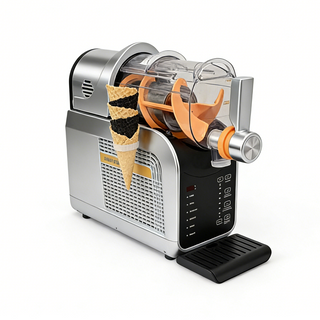
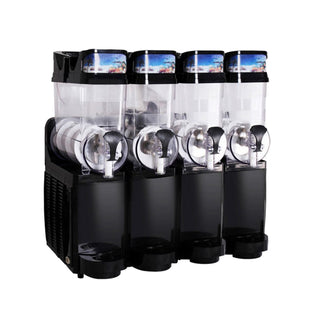
The commercial step up is a 12 L bowl on a proper compressor, available in one, two or three bowl configurations so the flavor count is a purchase decision rather than a rebuild later.
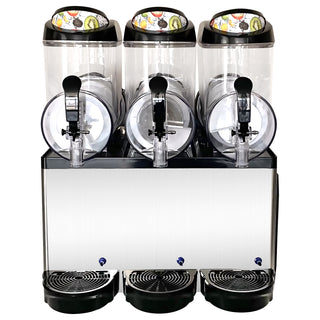
Three bowls of 12 L is the format that suits a venue selling a range — 36 L of standing product across three flavors, with each tank independently cooled so a slow seller does not have to be run down before you can change it.
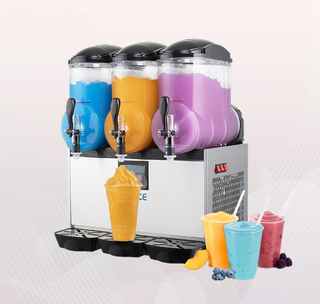
Where one flavor sells hard all day, a single large tank is the better buy. Capacity options from 15 up to 60 L let you match the tank to the queue, with power scaling accordingly — a 60 L tank draws around three times what the 15 L version does, which matters if the machine is going on a temporary supply.
The cleaning cost nobody budgets
A slush machine holds sweet liquid at just above freezing all day, which makes it the most demanding piece of equipment behind the counter in hygiene terms. Bowls come apart, seals come out, and the whole assembly gets washed and sanitized — daily for dairy-containing mixes, and at minimum every two to three days for plain fruit syrups, following the manufacturer's schedule and your local rules.
That labor is the real running cost. A three-bowl machine is three strip-downs, not one, which is the strongest argument for buying the bowl count you will actually sell rather than the one that looks impressive.
Two design details change how bad it gets. Magnetic drive transmission removes the shaft seal between motor and bowl, which is both the hardest part to clean and the most common leak point. And food-grade polycarbonate tanks handle repeated sanitizer contact better than cheaper plastics, which cloud and craze.
Frozen cocktails and other mixes that misbehave
Alcohol lowers the freezing point in the same direction sugar does, only harder. A frozen margarita that works in a domestic blender will sit as cold liquid in a slush machine bowl, because the bowl has to hold texture for hours rather than seconds. Keep the alcohol in the bowl low — roughly under 12% ABV — and build strength back with a float or a shot poured over, which most bars find sells better anyway.
Coffee and dairy add a hygiene requirement rather than a chemistry one: anything with milk in it shortens the cleaning interval sharply. Machines that advertise preset modes for cola, wine, coffee or cocktails are adjusting the target temperature and beater behavior for those densities, which helps, but does not change the cleaning schedule.
Common mistakes when buying a slush machine
- Buying bowls you will not fill. Every extra bowl is another daily clean and another line of wastage.
- Blaming the compressor for a mix fault. If the bowl will not set, check Brix before you call an engineer.
- Free-pouring syrup. Without a measured recipe the texture changes with whoever refilled it.
- Ignoring ambient heat. Air-cooled machines in a sunlit window work far harder than the same unit indoors.
- Confusing it with soft serve. Different mix, different temperature, different machine entirely.
If frozen drinks are new to the venue, start with one commercial bowl and a measured recipe rather than three bowls and a hope. The slush and granita machines range covers countertop through to high-volume tanks.
Not sure how many bowls your counter needs? Tell us what you plan to sell and how long the machine has to hold texture, and we will match a configuration to it.


