


In short: a commercial dishwasher is sized in racks per hour at your busiest hour, not in covers per day. That one number chooses between undercounter, hood type and conveyor — and after it, the water you feed the machine decides whether the plates come out clean or spotted.
The dish pit is the part of a kitchen nobody photographs and everybody underestimates. It is also the part that stops service when it fails: a kitchen that runs out of clean plates at half past eight is not a kitchen with a washing-up problem, it is a kitchen that has stopped serving.
Most of the bad outcomes trace back to one shortcut — buying the machine that fits the gap in the drawing rather than the machine that matches the peak. Here is the order the decision actually goes in.
How a commercial dishwasher is actually sized
The unit is racks per hour. A rack is a standard 500 × 500 mm basket, and it holds roughly eighteen plates, or a dozen glasses, or a mixed load somewhere in between. Work out how many racks your busiest hour produces and you have the specification; everything else is a detail hanging off it.
The arithmetic is unglamorous and takes five minutes. Count covers in the peak hour, multiply by the pieces each cover generates — plates, side plates, cutlery, glassware — and divide by what a rack holds. A hundred covers with three courses is comfortably ten to twelve racks in that hour, and that is before the pans.
Then apply the correction everyone skips: the machines are rated on a cycle time that assumes someone is loading the next rack while the current one runs. In a real kitchen at nine o'clock, the porter is also scraping, stacking and answering the pass. Assume you will get around seventy per cent of the rated figure and size accordingly. A machine bought at exactly your calculated peak is a machine that falls behind on the night it matters.
Undercounter: the machine for a bar or a small kitchen
An undercounter unit takes a single rack, runs a cycle in one to three minutes, and slides into a 600 mm gap under a worktop. Rated output is usually around thirty racks an hour, real-world closer to twenty.
That covers a bar, a café, a small bistro doing forty covers, or a second washing point at the far end of a long kitchen. What it does not cover is a restaurant kitchen at volume, and the reason is not really throughput — it is that an undercounter has no natural place to stage soiled and clean racks. Somebody ends up putting dirty plates on a clean surface, which is a hygiene finding waiting to be written up.
In a bar the undercounter-class machine is a glasswasher rather than a dishwasher, and that distinction matters enough to have its own section below.
Hood type: where most restaurants land
A hood-type — pass-through — machine is the default for a working restaurant kitchen for one structural reason: it sits between two tables. Soiled racks slide in from one side, the hood comes down, the cycle runs, and clean racks come out the other side. The layout enforces the hygiene rule instead of relying on the porter to remember it.
Sixteen dish sets a cycle at around a minute and a half is roughly forty racks an hour rated, meaning something near thirty in practice — enough for most restaurants up to a couple of hundred covers a service. Lifting the hood also gives you the height to get a gastronorm pan or a stock pot in, which an undercounter simply cannot swallow.
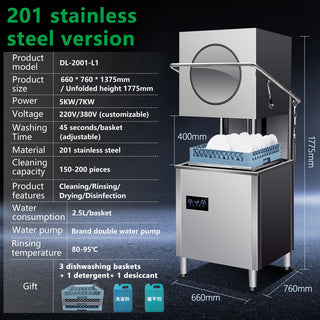
What a hood type needs from you is space on both sides. A pass-through installed with a table on one side only is an expensive undercounter with a taller door, and it happens more often than you would expect because the drawing looked fine before the walk-in went in.
Conveyor and tunnel: when the dish pit becomes a station
Above roughly three hundred covers a service — or in a hotel, a canteen, a banqueting kitchen — the pass-through stops being the constraint and the person operating it does. A conveyor machine takes racks continuously on a belt: loading and unloading happen at the same time, so throughput is limited by hands rather than by cycles.
A tunnel machine adds wash, rinse and drying zones along its length, and at that point the dish pit is a station with its own staffing and its own power supply. Forty-three kilowatts of heating is not a socket, it is a decision you take with the electrician before the fit-out is finalised.
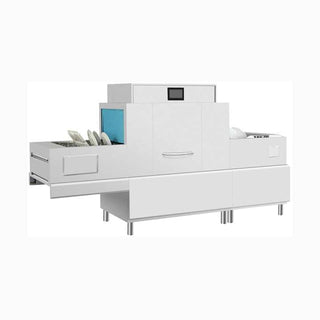
The honest test for a conveyor is whether the wash-up runs continuously for more than about two hours. If it does, the machine pays for itself in labour before it pays for itself in anything else. If your volume comes in two sharp bursts with a flat afternoon between them, a hood type and one more rack of storage usually beats it.
Glasses are a separate machine, and here is why
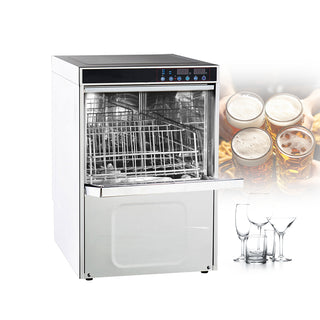
Every bar that shares the kitchen dishwasher learns the same lesson on the same evening. A dish machine runs hotter, holds a longer cycle and uses a detergent aimed at grease — all of which is wrong for a glass. Glasses come out etched over time, they come out hot enough that you cannot pour into them, and worst of all they come out on the kitchen's schedule rather than the bar's.
A glasswasher runs a short cycle, a gentler chemical dose and a rinse that leaves the glass dry enough to use. Thirty baskets an hour with an 85 °C sanitising rinse is the shape of the machine that keeps a bar in glassware through a rush.
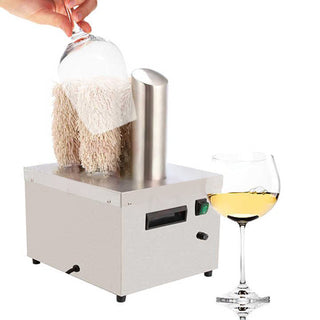
Finish the job properly and the glass reaches the guest clear rather than spotted. A polisher does that without a member of staff standing at the pass with a cloth during the hour you cannot spare one.
Thermal or chemical: what the 85 °C actually buys
Sanitising happens in the final rinse, and there are two ways to do it. A thermal machine takes the rinse to around 82–85 °C, which sanitises by heat and leaves the ware hot enough to air-dry itself in seconds. A low-temperature machine runs cooler and reaches the same result with a chemical sanitiser in the rinse.
Thermal costs more to run and needs the electrical supply to match; chemical costs less to install and turns into a standing chemical bill plus the risk that nobody notices when the dosing runs out. Most European kitchens end up thermal, and the deciding argument is usually drying: hot ware dries itself, cool ware needs racks and time you do not have.
Whichever you choose, the number your inspector will ask about is the rinse temperature, and the machine should be able to show it. A built-in gauge is not a luxury feature.
Water is the spec nobody reads
More failed dish pits come down to water than to machines. Hard water leaves scale inside the boiler and spots on the glass, and it does both quietly for months before anyone connects the two. If your incoming supply is hard — most of the UK south and east, much of Germany, large parts of Spain — a softener on the feed is not an accessory, it is part of the machine.
Two more numbers belong on the same page as the model you are buying: incoming water pressure, which the rinse arm depends on, and the drain height, because a machine that has to pump uphill to a raised gully needs a drain pump the standard build may not include. Both are cheap to sort before installation and expensive to discover afterwards.
The layout that makes the machine work
A commercial dishwasher is one component of a wash-up line, and the line is what an inspection actually looks at. Soiled ware arrives at one end, gets scraped and pre-rinsed, goes through the machine, and comes out clean at the other end without ever crossing its own path.
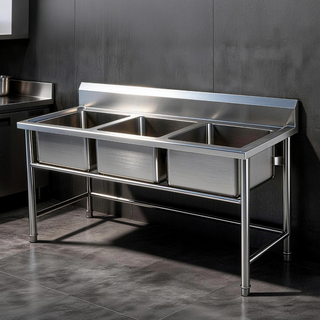
That needs a soiled table with a sink and a spray, and a clean table with enough length to stage racks while they cool. A three-compartment sink covers the wash-rinse-sanitise sequence for the items that never go through the machine — pans, boards, anything oversized — and in several jurisdictions it is required whether or not you own a dishwasher.
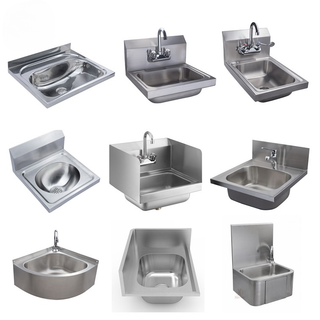
The one fitting people forget is the dedicated hand-wash basin. It has to be separate from the ware sinks and reachable without crossing the room, and its absence is one of the most commonly written-up findings in a first inspection.
Where kitchens buy the wrong commercial dishwasher
- Sizing to the daily total rather than the peak hour. The machine that comfortably handles four hundred covers spread over a day drowns on two hundred of them arriving between eight and nine.
- Buying rated output as if it were real output. Cycle times assume continuous loading by someone with nothing else to do. Plan on about seventy per cent.
- A pass-through with only one table. The hygiene benefit of the format is the two sides. Without them you have paid for a taller door.
- Sharing one machine between bar and kitchen. Different cycle, different chemistry, different schedule — and the bar always loses the argument at nine o'clock.
- Ignoring water hardness. Scale kills boilers and spots glassware, and the softener costs a fraction of the repair.
- No plan for pans. Gastronorms and stock pots either fit under a raised hood or they live in a sink. Decide which before the sink is specified.
Not sure which size your kitchen needs? Send us your peak-hour covers and the space you have for a wash-up line, and we will size the machine and the tables around it.


