


In short: a kitchen exhaust hood is sized from the equipment underneath it, not from the floor area. Get the airflow and the overhang right and the rest follows; get them wrong and no filter, fan or brand recovers it — and the approval is the first place you find out.
Ventilation is the least interesting line on a kitchen budget and the one most likely to hold up an opening. It is also the only piece of equipment that other trades depend on: the gas connection, the fire certificate and in many jurisdictions the occupancy approval all wait on the extraction being right.
The good news is that sizing a hood is arithmetic, not judgement. The bad news is that the arithmetic starts from something most people get to last — the final list of appliances and where each one stands.
What a kitchen exhaust hood is actually sized from
Not the room. Not the covers. The hood is sized from the appliance line beneath it, because what it has to remove is the plume each appliance throws — heat, grease-laden vapour and combustion products.
Appliances fall into duty bands, and the band sets the extraction rate per metre of hood. A bank of open burners, a charbroiler or a solid-fuel grill is heavy duty and needs the highest rate. Fryers and griddles sit in the middle. Ovens, steamers and pasta boilers are comparatively light. A hood over a mixed line is sized on the heaviest thing under it, not on the average — the charbroiler does not slow down because there is a steamer next to it.
In practice this means the ventilation drawing cannot be finished until the cooking line is final. Every time an appliance is swapped for a hotter one after the ducting is designed, somebody pays for it twice.
Overhang and height decide whether the hood catches anything
A canopy has to be bigger than the equipment it covers, on every open side. The plume rises and spreads, so a hood flush with the front edge of a range lets the front of the plume roll out into the kitchen no matter how much air the fan moves.
The usual rule is an overhang of roughly 150–300 mm on each exposed side, more where the appliance is hot and open. Mounting height matters just as much and pulls the other way: high enough to work under, low enough that the plume has not spread past the canopy edge by the time it arrives. Around 2 metres from the floor is the usual compromise, and every extra 100 mm of height needs more overhang to compensate.
This is also why a bigger fan does not fix a small canopy. Extra airflow through a hood that does not physically sit over the plume just pulls conditioned air out of the room faster.
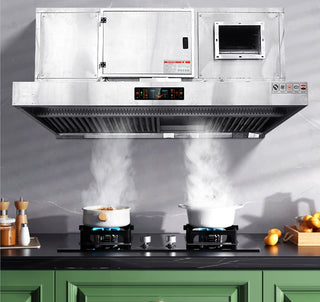
Ducted or ventless: the building usually decides
A ducted hood takes the air outside. It is the better answer whenever it is possible, because the grease and the heat genuinely leave. What makes it impossible is the building: a basement unit, a listed façade, an upper floor with no riser, or a landlord who will not allow a duct up the outside wall.
When there is no route out, a recirculating hood cleans the air and returns it. A serious one is a stack of stages — mechanical filtration, then electrostatic precipitation for the fine grease aerosol, then carbon or HEPA for odour and particulates — and it is a real solution, used in shopping-centre food halls and delivery kitchens everywhere.
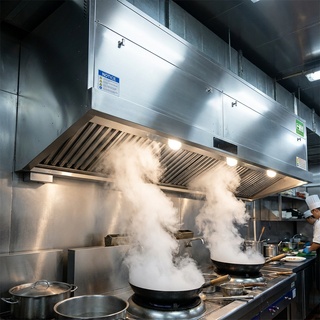
Two caveats, both worth knowing before you commit. Recirculating units carry an ongoing cost that ducted hoods do not: the cells need cleaning on a schedule and the carbon needs replacing, and a neglected unit stops working long before it stops running. And in most jurisdictions a recirculating hood is not accepted over solid fuel, and often not over a charbroiler — check that against your menu, not against your floor plan.
Baffle filters, and the fire risk that fails inspections
Grease is the reason this equipment is regulated. It leaves the pan as an aerosol, condenses on every cool surface it meets, and accumulates into the fuel load that makes kitchen fires spread through ductwork.
Stainless baffle filters are the commercial standard because they force the airstream to change direction sharply, throwing grease out onto the baffle where it drains to a collection channel. Mesh filters clog, and the cheap ones are a fire finding waiting to happen — an inspector who sees mesh in a commercial canopy will look harder at everything else.
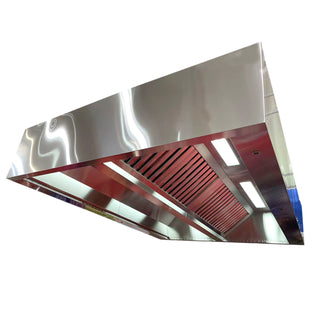
What the inspection actually looks for is a system: baffles in place and clean, a grease channel that drains somewhere, ductwork with access panels for cleaning, and a fire suppression system where the appliances require one. The hood is only the visible part of that list.
Make-up air is the half nobody budgets for
Every cubic metre the hood removes has to come back into the room, and this is the single most common gap in a small kitchen fit-out.
When it does not come back deliberately, it comes back through whatever gaps exist — under the back door, down a flue, past a window seal. A kitchen in that state is unpleasant in three specific ways: the doors are hard to open, the gas appliances burn badly and can trip on flame failure, and the extraction quietly under-performs because the fan is fighting a pressure difference.
Plan the replacement air alongside the hood, either as a dedicated make-up air unit or as designed intake into the room. In cold climates it needs tempering, which is a cost, and it is a much smaller cost than a kitchen that trips its burners every evening.
Island, downdraft and the open kitchen
A cooking suite in the middle of the room needs a canopy open on all four sides, which means more overhang and more airflow than a wall installation of the same equipment. That is the price of the island layout, and it is worth knowing before the layout is decided rather than after.
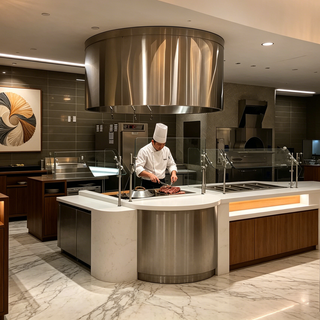
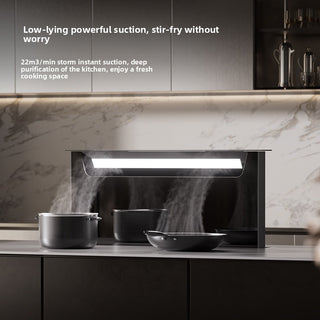
Where a ceiling canopy is impossible or unwanted — an open kitchen where a hood would block sightlines, a demo counter, a low ceiling — downdraft extraction pulls the plume sideways and down at the source. It works genuinely well for induction, plancha and lighter cooking, and less well for anything with a strong vertical plume, because it is asking the air to go the wrong way.
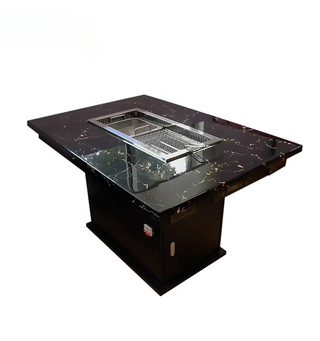
The specialist case is cooking at the table. Barbecue and hot-pot service is a heavy grease and smoke load produced right where the guests sit, and it is handled at the table rather than at the ceiling — extraction built into the table itself, which is the only approach that keeps the dining room usable.
Noise, and why the cheapest fan is not the cheap option
Extraction noise is measured in the dining room, not in the kitchen. A fan that is merely loud behind a closed door becomes the reason a table by the pass never gets sold.
Two things drive it: fan speed and duct velocity. A larger, slower fan moving the same volume is quieter than a small fast one, and generously sized ductwork is quieter than a tight run pushed hard. Both cost more at fit-out and neither can be retrofitted cheaply, which is why the second-cheapest quote frequently turns out to be the expensive one.
If the kitchen is anywhere near residential neighbours, the discharge point is a planning matter as much as an engineering one — height, direction and, in Germany especially, night-time immission limits that can force insulation or a different route entirely.
Cleaning is a record, not a chore
Filters come out and go through the dishwasher on a schedule set by how heavily you cook — daily for a charbroiler line, weekly for a light one. Ductwork is cleaned by a contractor at an interval your insurer will name, and the certificate they issue is a document you will be asked to produce.
Keep the schedule written down and signed off. In an insurance claim after a kitchen fire, the absence of that record is a much bigger problem than the fire.
Where kitchens size the exhaust hood wrong
- Sizing from the room instead of the appliances. Floor area tells you nothing about the plume. The heaviest appliance under the canopy sets the rate.
- A canopy flush with the equipment. Without overhang on every open side, the front of the plume rolls into the kitchen regardless of fan size.
- Finalising ductwork before the cooking line. One swap to a hotter appliance and the calculation is void.
- No make-up air. The extraction under-performs, the doors stick and the gas burners misbehave — all at once, and all blamed on the hood.
- A recirculating hood over solid fuel or a charbroiler. Frequently not accepted, and it is the menu that decides, not the floor plan.
- Mesh filters in a commercial canopy. They clog, they carry grease into the duct, and they attract attention to everything else in the kitchen.
Have the cooking line but not the extraction? Send us the appliance list and whether a duct can leave the building, and we will size the canopy and the airflow around it.


