

In short: a bain marie holds food on a fixed kitchen line, a chafing dish does the same job portably on a buffet, a heated display case sells hot food at the counter, and a soup kettle holds liquids in volume. Match the class to your service format first, then the specs.
Cooked food has a narrow safe window. In the UK and most of Europe the legal hot holding minimum is 63°C; the US FDA Food Code draws the line at 135°F (57°C). Below that, a buffet tray drifts into the danger zone where bacteria multiply fast enough to double in twenty minutes. Push too much direct heat at the problem instead, and the sauce splits, the rice crusts, and the carvery joint dries out. Holding food hot without cooking it further is a real engineering task — and it is the whole reason hot holding equipment exists as its own category.
The catch is the naming. The market calls these machines half a dozen things — bain marie, chafing dish, food warmer, buffet server, steam table — and sellers use the labels loosely, but the classes are not interchangeable. A chafing dish cannot run a servery line, and a drop-in bain marie is useless at an off-site banquet. Buy the wrong class and you will fight your equipment through every service.
This guide sorts the categories out: what each type actually does, wet heat versus dry, the specs that decide the buy, and which setup fits a buffet, a counter, or a kitchen line.
What is the difference between a bain marie, a chafing dish, and a food warmer?
The short answer: a bain marie is a fixed unit with heated wells that sits on a kitchen pass or servery line; a chafing dish is a portable buffet warmer you can carry to an event; a heated display case holds food at temperature while showing it to the customer; and a soup kettle holds liquids by the tens of liters. "Food warmer" is the umbrella term for all of them — in the US you will also hear "steam table" for the wet-well class.
| Type | How it holds | Best for | Portable? |
|---|---|---|---|
| Bain marie (steam table) | Water or dry wells with GN pans, typically 30–85°C | Kitchen pass, servery line, carvery | No — fixed line unit |
| Chafing dish | Water pan over an electric element or fuel burner | Buffets, banquets, catering, off-site events | Yes |
| Heated display case | Warm shelves behind lit glass | Counters: pastries, hot snacks, grab-and-go | Countertop |
| Soup kettle / jacketed kettle | Jacketed simmer, 10–100+ liters | Soups, stocks, and sauces at volume | No |
Every one of these does the same core job — keep cooked food at or above the safe line — but they answer different service questions. The bain marie answers "how do I keep six sauces ready at the pass"; the chafing dish answers "how do I run a buffet in a room with no kitchen"; the display case answers "how do I sell hot food over the counter"; the kettle answers "how do I hold forty liters of soup without a stockpot on a burner all day".
Wet heat or dry heat: which holds food better?
Wet wells hold food better; dry wells hold it more conveniently. A water bath surrounds the pan with gentle, even heat that will not scorch the bottom layer — the right call for sauces, gravies, curries, rice, and anything that splits or dries out. A dry well runs hotter at the pan base and skips the water entirely: nothing to fill, nothing to drain, but delicate food catches at the contact line and anything crisp turns soggy in the trapped moisture either way.
A useful rule of thumb: moist food goes in a wet well; battered and fried food should not sit in a well at all — it wants a display case with airflow or a heat lamp, so the crust stays a crust. If your menu leans on fried chicken or tempura, no bain marie will save it; that is a different machine.
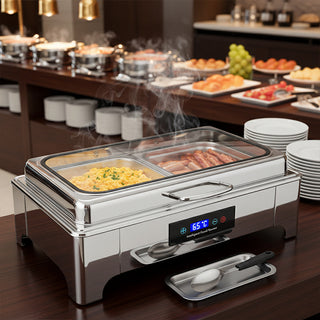
The same wet-heat principle drives chafing dishes, with one extra decision: the heat source. Fuel chafers burn gel or wick cartridges under the water pan — no socket needed, which is why caterers carry them to marquees and function rooms. Electric chafers hold a steadier temperature and cost nothing per burn, but they tether you to a power outlet, so they suit a fixed buffet line in a hotel or restaurant. Our electric stainless steel chafing dish set is the fixed-line type: 6 or 9 liter capacity, 201/304 stainless body, CE and UKCA certified, in silver, gold, or rose gold to match the room.
Key specs: temperature, pans, power, and cleaning
Once the class is settled, five specs separate a unit that runs quietly for years from one the kitchen curses daily.
Temperature range and control. The number that matters is the food's temperature, not the element's. You need the unit to hold at least 63°C at the food surface through a full service, so look for a stated range that clears it with margin — 30–85°C is the standard span on commercial units — and check where the thermostat sits. A single manual dial is fine when the whole line holds one product; a mixed line (a delicate hollandaise next to a chili) works better with independently controlled wells.
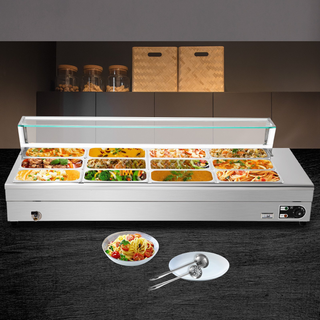
Pan capacity and layout. Bain maries are sized in gastronorm (GN) pans, the standard container grid that every commercial kitchen speaks. Count your menu, not the meters: how many separate items must be hot at once? A 12-pan unit like our commercial electric bain marie holds twelve 1/3-size GN pans (325 × 176 × 150 mm, about 6.8 liters each) behind a glass sneeze guard — enough to run a full servery or carvery line from one 1.5-meter unit.
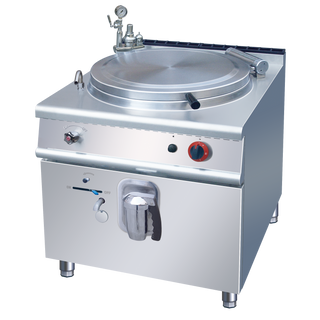
Power draw. Holding is cheap to run — that is one of its virtues. Most countertop warmers and displays pull 0.8–1.2 kW, and even a 12-pan bain marie draws only 2 kW — roughly what a domestic kettle pulls. The exception is equipment that cooks as well as holds: a gas-fired jacketed kettle like our 100-liter double-jacketed soup kettle runs a 12 kW burner, because it simmers stock from cold and then holds it — the one class in this guide that legitimately does both jobs.
Footprint and format. Measure before you fall in love. The span runs from a 51-centimeter countertop cube to a 1.5-meter servery unit to a floor-standing kettle at 800 × 900 mm. Drop-in wells recess into a counter you already own; freestanding units need clear bench or floor space plus ventilation room behind.
Cleaning and drainage. Wet wells need filling and, more importantly, draining. A unit with a proper drain valve empties in a minute; one without gets bailed out by hand with a jug, which is exactly the job that gets skipped on a busy night — and standing water that never fully drains is where biofilm starts. Removable pans, rounded well corners, and a real valve are worth more than any finish option.
Bain marie, chafing dish, or display case: which fits your venue?
Start from how food reaches the guest, and the shortlist writes itself.
Hotel or banquet buffet. Chafing dishes are the workhorse — one per dish on the line, electric for the permanent breakfast buffet, fuel for the ballroom. Behind the scenes, a bain marie holds the sauces and refills, and a soup kettle runs the soup station without hogging a burner. Build the line from the chafing dish collection and the bain marie & hot holding collection.
Cafe or coffee shop counter. A countertop heated display case does double duty: it holds pastries, pies, and hot snacks at temperature and it merchandises them — lit glass sells what a closed kitchen cannot. Our 3-tier countertop heated display is the compact version of the idea: roughly a 51-centimeter cube, 800 W, with a 0.6-liter water tray adding humidity so pastry does not dry out under the lights.
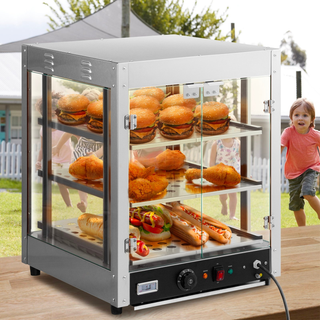
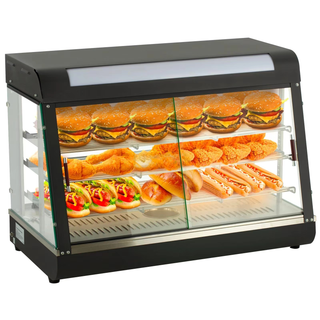
Restaurant line, canteen, or carvery. A multi-pan bain marie at the pass keeps plating fast: sauces, sides, and mash stay at temperature within arm's reach instead of coming off the stove to order. Where staff or guests serve themselves, a wider heated showcase works as the serving line itself — our stainless steel heated display showcase comes in 66, 90, and 120 cm widths, three tiers each, holding 30–85°C behind 5 mm glass.
Catering and off-site events. Chafers are the only class you can carry, so the decision is already made — the open question is fuel versus electric, which comes down to whether the venue guarantees you sockets. Most caterers run both: electric where there is power, fuel cartridges as the fallback.
Common mistakes when buying hot holding equipment
Using holding gear to cook or reheat. The most dangerous one. A bain marie or chafer cannot lift cold food through the danger zone fast enough — food must go in already at temperature, reheated on real cooking equipment first. The jacketed kettle is the exception; everything else in this category holds only.
Buying dry wells for a saucy menu. Dry heat scorches delicate sauces at the pan base. If the menu leans on gravies, curries, or hollandaise, pay for wet wells and the drain valve that comes with doing them properly.
Sizing chafers by table space instead of menu volume. Count dishes and covers, then work out pans. Two 9-liter chafers that run empty by 8 pm cost more in lost service than a third unit ever would.
Ignoring the circuit. Holding equipment is low-draw, but it stacks: six electric chafers on one buffet wall add up to several kilowatts on whatever socket ring happens to be there. Check the spare circuit capacity before the room layout is fixed.
Forgetting the merchandising side. At a counter, the warmer is the shopfront. A closed steel box keeps a pie exactly as hot as a lit glass display does — but only one of them sells the pie. If guests see the unit, display quality is a revenue spec, not a cosmetic one.
Not sure which class fits your line? Tell us your menu, covers, and counter space — we'll spec the hot holding setup for your venue, from a single countertop warmer to a full buffet line.


