


In short: a charbroiler heats from below, a salamander from above, and a rotisserie turns the food through the heat. That is not a detail — it is the whole difference, and it is why a kitchen that buys the wrong one ends up working around it for years.
Ask most operators what they need and the answer is "a grill". Ask what it has to do and three different machines appear: the one that puts bar marks on a steak, the one that finishes and glazes at the pass, and the one that turns forty chickens in the window while people walk past.
They look adjacent on a price list and they are not interchangeable in a kitchen. Here is what each one is actually for, and how to size the section they sit in.
Three machines, three directions of heat
Everything follows from where the heat comes from.
Below is a charbroiler. Radiant heat rises through a grate, fat drips onto the heat source, and what comes back up is the smoke that makes grilled food taste grilled. This is the only one of the three that produces that flavour, which is why nothing else replaces it.
Above is a salamander. Heat comes down onto a surface, so nothing drips into it and nothing smokes. It browns, melts and finishes, quickly and on demand.
Around is a rotisserie. The food turns continuously through radiant heat, self-basting as it goes, cooking evenly over a long period without anybody touching it.
A kitchen that sells steaks needs the first. A kitchen with a pass that glazes, gratinates or melts needs the second. A kitchen selling roast chicken to take away needs the third. Menus that do all three genuinely need all three, and that is a section, not an appliance.
The charbroiler, and what the grate is doing
A charbroiler is a heat source under a grate, and the grate is the part that does the visible work. Cast iron holds heat and lays down hard, dark bar marks; the width and angle of the bars decide what the mark looks like, and the slope decides where the fat goes.
The number to specify is the cooking width, because that is your capacity. Everything on a charbroiler cooks at the same time in the same place, so a section that is 20 cm too narrow means proteins waiting on a hot surface with nowhere to go during the exact hour you cannot afford it.
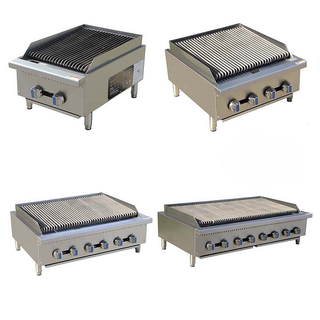
Countertop units suit a kitchen adding steaks to an existing line; a floor-standing unit with storage under it makes sense once the grill is the reason people come. Either way the constraint is the same as with any heavy appliance — it sets the extraction rate for the whole canopy above it.
Gas or electric, lava rock or radiants
Gas is the default for a charbroiler because it recovers heat fast between loads, which is what a service actually stresses. Electric versions are cleaner to install, cost more to run and are the answer when the building will not give you gas — an upper floor, a listed shell, some shopping-centre units.
Underneath the grate there are two schools. Lava rock absorbs dripping fat and vaporises it, which produces the most smoke and therefore the most flavour, and it needs turning and periodic replacement. Steel radiants do the same job with less mess and less flavour, and they last.
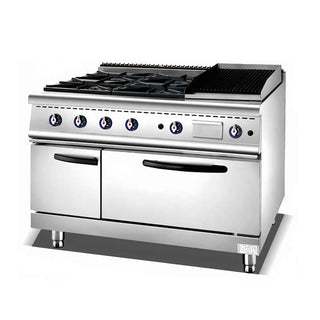
Where space is tight, a range that carries a lava rock grill alongside burners and an oven puts the whole thing in one footprint — worth considering in a small kitchen where a dedicated grill section cannot be justified but grilled dishes still need to exist.
The salamander does four jobs, all of them at the pass
A salamander grill is the most under-bought machine on this list, usually because its jobs are invisible in a menu description. It melts cheese on a burger, glazes and colours a finished dish, gratinates a top, and holds or reheats a plate for the thirty seconds before it goes out.
Two things matter when choosing one. First, an adjustable element height — the difference between browning something delicate and burning it is a few centimetres, and a fixed-height unit takes that control away. Second, where it goes: a salamander belongs above or beside the pass, within one step of where plates are finished, because everything it does happens in the last minute of a dish's life.
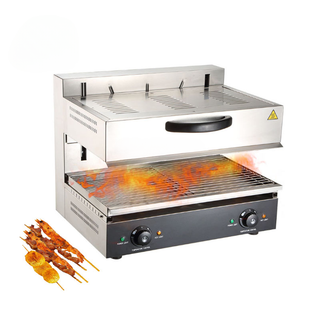
Electric is the common choice for exactly that reason — it can sit where the plating happens without a gas run to the middle of the kitchen. Gas versions recover faster and suit a heavy grill-led line where the salamander is working continuously rather than in bursts.
The rotisserie sells before it cooks
A rotisserie grill is the only machine here that is also a shopfront. Chickens turning in a glass-fronted cabinet do more for a lunchtime queue than any signage, and the product genuinely improves during the display — the rotation self-bastes, so the skin renders while the meat stays moist.
Size it in sticks or spits rather than in kilograms. A three-stick unit suits a butcher's counter or a restaurant selling a roast special; six or nine sticks is a shop where the rotisserie is the business. Then work out your turnaround: a chicken takes over an hour, so the machine's capacity is a queue at one end and a holding decision at the other — what you do with birds that finish before they sell.
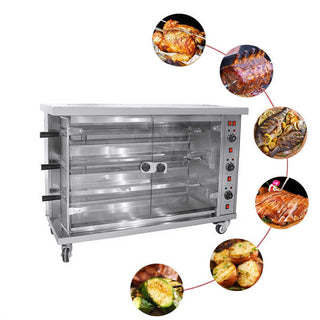
The labour argument is what usually settles it. Loading and unloading are the only two skilled moments; between them the machine runs unattended, which makes it one of very few pieces of kitchen equipment that reduces headcount rather than requiring it.
Vertical broilers are the same idea, different business
A doner or shawarma machine is a rotisserie turned on its end, and the change of axis changes the economics. The cone builds through the day, gets shaved to order, and the same machine both cooks and portions — so service is fast, waste is low and the visible product is doing marketing while it cooks.
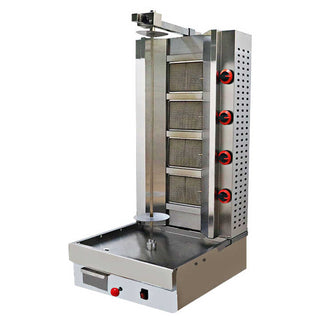
Specify by burner count rather than by cone weight: each burner is a heat zone up the height of the cone, and too few means the top cooks while the bottom does not. Rotation should be automatic and reversible, and the drip management matters more than the spec sheet suggests — fat running down a cone all day is either collected properly or it is a cleaning problem.
What a grill section does to your extraction
This is the cost people leave out, and it is frequently larger than the difference between two grills.
A charbroiler is heavy-duty in every ventilation classification there is: high heat, high grease, visible smoke. Adding one to a line usually raises the extraction rate for the whole canopy above it, and in many jurisdictions it rules out a recirculating hood entirely. The rule is that the canopy is sized from the heaviest appliance under it, which we went through in detail in sizing a kitchen exhaust hood.
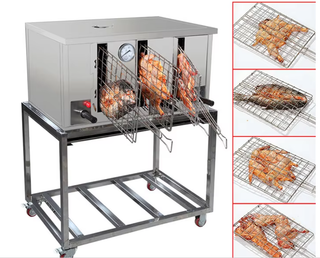
Where a duct is impossible, a smokeless grill with integrated extraction and controlled temperature is the compromise that keeps grilled dishes on the menu. It will not give you the lava-rock smoke, and it will let you grill in a unit where a charbroiler simply cannot be installed.
Sizing the section: centimetres per cover, not machines per kitchen
The useful unit is cooking width at peak. Count the covers in your busiest hour that include something off the grill, work out how long each item occupies the surface, and you get the width you need — including the space you must leave free to move things around, which is usually another 20 per cent on top.
Two rules of thumb that survive contact with a real service. A charbroiler running at more than about 80 per cent of its surface for a whole hour has no recovery capacity, and everything after that point comes out either late or wrong. And a salamander is sized by how many plates pass under it per hour rather than by width — one is enough for most kitchens, and a second one is a signal that the pass, not the grill, is the bottleneck.
Cleaning decides how long any of it lasts
All three machines fail in the same way: carbonised fat, left long enough, stops being a cleaning job and becomes a repair.
Grates come off and get scraped hot, then degreased cold. Lava rock is turned regularly and replaced when it stops absorbing. Salamander elements and reflectors need the splatter taken off before it bakes on, which takes two minutes daily and half a shift monthly. Rotisserie and vertical broiler drip trays are emptied every service, not every day.
Fat that leaves the machine goes into the extraction, which is why a grill section's cleaning schedule and its ventilation cleaning schedule are really one document — and one that an insurer will ask to see.
Where kitchens buy the wrong commercial grill
- Buying a salamander to replace a charbroiler. Heat from above cannot make grilled flavour, because nothing drips onto the heat source. It browns; it does not grill.
- Buying a charbroiler to do what a salamander does. Melting and glazing at the pass on a surface designed for searing is slow, and it ties up the machine your steaks need.
- Sizing by machine rather than by cooking width. Two narrow units in different places do not add up to one wide one, because the chef cannot stand in both.
- Forgetting the extraction uplift. A charbroiler frequently raises the rate for the whole canopy and can rule out a ventless hood, which is a fit-out decision rather than an equipment one.
- Under-specifying burners on a vertical broiler. Too few heat zones and the cone cooks unevenly all day, every day.
- No plan for finished rotisserie stock. The machine's capacity is only half the question; what happens to birds that cook before they sell is the other half.
Working out how much grill your menu needs? Send us the dishes that come off the grill and your peak-hour covers, and we will size the section and tell you what it does to the extraction.


