


In short: how to open a steakhouse is a yield question before it is a cooking one. The steak arrives at its best; nothing in your kitchen makes it better, and a dozen things make it worse. Every piece of equipment on this page exists to protect a product whose cost is already half the menu price.
Most restaurant formats add value in the kitchen. A pizzeria turns flour into something worth twenty times the flour. A cocktail bar turns spirit into a drink at four times the pour cost. A steakhouse does not: it buys the most expensive raw material in casual dining and sells it having changed it as little as possible.
That inverts the usual planning. The question is not what the kitchen can create — it is where the product leaks between the delivery door and the plate. It leaks in trim, in overcooking, in portions cut by eye, in stock that ages badly and in offcuts nobody sells. Get those five under control and the format works; miss two of them and no amount of covers rescues it.
This guide sits under the wider how to open a restaurant and covers the steak-led case specifically.
The worst food cost in the dining room, on purpose
A steakhouse runs a food cost percentage that would alarm any other restaurant, and it is not a mistake. Guests know roughly what beef costs, so the markup a pasta dish carries is not available. The business works because the average spend is high, the wine attaches well and the covers turn predictably — not because the plate is cheap.
What follows from that is a discipline about grams. On a dish where the raw material is half the sale price, a portion cut ten per cent heavy gives away five per cent of the revenue of that plate. Do it across a service and it is the whole night's profit, and nobody in the kitchen will feel it happening.
So the first equipment decision is not the grill. It is how meat gets from a box to a portion.
Whole primal or portion-cut: the decision that sets the kitchen
Buying whole primals is cheaper per kilo and it is the reason serious steakhouses have butchery on site. It also brings in trim, bone, fat and the labour to deal with all three, plus a walk-in cold requirement several times what a portion-cut kitchen needs.
Buying portion-cut costs more per kilo and removes almost all of that. Portions are consistent because someone else guaranteed them, cold storage is smaller, and the skill requirement in the kitchen drops sharply.
The honest test is whether you can sell the rest of the animal. A kitchen that breaks down primals and sells only fillet and ribeye has bought expensive trim and thrown the economics away. If the menu has a burger, a short rib, a tartare and a stock pot, in-house butchery pays. If it does not, portion-cut is not the lazy option — it is the correct one.
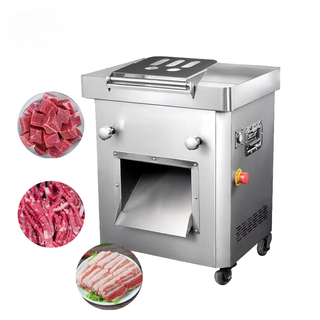
Either way, portioning by eye is where the margin goes. A powered cutter takes the variance out of the cuts that get sliced rather than steaked, and it does it fast enough to be used during prep rather than skipped.
Ageing: buy it aged, or hold it yourself
Dry ageing concentrates flavour and loses weight — typically a fifth to a third of it, between evaporation and the crust that gets trimmed away. That loss is the cost of the flavour, and it is real money on a product this expensive.
Almost every steakhouse should buy meat already aged, at least at first. The supplier carries the shrinkage risk, the humidity control and the four weeks of capital sitting in a fridge, and prices it in a way that is usually cheaper than doing it badly yourself.
Ageing on site is a marketing decision as much as a culinary one — a glass-fronted cabinet in the dining room sells steaks before the menu does. Treat it as a second-year project with dedicated equipment and a dedicated space, not as something a walk-in can do on the side. A walk-in has the wrong humidity, the wrong airflow and other people's food in it.
The grill is the identity, and it is not one machine
A charbroiler is what makes a steakhouse taste like a steakhouse: heat from below, fat dripping onto it, and the smoke that comes back up. Nothing else on the line produces that, which is why this is the one appliance you specify first and compromise on last.
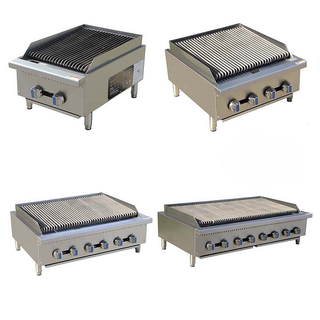
Size it in cooking width against your peak hour rather than by model. And leave surface free deliberately — a grill running flat out has no recovery capacity, and on a menu where every dish comes off it, that is the whole service.
The grill is rarely alone. A salamander finishes and holds at the pass; a flat top handles the things that would fall through a grate. We compared the three heat directions in charbroiler, salamander or rotisserie, and the short version for this format is that the charbroiler is the identity and the others are the throughput.
Sous vide is how volume steakhouses hit temperature
The thing that kills a steakhouse's reputation is not flavour, it is doneness. A guest who ordered medium rare and got medium has been sold the wrong product at a high price, and they will remember it exactly.
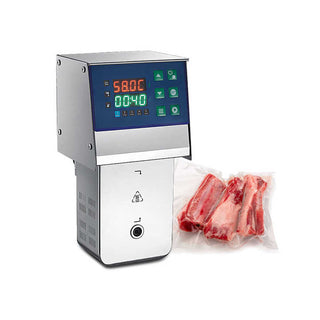
Cooking from raw on the grill puts that entirely in the hands of whoever is on the section, at the busiest hour, on thicker cuts where the margin for error is minutes. The volume answer is a two-stage cook: bring the steak to precise core temperature in a water bath, then finish it hot and fast on the charbroiler for the crust and the marks. Doneness becomes a setting rather than a judgement, and the grill time drops to a minute or two per side, which also raises the capacity of the section you just sized.
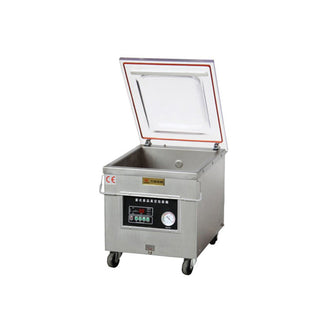
That method needs vacuum packing, and the sealer is not an accessory to it — it is half the process. It also earns its place independently: portioned steaks sealed and dated hold better, waste less and make stock rotation something you can actually see.
The purist objection is fair and worth stating: a steak cooked entirely on a grill by someone who knows what they are doing is better than a two-stage steak. The two-stage version is more consistent at volume with a normal brigade, which is a different claim, and for most openings it is the right trade.
Resting is a station nobody equips
Every steak needs to rest, and in most kitchens it rests wherever there is room. That means it either cools on a cold surface or carries on cooking on a warm one, and both undo the temperature you were careful about.
What it needs is somewhere warm enough to hold and not so hot that it continues cooking — around 50–60 °C, out of the draught, for a few minutes per centimetre of thickness. A holding cabinet or a designated warm shelf at the pass does it; the corner of a bench does not.
Build the rest into the ticket time rather than treating it as slack. A kitchen that has not planned for it will either serve the steak early or hold the rest of the table's food, and the second one is how a steakhouse gets a reputation for slow service it does not deserve.
Cold storage is larger than the menu suggests
Beef occupies more cold space per euro of sales than almost anything else, and it needs it at a stable temperature with airflow around it. A kitchen doing its own butchery needs hanging or shelf space for primals plus separate space for portioned product, and the two should not share a shelf.
On the line itself, the useful format is drawers rather than doors: a drawer chiller under the grill holds portioned steaks at the point of use and does not dump its cold air every time it is opened during service.

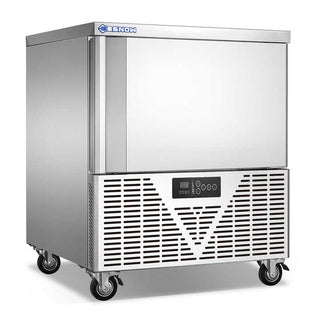
The one piece of cold that pays for itself in a steakhouse specifically is blast chilling, and not for steak — for everything else. Stock, sauces and the braised cuts that come out of the trim all need to come down through the danger band quickly, and a walk-in was designed to hold cold rather than to remove heat.
The second menu that pays for the first
If you break down primals, you generate trim, and trim is either a cost or a menu. Ground beef from your own trim is a burger with a story and a food cost far below a bought-in patty. Short rib and chuck braise into the dishes that sell on a Tuesday when nobody wants a fifty-euro steak. Bones make the stock that makes the sauce you are currently buying.
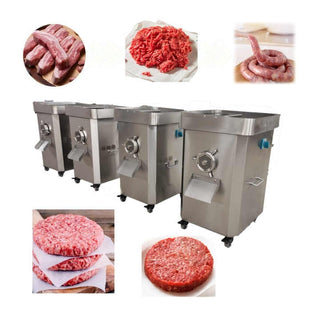
Design that second menu at the same time as the first, not later. It is what makes whole-primal buying work, it fills the price gap under the steaks, and it is the difference between a steakhouse that is busy four nights a week and one that is busy seven.
The knife on the table is part of the product
A steak served with a knife that tears rather than cuts is a worse steak, and the guest will not be able to say why. This is one of the very few places in hospitality where an inexpensive item changes the perceived quality of an expensive one.
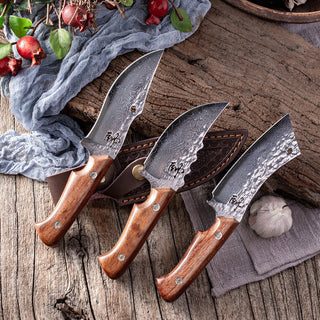
Buy enough that they are always sharp — a rotation, with a set out of service being sharpened, rather than one set that slowly dulls across a year. Steak knives also disappear at a rate that surprises people, so budget replacement into the first year rather than treating it as a one-off purchase.
How to open a steakhouse: where the money actually goes
The fit-out is a restaurant fit-out with two additions: heavier extraction, because a charbroiler is heavy duty in every ventilation classification, and more cold storage than the floor area suggests. Neither is optional and both are decided at drawing stage.
The operating shape is unusual in two ways. Food cost runs high by design, so the model depends on average spend rather than on plate margin — which makes the wine list a structural part of the business rather than an accessory. And stock value sitting in the fridge is high, so a slow week costs more here than in a comparable restaurant, because the inventory is expensive and it does not wait indefinitely.
The number worth modelling before signing anything is covers per week at target average spend, tested against a bad week rather than a good one.
Licences: standard restaurant, plus how you handle meat
United States. State and often county liquor licence through the ABC board — the slowest step and sometimes quota-capped, so start it first. Plus a health department permit, food-handler or ServSafe certification, and a certificate of occupancy. If you butcher on site, expect the health inspection to look specifically at separation of raw handling from other prep.
Australia. An on-premises liquor licence from the state regulator, RSA competency for everyone who serves, council premises approval and food-business notification, and a Food Safety Supervisor in most states. In-house butchery is generally covered by the food-business approval rather than a separate licence, but it is declared, not assumed.
United Kingdom. Premises Licence from the council plus a Personal Licence for the Designated Premises Supervisor, food-business registration at least 28 days before opening, a fire risk assessment, and TheMusicLicence if you play music. Extraction discharge is frequently a planning condition where there are residential neighbours — relevant here, because the charbroiler makes it a bigger conversation than for most restaurants.
United Arab Emirates. A trade licence with F&B activity and eligible zoning, Dubai Municipality inspections covering ventilation and food handling, Civil Defence clearance, and health cards for food handlers. Alcohol is tightly controlled and routed through Dubai Police GHQ with the Department of Economy and Tourism, or the DCT in Abu Dhabi — and service is generally confined to hotels and licensed venues, which for a steakhouse frequently decides the site before anything else does.
What goes wrong in the first month
Three failures show up early and all three are yield, not cooking.
Portions drift heavy, because nobody is weighing during service and a generous cut feels like hospitality. Fix it with a scale on the section and a spec that is checked, not remembered.
Doneness misses cluster at peak, on the thickest cuts, exactly when the section is busiest — which is the argument for the two-stage cook rather than an argument about the chef.
And the trim menu does not exist yet, so the offcuts of an expensive animal go into a bin while the kitchen buys in mince. That one is entirely a planning failure, and it is the cheapest of the three to fix.
Working out the line for a steak-led menu? Tell us whether you are butchering on site and what your peak-hour covers look like, and we will size the grill section, the cold storage and the prep around it.


