


In short: a commercial freezer holds food that is already frozen. A blast freezer takes heat out of food that is not. They are rated for opposite jobs, and the most common and most expensive mistake in a kitchen's cold plan is asking the storage cabinet to do the blast machine's work.
Both machines run below zero and both are sold as freezers, which is where the confusion starts and where a lot of money leaves.
The difference is not how cold they get. It is how fast they can take heat out, and whether they were designed to have hot food put into them at all.
One word, two jobs
A storage freezer is built to maintain around −18 °C once the contents are already there. Its refrigeration capacity is sized for holding: it replaces the heat that leaks in through the walls and the door, and very little more. Put a full tray of hot food inside and it will get there eventually, over many hours, while everything around it partially thaws.
A blast freezer is built for the opposite. Massive refrigeration relative to its volume, high-velocity air across every surface, and a rating expressed as a weight of food taken from one temperature to another within a time — typically something like 90 minutes from +70 °C to +3 °C for chilling, or a few hours down to −18 °C for freezing. Once the cycle finishes, the food goes into the storage freezer.
So they are not alternatives. A kitchen that preps ahead needs both, and the question is only how big each one has to be.
Why hot food in a commercial freezer fails twice
The first failure is the food you just put in. It sits for hours in the temperature band where bacteria multiply fastest, and it does so slowly enough that the pathogen risk is real rather than theoretical. In most food-safety regimes this is written down explicitly: cooked food has to move through that band within a defined time, and a storage freezer cannot deliver it.
The second failure is everything else in the cabinet. The heat you introduced has to go somewhere, and on its way out it warms the frozen product around it — which partially thaws and refreezes. That is invisible, cumulative and it is why a kitchen that habitually cools things in the freezer has ice-crystalled, dry, freezer-burnt stock that nobody can explain.
The third cost is the machine. A storage compressor asked to run continuously against a load it was not sized for runs hot, cycles badly and dies early.
Ice crystals are the real reason blast freezing preserves texture
Water expands when it freezes, and the size of the crystals it forms depends on how fast it gets there.
Freeze slowly and the crystals grow large, puncturing cell walls as they do. The damage only becomes visible on thawing, when the liquid that used to be inside the cells runs out — which is why slowly frozen fish is watery, slowly frozen sauce splits, and slowly frozen berries collapse into mush.
Freeze fast and the crystals stay small, cell walls survive largely intact, and the thawed product is much closer to what went in. That is the whole culinary argument for blast freezing, and it applies just as much to a portioned braise as it does to fish.
It is also why the same machine is a fixture in gelato production, where crystal size is the texture rather than a side effect.
Chilling and freezing are two cycles on one machine
Most blast cabinets run both, and the chill cycle is the one a restaurant uses more.
Blast chilling takes cooked food from service temperature down to fridge temperature quickly, so it can be held for a few days and regenerated. That is the cook-chill model that lets a kitchen do Monday's work on Sunday, and it is the cycle behind most of the prep-ahead you see in volume operations.
Blast freezing goes further down and buys weeks or months instead of days, at the cost of a longer cycle and more energy.
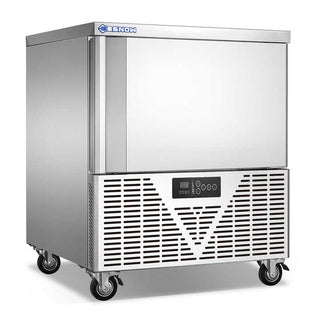
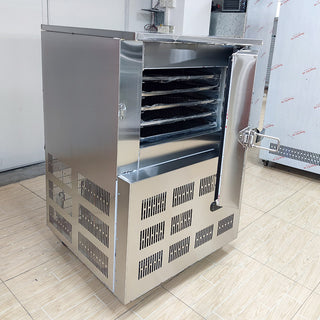
Rated by trays, these machines are sized against the batch you actually cook rather than the volume of the box: a 5-tray unit is a restaurant doing sensible prep, a 10-tray unit is a kitchen where cook-chill is the operating model.
Where the product is dense and flat — gelato pans, portioned blocks, plated components — a plate freezer makes contact with the product instead of blowing air past it, which pulls heat out considerably faster for the same footprint.
Sizing a blast freezer: kilos per cycle, not litres
The specification is a weight and a time together, and neither number means anything alone. "50 kg" is not a rating; "50 kg from +70 °C to +3 °C in 90 minutes" is.
Work from your largest single cook. If the kitchen braises 40 kg of shin on a Sunday, that batch has to fit in one cycle — splitting it across two means the second half sits at room temperature waiting, which is the exact risk the machine was bought to remove.
Two details that decide whether the rating is achievable in your kitchen. Product depth: a rating assumes food spread in shallow trays, and a deep gastronorm of the same weight takes far longer. And air path: trays have to be spaced so air moves between them, so a cabinet packed solid will miss its own specification.
Sizing storage: upright, chest, or split temperature
Storage freezing is a different calculation, and the honest starting point is delivery frequency. A kitchen taking frozen deliveries twice a week needs a fraction of what a remote site taking one a fortnight does.
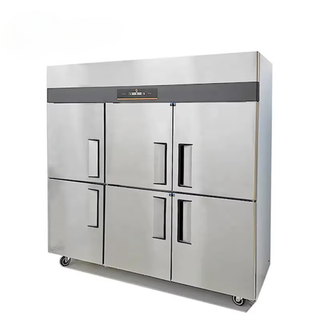
An upright cabinet is the working default: shelves at usable heights, small footprint, and stock that can be rotated without unloading it. It costs more to run than a chest, because opening the door drops the cold air out.
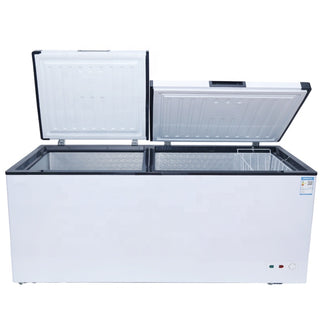
A chest freezer is the cheapest litre of frozen storage you can buy and the most efficient to run — cold air stays put when the lid opens — at the cost of stock rotation, which becomes an archaeology exercise unless you use baskets and a system. It is the right answer for bulk and the wrong one for daily picking.
Where the kitchen is small and the ratio of chilled to frozen changes with the season, a dual-temperature cabinet runs two independent zones in one footprint — which usually beats buying a small dedicated freezer that is empty for half the year.
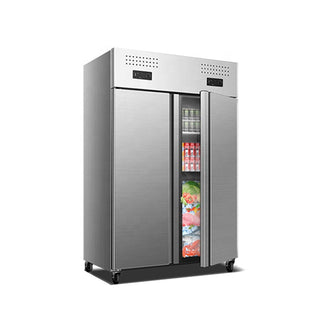
Below the line, the undercounter format matters more than its capacity suggests: frozen product at the point of use stops a chef opening the walk-in eleven times a service.
The record is most of the point
Blast chilling and freezing are the steps a food-safety inspection asks about most specifically, because they are the ones where a documented time and temperature either exists or does not.
Machines with a probe and a printout or a data log make that trivial: the cycle records what happened, and the record is the evidence. Machines without one put the burden on somebody writing a number on a clipboard at the end of a shift, which is exactly the sort of task that gets back-filled.
Whatever you buy, label every frozen item with what it is and when it went in. Frozen food does not spoil in a way you can see, which means an unlabelled tray is a tray nobody will ever confidently use.
Where kitchens buy the wrong freezer
- Using the storage freezer to cool hot food. The food sits in the danger band for hours, everything around it partially thaws, and the compressor runs against a load it was never sized for.
- Reading "kg" as a rating. The weight only means something with a temperature range and a time attached to it.
- Sizing a blast cabinet below the largest single cook. If the batch does not fit in one cycle, half of it waits at room temperature — which is the risk you were removing.
- Packing trays solid. Ratings assume air moves between shallow trays. A full deep gastronorm will miss the specification by a wide margin.
- Buying a chest freezer for daily picking. Cheapest litre to buy and run, worst format to rotate — it wants baskets, a system and bulk stock.
- No labels. Frozen food gives no visual clue about age, so an unlabelled tray eventually becomes waste by default.
Working out how much of each you need? Tell us your largest single cook and how often frozen stock is delivered, and we will size the blast cabinet and the storage separately rather than as one number.


