
A menu rewritten every morning decides the whole kitchen. How to open a bistro comes down to a board of about a dozen dishes, one line that can cook all of them, and cold storage sized for whatever the market sold you at dawn.
At half past six the chef is at the market with a notebook and no menu. The mackerel looks good. The chanterelles do not, and a grower at the end of the row wants rid of a crate of late tomatoes before he packs up for the day. By eleven the chalkboard lists eleven dishes, and three of them are built around that crate.
That morning routine explains most of the equipment list. Learning how to open a bistro means planning for a menu you cannot predict: a single cooking line flexible enough to handle whatever goes on the board, somewhere cold to put the morning's shopping, and a menu short enough that nothing waits in the fridge for a week. The wider restaurant build, from site to staffing, is in our guide to opening a restaurant. This one stays with the kitchen that a daily menu demands.
Why does a bistro menu stay short?
A bistro menu stays short because one line and two or three cooks can only hold so many dishes at once, and because every extra dish adds another ingredient to store. The usual board carries four or five starters, four or five mains and a couple of desserts. Push it past fifteen and the kitchen starts buying for the menu instead of writing the menu around the buying.
The short board is also a stock-control system. A lamb shoulder braised on Monday becomes Tuesday's ragout, its bones go into Wednesday's stock, and the trim ends up in a terrine. Each ingredient appears in two or three dishes across the week, so a case bought at the market gets used up instead of half used. A fixed-menu restaurant buys to par levels and reorders the same list every week. A bistro buys what is good that morning and then writes the menu, which is cheaper at the market and harder on the cold room.
That second point shapes almost every equipment decision below. Opportunistic buying tends to overfill storage, because a good price on a whole case of something is hard to refuse. The discipline that keeps a bistro solvent is to buy for the next two services rather than the week, and to store what you bought so that it lasts until you use it.
The chalkboard itself follows from this. A daily menu cannot live in a printed folder, so it goes on a board, a single sheet printed that morning, or a screen behind the counter. The format matters less than the habit of rewriting it before lunch, with the staff briefed on every change.
One line, set up to cook anything on the board
A bistro usually runs one cooking line, and it has to cook a braise and a piece of fish in the same service, with a sauce reducing next to both. The line is short, often three or four meters, and in most small kitchens one cook covers two stations at lunch. That rules out single-purpose machines. Each piece on the line should cover two or three cooking methods.
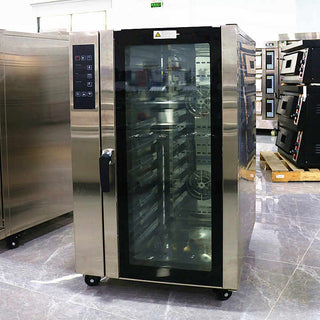
The oven is where that pays off first. A combi oven can roast with dry heat or steam, or mix the two, which covers a slow-cooked pork belly at 6pm and a steamed fish fillet at 8pm without a second box. This gas-fired unit takes eight trays, enough for the braises and roasts of a 50-seat room. Our comparison of combi and convection ovens covers when a plain convection oven is enough.
The range handles everything the oven cannot: sauces, pans, blanching, reductions. Six burners suit a bistro better than four, because a daily menu rarely balances its pan work evenly across the stations. This floor-standing range has six cast-iron burners at 6 kW each, runs on LPG or natural gas, and cuts the gas if a flame blows out, which matters on a line where burners run unattended between orders.

A flat surface completes the line if the board leans on seared fish, steaks or anything cooked to order in quantity. A 9.6 kW gas griddle fits that job. It takes less room than a second range, and the cabinet underneath holds pans. Many bistros add a small 13-liter sous vide bath later, once they see which proteins keep coming back to the board, because a bath holding anywhere between 40 and 95 °C lets a duck leg cook through in the afternoon and need only a sear at service.
Plan the extraction with the line, not after it. A combi, a six-burner range and a griddle under one canopy put out a lot of heat and grease, and our guide to sizing a kitchen exhaust hood works through the airflow. The stoves and ranges and ovens collections carry the rest of the line.
Where does the morning's market buying go?
The morning's buying splits three ways. A refrigerated counter on the line holds what you cook today, a larger fridge or walk-in holds tomorrow's, and vacuum bags cover anything that has to last longer. Getting that split right is what lets a bistro buy at the market without throwing half of it away.
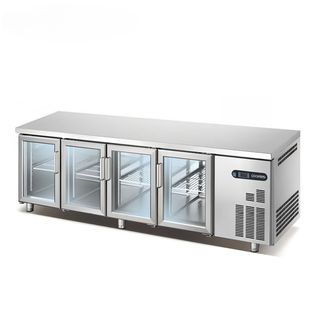
The counter on the line does the most work. A refrigerated prep table puts the day's mise en place under the cook's hands, with the backup stock in the drawers or doors below, so nobody walks to the back fridge mid-service. This one is 2,250 mm long with four doors and a digital controller, long enough to run the whole cold side of a small line.
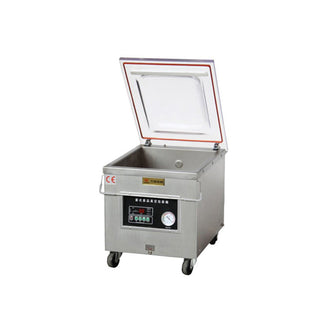
Vacuum packing is the tool that turns a good market buy into three days of use instead of one. Portion the fish the moment it arrives and bag it with a date on the label, and it keeps its quality far longer than on a tray under film. Bags also stack flat, so the same shelf holds more, and they go straight into a sous vide bath. This tabletop machine has a 350 mm seal bar, which takes a whole fillet. Our guide to vacuum packaging for kitchens covers bag choice and what the sealer will and will not do for shelf life.
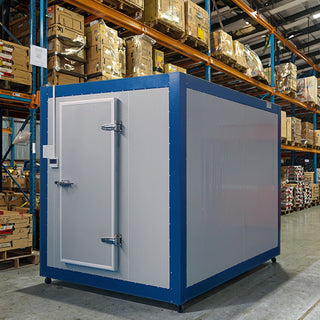
A walk-in cold room is the step most bistros postpone too long. Under about 40 seats, two good reach-in fridges and a prep counter usually cope. Above 50, and especially when the chef buys whole animals or full cases, a small walk-in pays back in space and in fewer wasted deliveries. This modular room is built from insulated panels, runs between −25 and +15 °C, and has a safety escape lock on the door. Our guide to cold rooms and walk-ins covers panel thickness and where the condensing unit can go.
Stocks and braises are the other storage problem. A bistro makes them in large batches, and a 20-liter pot of stock takes hours to cool in a normal fridge while warming everything around it. A blast chiller brings it down quickly and safely, and our comparison of blast freezers and ordinary freezers covers when a kitchen of this size needs one. The walk-in cold rooms, refrigerators and vacuum sealers collections cover the storage side.
One habit matters as much as any machine. Market produce arrives in the chef's car rather than a refrigerated truck, so check its temperature when it arrives, note where it came from, and label every container with a date. A daily menu makes rotation harder to see, and a label is the only thing that tells tomorrow's cook which tray to use first.
How much kitchen does a 30-, 50- or 70-seat bistro need?
A 30-seat bistro can run on one range and a combi with reach-in fridges, while a 70-seat room needs a walk-in, a second cook on the line and a dishwasher that keeps pace. The table below sets out how the kit scales with seats. Above about 100 covers a night the format starts turning into a brasserie, with a different kitchen.
| 30 seats | 50 seats | 70 seats | |
|---|---|---|---|
| Dishes on the board | 8–10 | 10–12 | 12–15 |
| Cooks on the line at dinner | 1–2 | 2 | 3 |
| Cooking | 4–6 burner range, compact combi or convection oven | 6-burner range, 8-tray combi | 6-burner range, 8-tray combi, griddle |
| Cold storage | Prep counter plus one upright fridge | Prep counter plus two uprights or a small walk-in | Prep counter plus walk-in; blast chiller worth adding |
| Preserving | Tabletop vacuum sealer | Vacuum sealer, sous vide bath | Vacuum sealer, sous vide bath |
| Warewashing | Undercounter dishwasher | Hood-type dishwasher | Hood-type dishwasher with a pre-rinse sink |
| Wine storage | One dual-zone cabinet | Dual-zone cabinet plus back-bar fridge | Two cabinets or a small wine wall |
The figures are working ranges from small-kitchen practice, not rules. A bistro with a strong lunch trade and a weak dinner may equip like the column to its left, while one that sells whole fish and large sharing plates may need the column to its right.
The money follows the same order. The cooking line and cold storage are the big-ticket items in any bistro fit-out, and they are the two places where buying undersized costs more than buying once. Warewashing sits in the middle. Crockery and glassware are cheap individually but get replaced every year, so buy enough depth to survive breakage. The item most often bought too early is a second oven. Wait until the board proves it needs one, because a combi that sits cold on quiet nights is a poor use of both floor space and budget.
Current prices sit on each product page. Rent, fit-out, extraction and opening stock usually outweigh the equipment line, and they vary far more by city.
Prep that has to finish before lunch
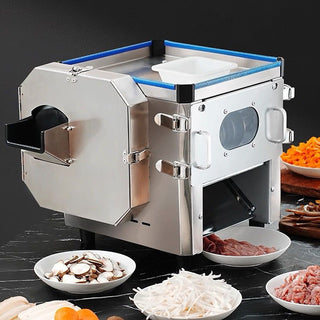
A daily menu compresses prep into the window between the market and the first order. Everything the chef bought at dawn has to be trimmed, portioned, sliced and bagged by about 11:30, often by two people. The slicing and shredding is where a machine saves the most time.
A multi-function cutter handles the volume work, such as vegetables for a soup, cabbage for a slaw or cured meat for a starter plate. This 850 W model is rated at 150 kg of produce and 400 kg of meat an hour, with cutting plates from 2.5 to 21 mm, so the same machine slices thin for a carpaccio and chunky for a stew. It sits on the counter and packs away when the line needs the space.
Everything else in the morning window is knife work, and a bistro cook uses the same two or three knives all day. Our guide to choosing a chef's knife covers what is worth buying for a small brigade. The food processors collection has heavier bowl cutters for kitchens that make their own terrines and pâtés.
What does a bistro's wine setup need to hold?
Most bistros sell wine by the glass and the carafe from a short list of twenty to forty bottles, so they need one well-controlled cabinet rather than a cellar. The list follows the board loosely. When the fish is good, the whites move faster, and the cabinet has to keep both colors at serving temperature through the evening.
A dual-zone cabinet keeps whites at the bottom of its range and reds a few degrees warmer in the same footprint. This compressor model holds 59 bottles and a dozen glasses, runs from 5 to 22 °C, and controls humidity between 60 and 80 percent, which protects corks on bottles that stay open-ended in the list for months. It is rated below 41 dB, quiet enough to stand in a small dining room.

Open bottles are the real cost of by-the-glass service. A short list helps. When each bottle empties within a night or two, little is lost, and anything slower-moving should come off the by-the-glass list or go under inert gas. The wine cabinets collection runs from under-counter units to full walls.
Plates, the dish pit and a room that turns
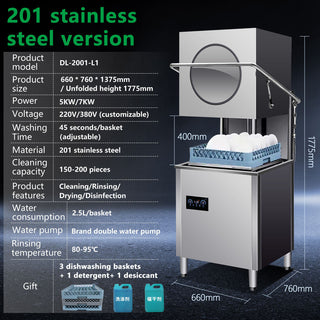
A 50-seat bistro turning its tables once and a half on a Friday sends a lot of crockery back to a small dish area. Hand-washing at that pace takes a full person, and in a kitchen of three cooks that person is usually missing. A hood-type dishwasher clears a rack in a couple of minutes and keeps the pass supplied with clean plates.
This freestanding hood-type machine washes 16 dish sets a cycle. Budget electrical supply for it early, since it draws 9 kW and needs a 220–380 V connection. Our guide to choosing a commercial dishwasher compares it with undercounter models for the smallest rooms.
The plates matter more in a bistro than their price suggests, because the room is small enough for every guest to see every dish go past. Plain white porcelain survives a daily-changing menu best, because it suits a braise on Monday and a tart on Thursday. Buy enough for one and a half full services, since breakage and a slow dish pit both eat into the stock. The plates and bowls collection carries restaurant crockery by shape.
Licensing a bistro in France, the UK, the US and Australia
A bistro needs the same four approvals everywhere: a registered business, food-safety sign-off, premises and fire approval, and an alcohol license for the wine. The alcohol license usually takes longest, so start it before the fit-out.
In France, where the format was born, the operator completes the permis d'exploitation, a mandatory training course of about three days, before serving alcohol. A wine-led bistro typically needs a Licence III, which covers fermented drinks such as wine and beer and lets you pour without a meal. A bistro that serves alcohol only with meals can sometimes work under the cheaper restaurant licence instead, so ask the town hall which one fits your menu. The Licence IV for spirits is scarce and usually transferred from an existing holder rather than newly issued. On top of that come the food-activity declaration and an HACCP plan, which for a market-buying kitchen should record where each delivery came from and at what temperature it arrived.
In the United Kingdom, alcohol needs a Premises Licence from the local council and a Personal Licence for the Designated Premises Supervisor, who has to hold an accredited APLH qualification and pass a basic DBS check. Register as a food business with the council at least 28 days before opening, expect a Food Hygiene Rating inspection, and complete a fire risk assessment for the premises.
In the United States, alcohol goes through the state Alcohol Beverage Control board, often with county sign-off, and it is the slowest step of the project. Some states cap the number of licenses. A beer-and-wine license is generally quicker to get than full liquor, and it suits a wine-led bistro that pours no spirits. You also need federal TTB registration, a business license and EIN, a health-department permit, food-handler or ServSafe certification for staff, and a certificate of occupancy.
In Australia, apply to the state or territory liquor regulator for an on-premises liquor licence. In New South Wales a Small Bar licence covers venues of up to 120 patrons. Everyone who serves alcohol needs a current RSA card, renewed every five years in NSW. Council premises approval and food-business notification come on top, along with a fire safety statement.
This is an overview, not legal advice. Check the current rules with your local licensing authority before you sign a lease, because fees and timelines vary by city and state.
Mistakes that shorten a bistro's first year
- A board that grows every week. Each new dish seems harmless, but at eighteen dishes the kitchen is buying for the menu again and the fridge is full of things used once. Cap the board and swap dishes in and out.
- Buying at the market for a week. A cheap case is only cheap if you use all of it. Buy for two services, and vacuum-pack whatever will not be cooked within a day.
- Specialist machines on a one-line kitchen. A pasta cooker or a rotisserie that serves one dish takes the space a combi or a griddle would use every service. Buy the second specialist machine only after the board has shown it needs one.
- A prep counter that is too short. When the cold side of the line cannot hold the day's mise en place, cooks walk to the back fridge in the middle of service. Measure the counter against the whole board, not the average ticket.
- No plan for cooling batch cooking. Stocks and braises left to cool in a reach-in warm everything else in it. A blast chiller or a disciplined ice-bath routine has to exist before the first big batch.
- Leaving the alcohol license until the fit-out is done. In most markets it is the longest lead time in the project. Apply while the kitchen is still being drawn.
For the kitchen equipment that sits behind any of these decisions, our guide to commercial kitchen equipment walks through each station of a full restaurant line.
Planning a small line for a menu that changes every day? Send us your seat count, a sample week of dishes and the size of the kitchen, and we will put together a line and a storage plan that fit the room.


