


In short: how to open a donut shop is a scheduling problem wearing a bakery costume. The product peaks about half an hour after it leaves the fryer and is worthless the next morning, so every decision — dough, fryer, proofing, display, even the coffee — exists to move stock through that window.
Donuts are one of the highest-margin things a small kitchen can make. They are also one of the few products with no second life. Bread becomes toast, croissants become almond croissants, cake keeps for two days. A day-old donut is a bin cost with a receipt attached.
That single fact is unusually useful, because it turns a long list of decisions into one question asked over and over: does this choice help me sell the batch while it is still good? Answer it consistently and the shop designs itself.
This guide sits under the wider how to open a bakery and stays on the donut case, which is sharper than the bakery average in both directions — better margins, shorter clock.
The four-hour product
A yeast-raised donut is at its best somewhere between twenty minutes and two hours after frying, still slightly warm, glaze just set. By hour four it is good. By hour eight it is a supermarket donut. By tomorrow it is waste, and no amount of packaging changes that — the staling is the starch retrograding, not the air getting in.
So the business runs on batch timing, not on daily volume. Two hundred donuts fried at six in the morning is a completely different shop from two hundred fried in four batches across the day, even though the daily number is identical. The second one sells more, wastes less and needs a different fryer.
Decide which of those you are before anything else. Everything downstream — how much proofing capacity, how big the fryer, whether you need an automatic line — follows from batch size and batch count, and neither is recoverable by buying more equipment later.
The dough decides the whole kitchen
There are effectively three products sold under one name, and they need different rooms.
Yeast-raised is the classic ring: light, airy, and it needs proofing — which means a controlled warm humid space and a schedule that starts hours before you open. It is the highest-margin version and the most operationally demanding.
Cake donuts are chemically leavened. No proofing, batter rather than dough, deposited straight into the oil. The kitchen is simpler and the shop can start frying much closer to opening, at the cost of the texture that people queue for.
Filled and finished is a decision layered on either: injecting, dipping, topping. It adds a station and a chiller, because cream and custard fillings put you under different food-safety rules than a glazed ring.
Most small shops that fail do so by trying all three in the first year with equipment for one. Pick the one your concept is built on and let the other two be occasional.
Frying: countertop, batch or an automatic line
The fryer is the constraint on everything, because it sets how many donuts exist per hour. Size it from the batch plan, not from the daily total.
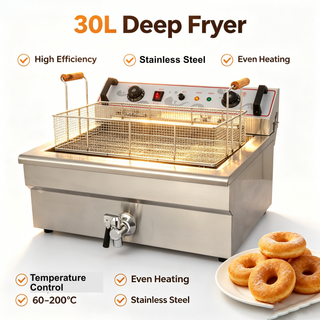
A single-tank countertop fryer suits a café adding donuts, a small shop with one morning batch, or a kitchen testing the concept before committing floor space. Thirty litres of oil holds temperature well enough for continuous small batches, and it sits on a bench rather than needing a line.
Above that, hand-frying stops being the bottleneck the moment the queue does. An automatic machine deposits, flips and fries hands-free at a consistent time and temperature — which matters less for speed than for uniformity, because a donut fried thirty seconds long is visibly darker and customers pick from the tray.
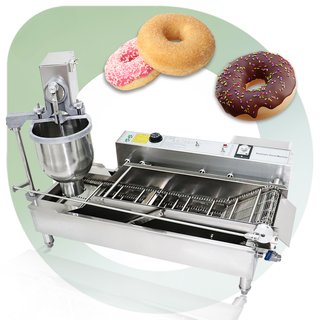
The kiosk case is worth naming separately: mini donuts fried in rows in front of the customer are a different product with a different economics, sold on theatre and impulse rather than on a morning routine. If that is the plan, the machine choice is made by the counter frontage, not by the back kitchen.
Oil is an ingredient, and it has a cost curve
Frying oil is the second largest consumable in a donut shop and the one that decides how the product tastes on day forty. Oil degrades with heat, time and the sugar and flour that fall into it, and degraded oil makes donuts that taste heavy and darken too fast.
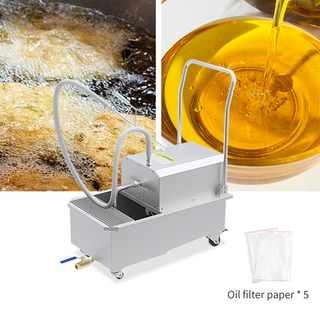
Filtering daily roughly doubles usable oil life, which is a direct saving and a quality argument in the same move. Doing it by hand with a jug is how it stops happening in week three; a filtration cart makes it a two-minute step at close.
Two practical numbers to fix early: frying temperature (a yeast donut wants a lower, gentler heat than most fried food, or the outside colours before the inside sets) and the disposal route for spent oil, which in every market covered below is a waste stream with rules attached rather than something you pour away.
Glazing and filling is a station, not a step
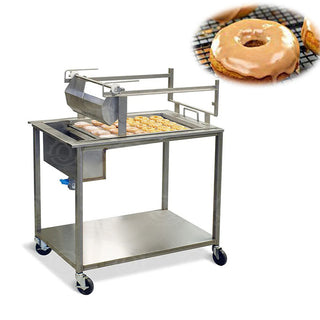
Finishing is where the shop's identity lives and where the labour hides. A glaze applied by dipping one donut at a time is fine for fifty and impossible for five hundred; a glazing table coats a full screen in one pass and returns the excess, which is both faster and less wasteful.
Filled donuts need a piston filler, and the reason is consistency rather than speed: a hand-piped jam donut varies by ten or fifteen grams, which on a filling that costs more than the dough is a margin leak you cannot see.
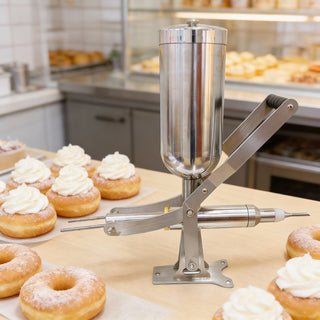
Glaze while the donut is still warm and it sets clear; glaze cold and it sits opaque and cracks. That one detail is the difference between the tray in the window looking like the photo and looking like a supermarket shelf, and it constrains the layout — the finishing bench belongs next to the fryer, not across the kitchen.
Proofing sets your opening time
For yeast dough, proofing is the longest step and the one that decides what time somebody has to be in the building. There are two ways to run it, and the choice is really about labour.
The direct route is a warm proofer in the morning: mix, divide, prove for around an hour under controlled heat and humidity, fry. Simple, and it means starting very early.
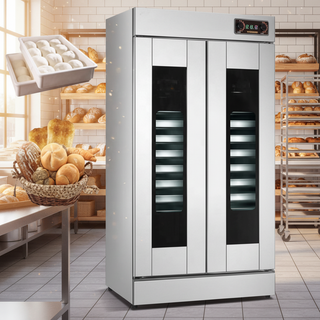
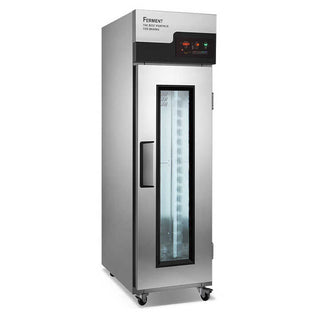
The alternative is retarding — holding shaped dough cold overnight, then bringing it up to temperature before frying. A refrigerated proofer does both jobs on a timer, so the dough is ready when the baker arrives rather than three hours after. It costs more and it buys back the worst shift in the building, which is usually the difference between a business you can staff and one you cannot.
The display case is a sales tool with a wrong setting
Donuts belong at ambient temperature in a case that is lit, open-fronted or at least easy to serve from, and — this is the part that catches people — not refrigerated. Refrigeration accelerates staling in starch, so a fridge is the fastest way to age the product you just made.
What the case has to do is display the whole range at eye level, because donut buying is impulsive and visual, and it has to empty in a way that still looks full. A tray that is a third empty at eleven o'clock reads as leftovers; the same donuts consolidated onto a smaller tray read as nearly sold out. That is merchandising, not equipment, and it is worth training.
Coffee is where the margin actually is
A donut shop that sells coffee badly is a donut shop with half the revenue. The attach rate is high, the margin on coffee is better than on donuts, and the coffee is what makes an eleven o'clock visit plausible when the morning rush is over.
It does not need to be a speciality programme. It needs to be fast, consistent and served without the donut queue stopping — which in practice means the coffee station is a separate point in the layout with its own queue path, not a second job for the person at the till.
How to open a donut shop the morning can carry
The spend concentrates in a small kitchen: fryer, proofing, finishing bench, extraction. Extraction is the item people underestimate, because deep frying at volume is a heavy grease load and the canopy is sized from the appliance, not the room — we went through that calculation in a separate piece on sizing a kitchen exhaust hood.
The revenue side is unusually front-loaded in the day. A donut shop typically takes the majority of its money before eleven, which makes rent a function of morning footfall rather than of location prestige. A cheaper site on a commuter path beats an expensive one on an evening street, and that decision is worth more than any equipment choice on this page.
Staffing is the third number, and it is set by the batch plan: one early baker plus counter cover is the small format; multiple batches through the day need a second production shift, which only pays if the afternoon traffic exists to sell into.
Permits: food only, and the oil has its own rules
No alcohol means the licensing is the simpler kind, but frying at volume adds two things a dry bakery does not deal with.
United States. A health department permit and food-handler certification per state, a certificate of occupancy for the unit, and — the frying-specific parts — a grease interceptor on the drain and a contracted route for waste cooking oil. Both are usually conditions of the plumbing and health sign-offs rather than separate applications, which means they surface during fit-out inspection when changing them is expensive.
United Kingdom. Register the food business with the council at least 28 days before opening, then the hygiene inspection and Food Hygiene Rating. Level 2 Food Hygiene training for staff handling food is the practical standard. Extraction discharge is frequently a planning condition where there are residential neighbours, and waste oil must go to a licensed carrier — it is a controlled waste, not a bin item.
Australia. Council premises approval plus food-business notification, a Food Safety Supervisor in most states, and trade-waste consent for the grease trap from the local water authority. Fit-out plans generally go to council before work starts rather than after.
In all three, the fixture that most often gets missed at first inspection is the separate hand-wash basin — required, and required to be reachable without crossing the production area.
What to do with the three o'clock shelf
Every donut shop has an afternoon problem, and the ones that survive have decided about it in advance rather than discovering it weekly.
The options are all legitimate and they exclude each other. Fry a deliberately small second batch at lunchtime and accept selling out by four — the cleanest answer, and it protects the product's reputation. Discount the last hour on a fixed rule, which trains regulars to arrive late and cannibalises your morning if the discount is deep. Or find a standing outlet — an office order, a café wholesale round, a charity collection — which turns predictable surplus into either revenue or goodwill.
What does not work is holding stock overnight to open with a full case. The case looks right and the product is wrong, and a customer who has one stale donut does not come back to find out whether it was a bad day.
Working out the batch plan and the kit around it? Tell us how many donuts you expect before eleven and whether you are yeast-raised or cake, and we will size the fryer, the proofing and the finishing bench to match.


