


In short: how to open a pizzeria starts with the oven, because it decides the style of pizza, the throughput, the staffing and the ventilation approval. Everything else in the kitchen is arranged to feed it.
Neapolitan pizza cooks in ninety seconds at around 450 °C. New York style takes six minutes at 290 °C. A conveyor pushes a pizza through in five minutes at a temperature nobody adjusts.
Those are not three recipes. They are three businesses with different staffing, different menus, different throughput and different conversations with the fire officer. Choose the oven and you have chosen most of the rest — which is why the oven is the first decision rather than the biggest purchase.
Four ovens, four businesses
| Oven | Runs at | Bake time | Needs | Suits |
|---|---|---|---|---|
| Wood-fired | 430–480 °C | 60–90 seconds | A skilled pizzaiolo, fuel storage, the heaviest extraction case | Neapolitan; the theater of an open kitchen |
| Gas deck | 280–350 °C | 4–8 minutes | Gas supply and a hood; moderate skill | New York, Roman, most independents |
| Electric deck | 280–350 °C | 4–8 minutes | Serious power, often three-phase; no flue in some builds | Sites with no gas or no chimney route |
| Conveyor | 240–290 °C | 5–7 minutes, fixed | Almost no skill; consistent output | Delivery, volume, franchise, ghost kitchens |
The row that decides the staffing model is the last column. A wood-fired oven needs somebody who can read a bake and turn a pizza — a skill that is hard to hire and harder to replace at short notice. A conveyor needs somebody who can load it, which is a fundamentally different labor market.
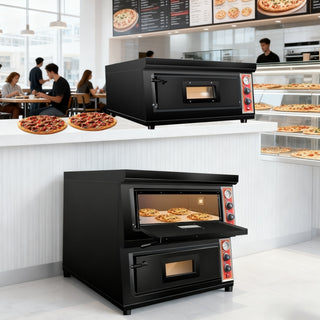
Deck ovens are where most independents land. Stone or refractory decks hold heat and radiate it into the base, which is what produces a proper crust rather than a baked disc, and multiple decks let a kitchen run two temperatures at once.
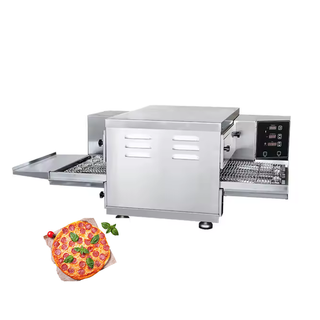
Conveyors trade craft for predictability, and that trade is correct for delivery-led operations. Every pizza gets the same bake regardless of who is working, which matters when the busiest hour is also the hour your least experienced person is on the line.
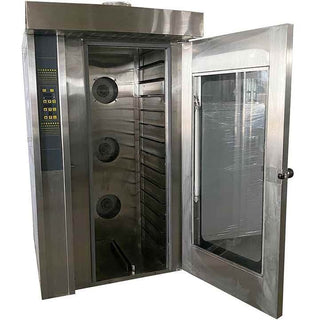
And if the menu extends beyond pizza — pasta, sides, desserts — a second oven that is not the pizza oven stops the whole kitchen queueing behind one appliance.
The ovens and automated cooking ranges cover deck and conveyor builds.
Why does pizza dough run the kitchen?
Pizza dough is made a day or more before it is used, which makes a pizzeria a planning business more than a cooking one.
Fermentation is the variable. A dough proofed for 24 to 72 hours in cold storage develops flavor and an extensible structure that a two-hour dough never will, and the fridge is doing the work while nobody is in the building. That means a pizzeria's real capacity is decided by how much dough it can hold cold, not by how fast the oven runs.
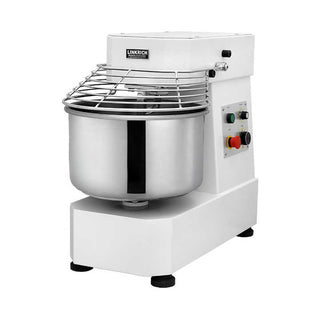
Mixing matters more here than in most kitchens. A spiral mixer works dough gently while keeping it cool — a planetary mixer heats it through friction, and warm dough ferments unpredictably before it ever reaches the fridge. This is one of the few places where the specific machine type is not interchangeable.
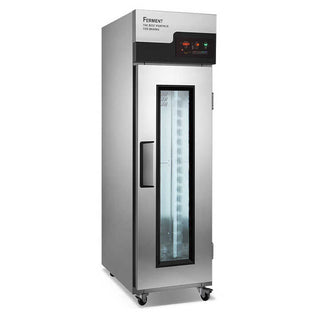
Controlled retarding is the other half. A cabinet that holds dough boxes at a set temperature turns fermentation from a guess into a schedule, which is what lets a kitchen produce the same pizza on a Tuesday and a Saturday.
Size both against the busiest day rather than the average. Running out of dough at eight on a Friday means closing the kitchen with a full dining room, and there is no way to make more in the time available.
The line that feeds the oven
Between the fridge and the oven sits the station that decides service speed.
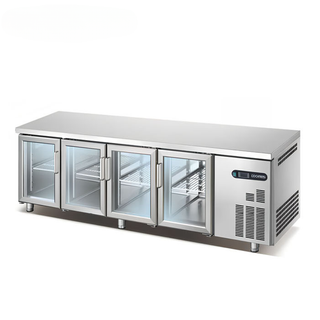
A refrigerated prep table holds toppings chilled and within reach, with backup below. The measurement that matters is the length of the chilled well against the number of toppings on the menu — a menu with thirty ingredients on a table built for eighteen means somebody is walking to a fridge during every rush.
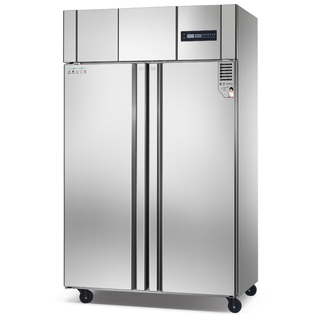
Behind it, reach-in cold holds cheese, dough boxes and prepped stock. Pizza kitchens use more cold storage than their size suggests, mostly because dough occupies volume for days. Our guide to commercial refrigeration covers sizing against delivery frequency, and commercial kitchen equipment covers the rest of the stations.
Layout is simple to state and easy to get wrong: fridge, bench, oven, exit — in a line, in that order, with nothing crossing it. The most common failure is putting the pass on the opposite side of the oven from the bench, so every finished pizza requires a walk around the hottest object in the building.
What does a pizzeria cost to open?
Pizza is one of the cheaper restaurant formats to enter and one of the easiest to overspend on, because the two big numbers are unrelated to each other.
The first is the oven and its services. A conveyor or a gas deck in a building that already has gas, a hood and a flue is a modest project. The same oven in a retail unit with none of those is a construction job, and the construction is several times the oven. This single variable moves the total more than any equipment choice.
The second is cold storage, and it is consistently underestimated because dough occupies volume for days rather than hours. A pizzeria needs more refrigerated space per cover than most restaurants of the same size, and discovering that after the fit-out means a fridge in a corridor.
Then the honest cheap part: the rest of the kitchen. A mixer, a prep table, a dishwasher and shelving are a small share of the total, which is why the format attracts first-time operators. The margin is genuinely good too — flour, water, cheese and tomato is one of the lowest food costs in hospitality, which is precisely why the competition is what it is.
Where the money quietly goes instead is the dining room, if there is one. Seating, lighting, toilets and a bar cost what they cost regardless of what comes out of the kitchen, and a delivery-led operation that skips them is a fundamentally cheaper business. Each product card carries its live price if you want to build a specific list.
How many pizzas an hour can one oven produce?
The number every plan needs and almost none of them contain.
Capacity is decks multiplied by pizzas per deck divided by bake time — with a correction for recovery, because a deck that has just had four cold pizzas placed on it is no longer at temperature. A single-deck oven fitting four pizzas at a six-minute bake is around forty an hour in theory and closer to thirty in a real service.
Wood-fired inverts this. A ninety-second bake means very high theoretical throughput, but only one or two pizzas can be managed at a time by one pizzaiolo, so the person becomes the constraint rather than the oven. A conveyor is the opposite again: output is fixed, predictable and completely independent of who is loading it.
The practical planning step is to work backwards from the busiest hour you want to serve. If a Friday peak is eighty pizzas, a single deck is not enough regardless of how good the pizza is, and no amount of staffing fixes it. That is the calculation that should decide the oven purchase — before style, before fuel, before anything about how it looks in an open kitchen.
Extraction is the approval, not the accessory
A pizza oven is the most demanding ventilation case in most commercial kitchens, and in a pizzeria it is usually the item that decides whether a given building works at all.
| Oven | What has to be handled | Typical requirement | Where it fails |
|---|---|---|---|
| Wood-fired | Combustion products, smoke, sparks, very high flue temperatures | A dedicated insulated flue to roof level, spark arrest, fire-rated separation | Buildings with no chimney route or with neighbours above |
| Gas deck | Combustion products plus grease-laden vapor | Canopy with grease filters, interlocked gas supply, make-up air | Undersized make-up air starving the burners |
| Electric deck | Heat and vapor only | Canopy and extraction; no combustion flue in many builds | Power supply — often needs a three-phase upgrade |
| Conveyor | Continuous heat and vapor at moderate volume | Canopy sized to the belt, continuous running | Noise and heat spill in small units |
Two things follow. First, wood-fired is a building decision more than an equipment decision — establish the flue route before signing anything, because retrofitting one through occupied floors above is frequently impossible rather than expensive. Second, whatever the oven, extraction has to be balanced by make-up air, or the kitchen fights its own doors and the burners run badly.
How to open a pizzeria that survives delivery
Most pizzerias now run two businesses through one kitchen, and the second one has its own equipment consequences.
Delivery changes the product at the moment it leaves the oven. Steam trapped under a pizza in a closed box softens the base that the oven just crisped, which is why a pizza that was excellent in the dining room arrives ordinary. Vented boxes and a short hold before boxing help; a pizza style with a thinner, wetter base helps less than a sturdier one does.
It also changes the floor plan. A delivery-led pizzeria needs a collection point that riders can reach without crossing the dining room, and a holding area where boxed orders wait without blocking the pass. Retrofitting that into a room designed only for tables is one of the more common fit-out regrets.
And it changes the oven argument. If more than half the volume is delivery, the case for a conveyor gets much stronger — consistency at 9pm on a Saturday with a rider waiting outweighs the craft argument that only the dining room can appreciate.
Our guide to opening a restaurant covers the wider kitchen if the menu is going beyond pizza.
What the paperwork asks about the oven
A pizzeria needs the ordinary approvals — a registered business, food-safety sign-off, premises and fire approval, and an alcohol licence only if you pour. What is specific here is that fire and ventilation sit at the center of the review rather than at the edge of it.
In Italy, you register with a Partita IVA under the correct ATECO code and file a SCIA with the local SUAP desk, typically at least 30 days before opening. Food-service competence comes through the SAB course, a relevant qualification or documented experience, with HACCP training for staff. The premises must satisfy ASL health rules under EC Regulation 852/2004 — and a wood-fired oven adds fire and extraction requirements to that review.
In the United States, licensing is state and county level: a business licence, a health department food-service permit with inspection, a manager with food-safety certification such as ServSafe, and a certificate of occupancy once building, fire, plumbing and electrical inspections pass. Pizza ovens draw particular attention on fire and ventilation, so budget time for it rather than assuming a standard hood approval.
In the United Kingdom, register as a food business with the local council at least 28 days before opening; registration is free, HACCP-based controls are required, and the premises receives a published Food Hygiene Rating. Serving beer or wine needs a Premises Licence with a Personal Licence holder as Designated Premises Supervisor — and a delivery-led pizzeria serving hot food between 11pm and 5am needs a Late Night Refreshment licence, which is the one most often missed.
In Australia, notify the local council before trading and appoint a certified Food Safety Supervisor — in NSW the certificate runs five years and recertification rules changed on 1 March 2026. A development approval for change of use and a construction certificate for the fit-out usually apply, and the oven's extraction forms part of that approval.
Treat this as an overview rather than legal advice and confirm current requirements locally. The thread everywhere: raise the oven and its flue with your authority early, because it is the item most likely to change what the building can be.
The menu decisions the oven has already made
Once the oven is chosen, a surprising amount of the menu is settled — and the operators who fight that are the ones whose kitchens run badly.
Bake temperature decides what else can go in the oven. At 450 °C nothing survives except pizza, so a wood-fired kitchen needs a second heat source for anything baked, roasted or finished. At 300 °C a deck oven will happily bake focaccia, a tray of vegetables or a dessert, which widens the menu without widening the kitchen.
Bake time decides the ticket. A ninety-second pizza can be fired to order with the table already seated; a seven-minute one cannot, so the kitchen has to start it while starters are still going out. That changes how the front of house takes orders, not just how the kitchen cooks.
Deck size decides the pizza size, which decides pricing. A deck that fits four 12-inch pizzas fits two 16-inch ones, and the throughput arithmetic changes accordingly. Operators who add a large size after opening frequently halve their capacity without noticing until the second Friday.
And the topping count decides the prep table, which is the one constraint that gets ignored most often. Every ingredient added to the menu needs a well in the chilled table and a place in the fridge below. A menu that grows by five toppings has quietly outgrown its station, and the symptom appears as slow service rather than as a purchasing problem.
Why the second hour of a rush fails
Almost every new pizzeria handles the first hour of a Friday and falls apart in the second. The reasons arrive in a predictable order.
- Dough runs low. The day's batch was sized on an average Friday, and there is no way to produce more within the fermentation window. Everything after this point is triage.
- The prep table warms up. Lids left open through continuous service let a full well drift out of temperature, and the chilled backup below has already been emptied into it.
- The oven stops recovering. Deck temperature drops as pizzas go in back to back, and a deck loaded past its recovery rate produces pale bases that then need longer, which compounds the delay.
- The pass jams. Boxed delivery orders and dining-room plates compete for the same surface, and the surface was sized for one of them.
- The dishwasher falls behind. Nobody notices until the kitchen runs out of the trays and peels it uses continuously.
Four of those five are equipment sizing rather than staffing, which is the useful conclusion: a pizzeria that fails in hour two is usually failing at a purchase decision made months earlier. Size dough capacity, prep well length and oven recovery against the busiest hour you plan to have, not the one you currently have.
Choosing between deck and conveyor? Tell us your pizza style, your expected split between dining room and delivery, and whether the building has a flue route, and we will spec the oven and the line that feeds it together.


