


A bakery is the only hospitality business that manufactures a full day of stock before a customer walks in. This guide to how to open a bakery follows that day in order — the night shift, the handover, the counter, and whatever is left at closing.
Most trades find out what they need to make as the orders arrive. A bakery decides at three in the morning. By the time the door opens, the day's production is finished and cooling on racks, and every decision about quantity has already been made on a guess. Sell out by two and you turned trade away; stand in front of full shelves at five and you baked money into bin bags.
That single fact shapes the whole build. What you are buying is not really a kitchen — it is a small production line running on a shift that ends when retail begins, plus a shopfront whose only job is to sell what the line produced. So this guide runs in that order: the night, the handover, the counter, and the leftovers. Licensing comes last, although two of those requirements will decide your opening date and one of them decides what you are allowed to print on a label.
What kind of bakery are you actually running?
Four models hide behind the word, and they buy almost entirely different equipment. Settle yours before spending anything.
A bread-led artisan bakery puts its money into dough handling and oven mass: a spiral mixer, cold retarding for long fermentation, and a deck oven that holds heat for crust and oven spring. A pastry and cake bakery shifts toward the planetary mixer, portioning, fast chilling, and a refrigerated display, because most of what it sells is cream, custard, or chocolate and therefore temperature-controlled all day. A bake-off café buys frozen or part-baked product and finishes it on site, trading margin for a far smaller kitchen and no night shift. A wholesale bakery supplying cafés and shops needs throughput, consistency, packaging, and labelling more than it needs a beautiful counter.
Most independents end up as a hybrid — production for the shop, plus a wholesale line that quietly grows into half the business. Plan for that from the start, because the machines that suit a shop of your size are usually one size below the ones that survive a first wholesale contract. Our production equipment collection covers the line, and the café collection covers the front of house if you sell coffee alongside.
The night shift: mixing, proving, baking
Production runs in a fixed sequence, and the line moves at the speed of its slowest stage. Size the stages against each other rather than buying each on its own merits — an oven that outpaces the mixer feeding it is money standing still.
Dough is where the format shows
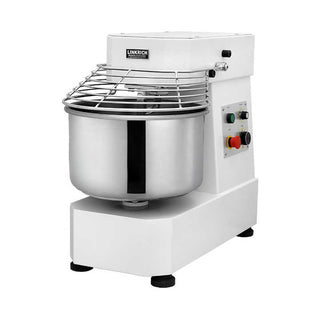
Bread and cake want different mixers, and one machine doing both does neither well. A spiral mixer works dough gently with a fixed bowl and a spiral hook, developing gluten without overheating it, which is what a real bread program needs. Our commercial spiral dough mixer comes in 20 to 50 L — size it to your largest single batch rather than your average, because splitting a batch across two mixes adds an hour to every night.
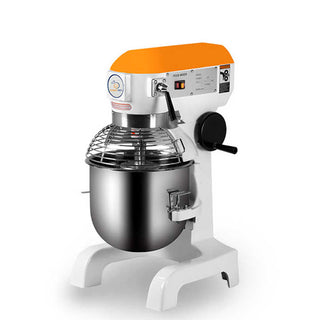
A planetary mixer is the pastry side of the room: batters, creams, meringue, icing, and light doughs, with beaters and whisks that swap in seconds. Our commercial planetary mixer comes in 10, 20, and 30 L. A cake-led bakery leans on this machine the way a bread bakery leans on the spiral, and most kitchens end up owning both — the mixer collection has the sizes between them.
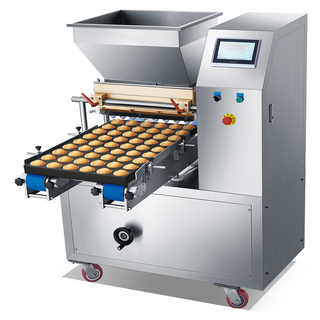
Anything portioned by hand at two in the morning is worth automating once volume grows. A depositor fills muffin cases, cookies, and cake shells to a set weight far faster than a piping bag, and with far less variation between the first tray and the fortieth. Our automatic cake and cookie filling depositor tends to pay for itself in labor hours rather than in extra output, and the prep collection covers cutters and processors for the rest.
The cold pause that moves your shift
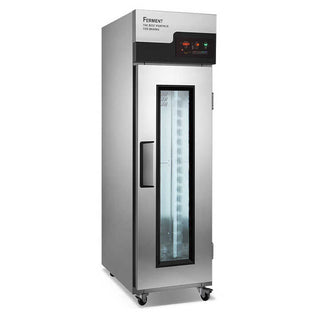
The most valuable machine in a modern bakery is the one that slows things down. A retarder-prover holds shaped dough cold overnight and then wakes it on a timer, so the dough proves while nobody is in the building and is ready to bake when the baker arrives. That one step turns an inhuman start time into a survivable one, and it improves flavor at the same time, because long cold fermentation does more for taste than anything you can add to the mix. Our refrigerated bread fermentation cabinet holds 18 trays on a programmable cycle; the proofing collection covers the range.
Ovens: heat that stays put
Bread wants stored heat and steam; pastry wants even, moving air. A deck oven bakes on stone and holds enough mass that the temperature does not collapse when a full load goes in, which is what produces crust and rise. Our commercial deck oven with a stone base comes in electric and gas, and the oven collection carries the sizes above it.
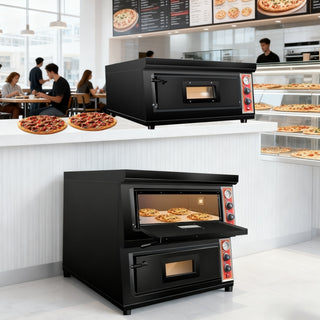
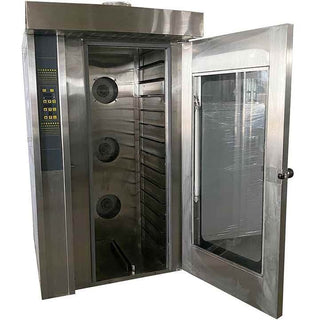
A convection oven does the other half of the work: fans move hot air across many trays at once, which suits croissants, cookies, and anything baked in volume where even color matters more than crust. Our professional convection oven is the workhorse for a mixed counter, and a combi oven earns its place if you also cook savory items for a lunch trade. Size ovens by trays per hour against your opening time, and design extraction in with them — an oven line is not something you ventilate afterward.
Between the last bake and the first customer
There is an hour between the end of production and the start of trade that most equipment lists ignore, and it is where quality is won or lost. Bread has to cool before it is bagged or it steams itself soggy. Cream products have to be chilled fast and properly or they are neither safe nor sellable.
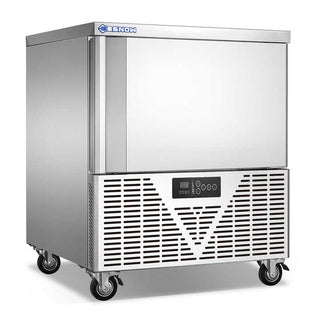
Fast chilling is what makes a pastry program possible at all. It drops just-baked or just-filled product through the danger zone in minutes rather than hours, so you can make ahead, hold safely, and stop building every day from zero. Our commercial blast freezer comes in 3, 5, and 10-tray builds, so a small kitchen can start at the bottom and scale — see the blast chilling collection.
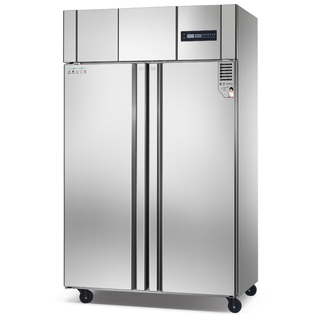
Behind it sits ordinary bulk cold storage, which bakeries under-buy constantly. Butter, eggs, cream, fillings, and pre-portioned dough all need a home that is not the display cabinet, and flour needs dry storage sized for a delivery rather than a day. A double-door upright is the usual base — our commercial double-door industrial refrigerator — with freezing capacity from the freezer collection and longer holding in the preservation range. Buy for your busiest week and for the delivery schedule you can actually get, not for an average Tuesday.
The counter: where a bakery makes its margin
Everything above this line is cost. The counter is the only part of the building that earns, and in a bakery it earns almost entirely through visibility — people buy what they can see, and they buy more of it when it looks like it was made this morning, which it was.
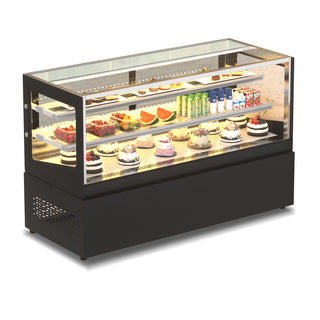
Anything with cream, custard, or fresh fruit has to sit chilled, for safety and because it will not survive a warm room. A refrigerated display keeps cakes and filled pastries cold at eye level, where the impulse decision actually happens. Our commercial refrigerated display cabinet is the standard counter unit, and the display fridge collection covers the shapes around it.
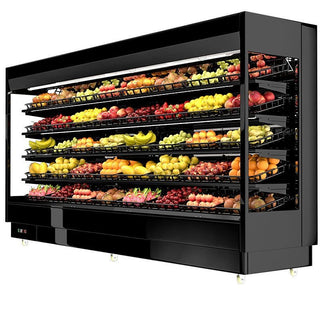
Alongside it, an open multideck sells everything you do not have to hand over: bottled drinks, sandwiches, yogurts, and grab-and-go boxes that turn a bread customer into a lunch customer. Its air curtain holds temperature with the front open, which is what makes self-serve work. Our open multideck display chiller handles that wall, and if you add coffee, the espresso range covers the machine and grinder — a bakery with decent coffee sells a noticeably higher average basket than one without.
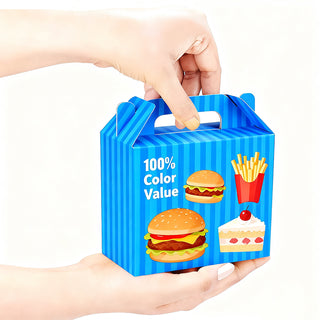
Then there is the box, which is the most under-rated marketing in the trade. A cake leaves your shop and travels to a table full of people who have never visited you, and the box is what carries your name there. Branded packaging costs little per unit and does more work than most advertising. Our custom printed gift and pastry boxes are produced to your artwork, with bags, cups, and napkins in the branded packaging collection.
What happens to what you did not sell?
This is the question that separates bakeries that last from bakeries that quietly bleed. You cannot cook to order — the flour, the labor, and the oven time are spent before you know demand — so plan the second life of the product before you open rather than after your first bad week.
Three routes work. Freeze at the right stage: part-baked bread and unbaked laminated dough both freeze well, so you produce in bigger, more efficient batches and finish daily to demand, which is exactly what the blast chiller and freezer capacity above are for. Convert: yesterday's bread becomes croutons, crumbs, or a pudding on the lunch menu, and cake becomes trifle or cake pops. Sell it as what it is: end-of-day pricing, a surplus-food app, or a standing donation arrangement — each recovers something, and none of them pretends the product is fresh.
Wholesale deserves its own thought, because it inverts the problem entirely. Supplying cafés, hotels, and restaurants means baking to a confirmed order instead of a forecast, which is the most effective waste reduction available to a bakery. It also drags in requirements retail does not have: date coding, ingredient labelling, transport, and batch consistency. If that is your direction, the packaging collection covers sealing and labelling machines, and a handheld or benchtop coding printer from the production range handles best-before dates on every pack.
How much does it cost to equip a bakery?
What you make sets what you buy, and every product line has one machine that caps output. Cost the build from your menu and find that ceiling before spending anywhere else, because everything downstream of it is capacity you cannot use.
| Product line | The line you have to build | What caps your output | Where the money concentrates |
|---|---|---|---|
| Bread-led artisan | Spiral mixer, retarder-prover, deck oven, racks | Deck area and bake time per load | Oven mass and cold retarding |
| Pastry and cake | Planetary mixer, depositor, convection oven, blast chiller, chilled display | Chilling and finishing labor, not the oven | Refrigeration from end to end |
| Bake-off café | Freezer, convection oven, display, coffee | Freezer capacity and oven cycles | Front of house and coffee |
| Wholesale | Larger mixers and ovens, packaging, coding and labelling | Batch size and delivery windows | Throughput plus packaging and compliance |
Two costs sit outside that table and outrun it. The first is labor: a bakery runs a night shift, and night hours are the largest recurring line in the business — which is precisely why a retarder-prover earns its price by moving work into machine time. The second is the building. Ovens need power or gas capacity, extraction, and floor loading; a mixer wants a dedicated circuit; a wholesale operation needs a loading route that is not your shop door. Those are lease decisions rather than purchases, and they are the ones you cannot fix later. Equipment is one line among several, with fit-out, rent, registration, and opening stock on top. Each product card carries its live price when you cost the real list.
What licences does a bakery need?
A bakery clears a shorter list than any licensed venue — there is no alcohol permission to wait on — but it carries one obligation most food businesses do not: what goes on the label. Four requirements, in the order they will hit you.
Register the food business. In the UK, register with your local council at least 28 days before trading; it is free, legally required, and followed by a Food Hygiene Rating inspection. In Australia, notify the local council as a food business and appoint a certified Food Safety Supervisor under Standard 3.2.2A, which most states have adopted — confirm yours. In the US, requirements stack by state, county, and city: a business license and EIN, a health department permit, and food-handler or ServSafe certification. In Germany, business registration sits alongside food-hygiene obligations and staff instruction under the Infektionsschutzgesetz.
Get the premises approved, extraction included. Ovens, flour dust, and heat make a bakery a heavier premises job than a café. Expect a certificate of occupancy or building sign-off, a fire risk assessment, and ventilation that a plans examiner will study closely. Flour dust is both a respiratory and, at volume, an explosion consideration, so raise it with whoever designs your extraction rather than treating hoods as a formality.
Label what you sell — the bakery-specific one. Anything you pack on site before a customer asks for it falls under prepacked-for-direct-sale rules, which in the UK since Natasha's Law require a full ingredient list with the 14 allergens emphasized on the pack itself. Australia and the US run their own allergen declaration regimes, and every wholesale pack anywhere needs a date code and an ingredient declaration. Since a bakery handles wheat, egg, milk, and nuts daily, allergen separation and labelling is a production-design problem rather than a printing task. Decide who writes the labels, and how, before you open.
Check whether the trade itself is regulated. This one catches people in Germany, where baking is a listed craft: running a Bäckerei generally requires a master qualification (Bäckermeister) or an equivalent authorization, with registration in the Handwerksrolle at the Handwerkskammer. Exemptions and alternative routes exist, so confirm your position with the local chamber before signing anything. In the US the opposite question is worth asking, because many states have cottage food laws that let a home baker trade within limits — a legitimate way to test a concept before committing to premises.
Treat all of the above as a map rather than legal advice: documents, fees, and thresholds differ by council, state, and chamber, and they change. Confirm your own list with the local authority before you commit to an opening date.
The problems that show up at five-thirty in the morning
Bakery failures are rarely dramatic. They are the same three or four frictions, repeated daily, until the margin is gone.
The first is a line that is out of balance. A mixer that needs two batches to fill one oven load, or an oven that empties faster than anyone can shape the next tray, adds an hour to every night — and that hour is paid at night rates for as long as the business exists. Before buying, walk your own production plan stage by stage with a clock, and buy to the bottleneck rather than to the brochure.
The second is a start time nobody can sustain. Bakeries lose staff to the hours more often than to the pay, and the fix is equipment rather than heroism: cold retarding, part-baking, and freezing all move work out of the small hours. A rota that only works while the head baker never gets ill is not a rota.
The third is under-buying cold. Refrigeration is what lets you produce ahead, hold safely, and stop throwing product away; a bakery with too little of it is forced to make everything fresh every single day, which is the most expensive way to run the business. The fourth is the display itself: whatever sits in it at four in the afternoon is what you look like to the customer who walks in then. Plan a smaller, well-kept counter for the last two hours rather than a half-empty full-size one — it protects the margin and the impression at the same time.
The bakery formats, and what each one changes
Shift the product and the night shift changes shape. A patisserie is a refrigeration business where the oven is the smallest decision, while a donut shop runs on a fryer and a bagel shop on a boiling kettle before anything is baked at all.
Move to service and the counter takes over: a creperie and a dessert bar cook to order in front of the guest, and an ice cream shop or frozen yogurt shop replaces the oven with freezing capacity entirely.
Working out what your production line actually needs? Tell us what you intend to bake, roughly how much of it a day, and whether the shop is the whole business or the front of a wholesale operation. We will come back with a line specced stage by stage — mixer through to display — sized so that nothing in it stands waiting on anything else.


