
Steel grade, weight and finish decide how restaurant cutlery looks after a year of dish racks. Choose 18/10 for forks and spoons, a harder steel for knife blades, and stock around three of each piece per seat.
Hold a fridge magnet against a fork from your dish pit. If it sticks, the fork contains little or no nickel, and it will show water spots and dull faster than one the magnet slides off, and it pits sooner. That quick test sorts most restaurant cutlery into two families before anyone talks about weight or design, and it explains why two sets that look identical in a photo can look very different after six months of commercial wash cycles.
Grade is the first decision. Weight and finish come next, and only after them the number of sets to order. Getting the order wrong usually means a dining room full of pretty flatware that spots in the first month.
18/10, 18/0 or 13/0: which steel should restaurant cutlery be?
For forks and spoons, 18/10 is the standard for a sit-down restaurant, and 18/0 is the budget grade for high-loss or high-volume service. The numbers give the percentage of chromium and nickel in the steel. Chromium stops rust, and nickel adds corrosion resistance and the warm, bright luster that 18/10 keeps after thousands of washes.
| Grade | Also sold as | Magnetic | Corrosion and spotting | Best use |
|---|---|---|---|---|
| 18/10 | 300-series, 304 | No, or barely | Best resistance; holds a polish | Forks and spoons for full-service dining rooms |
| 18/8 | 304 | No, or barely | Close to 18/10 | The same jobs as 18/10; the difference is small in service |
| 18/0 | 430 | Yes | Spots and dulls sooner, especially if left wet | Cafés and canteens, or venues where cutlery goes missing |
| 13/0 | 410, 420 | Yes | The weakest resistance of the three | Knife blades, because it can be hardened to hold an edge or serration |
That last row matters more than it looks. Table knives in good 18/10 sets are rarely 18/10 all through, because nickel steel cannot be hardened. The blade is usually a 13/0 steel, forged or welded to the handle, so it keeps a serration. A set sold as 18/10 whose knives stay sharp is normal; one whose knives are as soft as the spoons is a set whose knives will be bent by the first steak.
Grade also shows up in the dish pit in a way most buyers never think about. Magnetic flatware retrievers, the magnets that sit over a trash can and catch forks scraped off with the leftovers, only work on magnetic steel. With 18/10 flatware, whatever goes into the bin stays there.
Here is a set that sits in the harder, magnetic family. It is 410-grade steel with a mirror polish, 24 pieces covering six place settings, and comes in twelve colors from plain silver to black and rose gold.

For a dessert course where the pieces see less abrasion than dinner forks, the grade choice relaxes a little. This three-piece dessert set is 304 steel, the grade usually sold as 18/8 or 18/10, with a mirror polish and a bent handle.

How heavy should a dinner fork be?
Heavy enough that the fork does not bend when someone cuts a potato with its side, and balanced so it does not tip off the plate rim. Beyond that, weight is a style decision, and heavier is not automatically better.
Foodservice flatware is often sold in weight classes running from economy up to extra heavy, with medium and heavy between them. Economy pieces are thin and flex under pressure, which is fine for a canteen but reads as cheap on a white tablecloth. Heavy and extra heavy suit steakhouses and fine dining, where the weight in the hand is part of what the guest pays for. Most bistros and casual restaurants land on medium or heavy.
Weight also has costs that are easy to miss. Heavier cutlery fills a dish rack faster, makes a tray of place settings harder to carry, and goes missing more often, because a hefty, good-looking fork is the one guests slip into a bag. Before ordering a full run, ask for one sample piece of each item, weigh the fork on a kitchen scale, and hold it the way a guest would. Check that the knife and fork weigh roughly the same, since a light fork beside a heavy knife feels wrong in the hand.
Thickness at the neck, where the handle narrows toward the tines or bowl, is the other number to feel for. That is where cheap forks bend.
Mirror, satin or PVD color after a year of service
Mirror polish looks best on day one and shows every scratch by day ninety. Satin, a brushed finish with fine parallel lines, hides scratches far better, and water marks show less on it. Colored finishes, usually applied by physical vapor deposition (PVD), give gold, black or rose gold, and they need gentler handling than plain steel.
| Finish | First impression | After a year of service | Care it needs |
|---|---|---|---|
| Mirror | Bright, formal, reflective | Fine scratches and fingerprints visible under direct light | Polishing before service to remove spots |
| Satin (brushed) | Soft, matte, contemporary | Scratches blend into the brushed lines | Less polishing; water marks show less |
| PVD color | Gold, black, rose gold or two-tone | Can wear at tines and edges if washed with harsh chemicals or scoured | Mild detergent, no abrasive pads, no chlorine soaks |
| Embossed or patterned handle | Decorative, grippy | Pattern can trap residue if not washed promptly | A presoak before the machine |
Colored cutlery is where buyers get caught most often. PVD bonds a thin, hard layer to the steel and generally survives commercial dishwashers, but cheaper colored cutlery can be plated or sprayed instead, and those finishes wear through at the tips of the tines within months. Listings often name the color without naming the process, so ask the supplier directly whether the finish is PVD and whether it is rated for commercial dishwashers.
This seven-piece set shows how a mirror finish and an embossed handle combine. The pattern gives grip and hides light scratching on the handle, while the polished bowls and tines keep the formal look. It comes in black, gold or rose gold, and can be ordered in multiples up to eight sets at once.
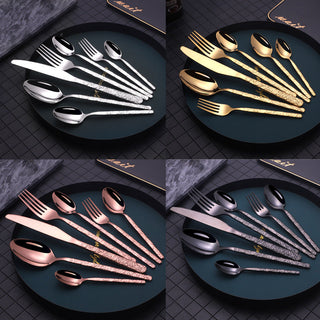
A colored dessert set is a lower-risk way to test a finish before committing a whole dining room to it. This four-piece set in 400-series steel comes in eight finishes, including dual-tone options, and sees far fewer wash cycles than dinner cutlery if it only comes out for the dessert course.

Which pieces does each cover need?
A casual restaurant sets two to four pieces per cover, while a tasting menu may need eight or more. List the menu's courses and count what each one requires, rather than buying a generic set and finding the fish course has no knife.
- Café or counter service. Table fork and knife plus a teaspoon, often laid only when the order arrives.
- Bistro or casual dining. Dinner fork and knife on the table, a dessert spoon and teaspoon brought with those courses, a soup spoon if soup is on the menu.
- Steakhouse. A dedicated steak knife in place of the table knife; our guide to knife types covers the serrated and straight-edge options.
- Fine dining. Separate pieces per course, including fish knife and fork, dessert fork and spoon, and often a butter knife, reset between courses.
Catering and banqueting add a different need, which is getting complete settings from the store room to the table without sorting. Sets packed per cover save time there. This four-piece set ships in its own mesh case and comes in twelve two-tone finishes, which suits catering kits and room service trays better than a dining room.

If the table also carries charger plates, match the metal tone of the cutlery to the charger rim, or pick a deliberate contrast. Our guide to choosing charger plates covers the table setting from the plate side.
Stocking three of each piece, plus a reserve for loss
Stock about three of each piece per seat. At any moment during service one set is on the table, one is in the wash, and one is clean and waiting, and a restaurant that stocks only two finds itself polishing forks mid-service. Teaspoons need more, often four or five per seat, if coffee or tea is served all day.
Add a reserve for loss on top of that. Forks and teaspoons go out in napkins, into trash bins and home in bags, and a replacement order six months later may not match the original if the pattern or finish has been discontinued. Buying a reserve of ten to fifteen percent with the first order is cheaper than a mismatched table later. Browse the full cutlery sets collection with that reserve in mind, and pick a pattern you expect to be able to reorder.
Washing and polishing restaurant cutlery without spotting
Most spotting starts in the dish pit rather than in the steel. Food left drying on the cutlery is one cause and chlorine-based cleaners are another, while water left to evaporate on the surface leaves the marks guests actually see. Fix those habits and even 18/0 lasts well.
- Presoak on the way in. Drop used cutlery into a presoak solution so egg and salty or acidic sauces do not dry on it. Keep the soak short; hours in water pit the steel.
- Wash loose, eating ends up. In cutlery baskets or cylinders the heads face up for the first wash so water reaches them.
- Flip for the clean side. After washing, tip the pieces into clean cylinders with handles up, so staff never touch the part that goes in a guest's mouth.
- Skip chlorine. Bleach-based sanitizers and cleaners cause pitting and can strip colored finishes.
- Dry fast. Polish with a lint-free cloth while the pieces are still warm, or run them through a cutlery polishing machine in a high-volume room. Hard water leaves marks, so a rinse aid and a water softener on the dishwasher reduce the polishing work.
The dishwasher matters here too. Our guide on how to choose a commercial dishwasher covers rinse temperature and water softening, both of which change how much polishing your staff do before each service. Plates follow similar rules, and the plates and bowls collection sits alongside the cutlery.
Laying tables for a new dining room? Send us your seat count, the courses on the menu and the look you want, and we will work out the pieces per cover, the par stock and a finish that holds up in your dish pit.


