
Two machines share one name. A commercial food processor either chops everything in a bowl or cuts shaped pieces through a feed chute. Decide which job fills your prep list, then size it in kilos per hour and pick the discs to match.
Order a commercial food processor for a kitchen that slices forty heads of cabbage a morning, and you may end up with a bowl machine that turns cabbage into wet confetti in eight seconds. Order a vegetable cutter for a kitchen that makes hummus and pesto by the tub, and you get a chute with no way to turn chickpeas into a paste. Both are sold under the same label, both run on a similar motor, and a catalog listing rarely says which of the two you are looking at.
So the first decision is about the food on your prep list and what shape it has to leave the machine in. Throughput and the choice of discs both follow from that answer.
Two machines sold under the name commercial food processor
A bowl cutter chops and purees inside a closed bowl, and a continuous-feed vegetable cutter slices, shreds or dices product that drops out into a pan. Everything else in this category is a variation on one of these, or a combination unit that carries both heads on one motor base.
| Machine | What comes out | How output is measured | Typical jobs | Where it falls short |
|---|---|---|---|---|
| Bowl cutter (vertical cutter) | Chopped, minced or pureed mass | Bowl volume in liters per batch | Pesto, hummus, curry paste, salsa, forcemeat, breadcrumbs, nut butters | Cannot make even slices or dice; overfilling gives an uneven chop |
| Continuous-feed vegetable cutter | Slices, shreds, julienne or dice, each piece the same size | Kilos per hour | Salad and slaw prep, soup vegetables, potato and onion prep | Cannot puree or emulsify; soft produce needs the right disc |
| Combination unit | Either, depending on the head fitted | Both, at smaller scale | Small kitchens with one bench and mixed prep | One motor, so one job at a time |
| Meat strip and dice cutter | Fresh meat in strips or cubes | Kilos per hour | Stir-fry strips, stew cubes, kebab prep | Fresh meat only; frozen blocks need a slicer |
Most restaurants that cook from raw produce end up owning one of each. The bowl cutter covers sauces and fillings, and the vegetable cutter takes over the volume jobs that used to occupy one cook with a knife for the first two hours of the shift.
What does a bowl cutter do that a vegetable cutter can't?
A bowl cutter breaks food down without caring about shape. Blades spin low in a closed bowl, product is thrown against the walls and falls back into them, and in a few seconds you have a coarse chop. Keep going and it becomes a paste, then an emulsion. That makes it the machine for anything blended or bound, from dips and spice pastes to falafel mix and dumpling filling.
Capacity is quoted as bowl volume, and the working load is well below it. Liquid mixes climb the walls, so a bowl only holds a fraction of its nominal liters in soup or sauce before it leaks at the lid. Dry and dense loads can go closer to the rated figure. When comparing models, ask what weight of your own product each one takes per batch rather than reading the liter number as a yield.
Large kitchens and central production units use floor-standing cutters. This one has a 32-liter stainless steel bowl, an 1,800 W motor turning the blades at 1,400 rpm, and stands 116 cm tall, so it sits on the floor next to the bench rather than on it. The maker lists meat and spices as well as produce among its jobs.

Speed matters more than people expect. A single fixed speed chops well but struggles to take a nut paste or mayonnaise-style emulsion fully smooth, and a machine run too long warms the product through friction. Pulse control, and a scraper or lid port that lets you push food down without stopping, both save minutes on every batch.
Continuous-feed vegetable cutters and the discs that decide the cut
A continuous-feed vegetable cutter pushes produce against a spinning disc and throws the cut pieces out of the front into a gastronorm pan or tub. It never stops for a batch. You keep feeding the hopper and the pan keeps filling, which is why this style is quoted in kilos per hour rather than liters.
The disc is the cut. Each disc makes one thing, so the practical question is which discs arrive with the machine and which ones you will have to order on top:
- Slicing discs in fixed thicknesses, from paper-thin for garnish up to thick slices for gratins and roasting trays.
- Shredding or grating discs for slaws and hard cheese.
- Julienne discs that cut sticks for stir-fry and papaya or kohlrabi salads.
- Dicing grids, which work together with a slicing disc. The disc cuts a slab and the grid pushes it through into cubes. Dice size is set by the grid and the slice together.
Here is a bench model that ships with a starter set of discs: 2 mm and 4 mm slices, a 3 mm shred and an 8 × 8 × 8 mm dice. It is rated at 300 kg/h on a 750 W motor, runs on 110–240 V and takes 580 × 385 mm of bench. The round hopper suits whole onions and potatoes.
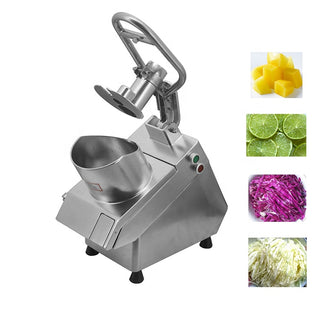
Hopper shape changes how fast a cook can load. A wide, half-moon hopper swallows a whole cabbage or a handful of potatoes at once. A narrow tube keeps long produce such as cucumbers or leeks upright, so each slice comes off as a clean round instead of an oval. Busy salad kitchens often want both.
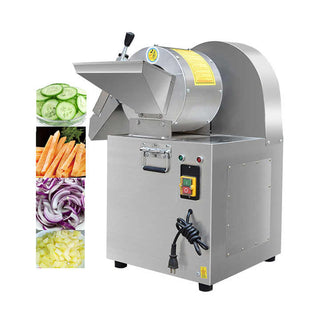
When the job moves from a restaurant to catering volumes, a heavier floor unit takes over. This cutter comes in two sizes. The 300 kg/h model runs on a 1.5 kW motor with a 53 × 38 × 70 cm footprint on 220 V, and the 500–800 kg/h model has a larger drive and also runs on 380 V three-phase. Both slice, dice, shred and cut julienne. The listing does not give disc sizes, so confirm the cut range for your menu before ordering.
How many kilos an hour does your prep list need?
Work out the weight of raw produce you cut on your heaviest day, then divide by the time you are willing to give it. A kitchen that dices 25 kg of onion and carrot and slices 15 kg of cabbage needs 40 kg of cutting. On a machine rated at 300 kg/h that is under ten minutes of machine time. Real throughput is lower than the rating, because loading and swapping discs take time, but the gap between a knife and a machine is large enough that most restaurants are nowhere near the limit.
Ratings start to matter in catering and in central kitchens that prep for several menus. At that scale, the time lost to changing discs and cleaning between products becomes the bottleneck, and a second machine set up for a different cut can beat one faster machine.
For bowl cutters, the sum is per batch. If one batch of paste takes a few minutes including loading and scraping, count how many batches a day your menu calls for and whether a larger bowl would cut that number or just leave half the bowl empty.
Can one commercial food processor handle meat and vegetables?
Some can, within limits. Machines built with interchangeable cutting heads and a stronger motor will slice and shred fresh meat as well as firm vegetables. Fresh meat has to be well chilled to cut cleanly, though, and frozen blocks belong on a slicer.
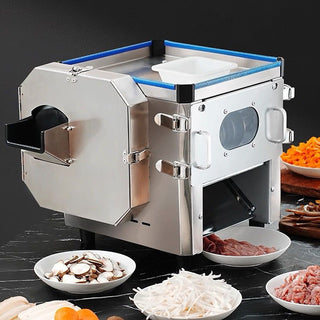
This cutter shows the split in its own ratings. On one 850 W motor it is rated at up to 400 kg/h for meat and 150 kg/h for fruit and vegetables, with optional knife sets in seven thicknesses from 2.5 mm to 21 mm. Its footprint is 46 × 46 cm and it stands 38 cm high, small enough for a deli counter or a noodle kitchen that cuts pork for stir-fry.
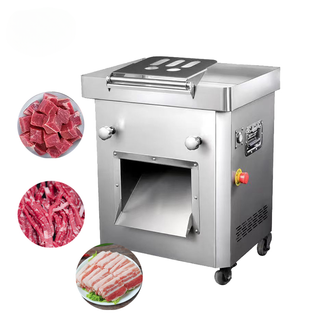
For kitchens where meat prep is the main job, a dedicated machine with a wider inlet saves trimming time. This one takes cuts through a 270 × 100 mm feed inlet and adjusts from roughly 2.5 mm to 50 mm, so the same unit covers thin strips and stew-sized cubes. It has a 2,200 W motor and comes in 220 V or 110 V versions.
Sharing one machine between meat and produce means planning the cleaning between them as seriously as the cutting. Allergen and cross-contamination rules in most markets expect a full strip-down and sanitize between raw meat and ready-to-eat vegetables. For frozen blocks of meat, and for thin-sliced meats for hot pot, look at the meat and food slicers instead. For mince, the meat grinders do the job better than a bowl.
Cleaning and guarding a prep machine
The machine that is quickest to take apart gets used, and the one that takes fifteen minutes to clean gets skipped in favor of a knife when the team is short. Before buying, check which parts come off without tools, whether the bowl and discs are dishwasher safe, and whether the motor base has gaps where food collects.
Guards and interlocks are not optional in a commercial kitchen. A proper machine stops when the hopper or lid is opened and will not restart until it is closed again. In the EU, look for conformity with the Machinery Directive (2006/42/EC), which the bench vegetable cutter above carries. Check the equivalent marking for your own market.
Plan the space around the machine as well as under it. A vegetable cutter needs room in front for the pan that catches the output and room above for loading, which rules out some shelves under a wall cupboard. Floor-standing bowl cutters need a clear path for the bowl to tip or lift out. A stainless prep table at the right height is part of the purchase, not an afterthought.
Matching the machine to the menu
The menu tells you which machine to buy first:
- Plant-based and vegetable-led kitchens usually need both on day one. The bowl cutter runs patties and dips, while the vegetable cutter handles salads and roasting trays.
- Salad bars and sandwich shops get more from a bench vegetable cutter with a good set of slicing and shredding discs than from a bowl.
- Curry kitchens and taquerias that make pastes and salsas daily should start with a bowl cutter sized to the largest daily batch.
- Catering and central kitchens should size by the heaviest day of the year, then consider two machines so one cut can run while the other is cleaned.
For the rest of the prep area, the food prep range groups cutters with mixers and slicers, and our overview of commercial kitchen equipment covers what sits around them. If your prep ends in a vacuum bag for the next day's service, see vacuum packaging for kitchens. For dough rather than vegetables, the comparison of planetary and spiral mixers is the better place to start.
Every machine above sits in the food processors and cutters collection.
Not sure whether your prep list needs a bowl, a chute or both? Send us the ten items you cut most, with rough weights per day, and we will suggest a machine and the discs to go with it.


