


In short: size a commercial juicer to your busiest hour. Citrus presses carry orange juice, cold press juicers handle greens and ginger, and centrifugal machines suit mixed menus. Then check cleaning time and yield.
At 7:40 on a weekday there are nine people in line, and seven of them want the same large orange juice. Whether that line clears in six minutes or twenty depends on a commercial juicer bought months earlier, usually on the strength of a motor rating that has little to do with how fast juice reaches a cup.
Three things decide it instead. How the machine breaks down fruit sets what it can handle and how much juice it gets out. How quickly it can be fed and emptied sets real throughput. And how long it takes to strip and wash sets whether staff will run it at 3 p.m. or leave it dirty until close.
Which type of commercial juicer does what?
There are three working families behind a juice counter, plus a couple of specialist machines. Each one is good at a narrow job, and the usual mistake is asking one of them to do all the others' work too.
| Type | How it extracts | Speed | Best produce | Juice character | Cleaning |
|---|---|---|---|---|---|
| Citrus press | Halves and squeezes whole fruit | Fast; the one below is rated at 23 oranges a minute | Oranges, lemons, limes, pomegranates | Clean, pulpy, little foam | Blades and cups lift out; acid-proof steel helps |
| Centrifugal | Grating disc spins produce against a mesh basket | Fast; up to 2800 rpm on our model | Carrot, apple, beet, celery, mixed fruit | Thin, some foam, separates if it sits | Basket mesh clogs with fiber; quick-release parts |
| Cold press (slow, masticating) | Screw or twin gear crushes and squeezes | Slow; 38 to 150 rpm across one range | Ginger, greens, apple, hard roots | Dense, deep color, holds better in the fridge | More parts; the screen needs a brush |
| In-fruit probe | Blends the flesh inside the rind | Seconds per fruit | Oranges, pineapple, watermelon | Pulpy, served in the fruit | Rinse the probe and blade |
A juice bar with a real menu ends up with two of these, not one. A café that sells orange juice at breakfast and nothing else needs only the first.
Citrus press
An automatic citrus juicer is the machine behind the breakfast queue. You load whole oranges into a hopper, it cuts and presses them and pours continuously, and nobody on staff has to hold a halved orange over a reamer. Our automatic model is rated at up to 23 oranges a minute with a 40 to 50% juice yield, takes fruit 40 to 80 mm across and runs on a 120 W motor. It stands 889 mm tall, so check the clearance under any shelf above the counter before it arrives.
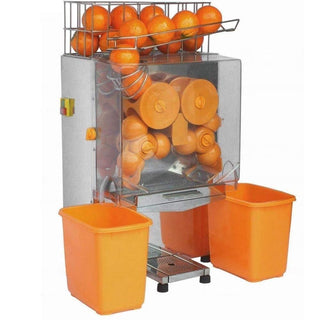
What it will not do is anything that is not round and juicy. Apples and carrots need a different machine, and so do greens, and a citrus press is a poor buy for a menu where orange juice is one line out of fifteen.
Centrifugal juicer
A centrifugal juicer is the generalist. A flat grating disc shreds whatever you drop down the chute, and the spinning basket throws juice through a fine mesh while the pulp is ejected to a separate bin. Our 304 stainless steel model runs a 370 W motor to 2800 rpm with two speed settings, one for soft fruit and a faster one for dense roots such as carrot or beet, and the manufacturer rates it at roughly 80 to 100 kg of fruit an hour. At 340 by 270 mm it fits on an ordinary back counter.
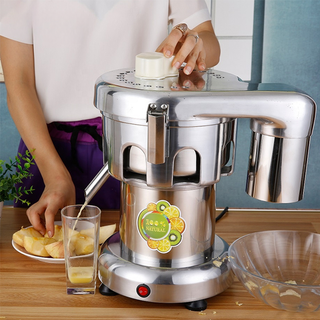
The speed costs something. Fast grating whips air into the juice, so a centrifugal glass has a foam cap and starts to separate within minutes. For drinks made and handed over straight away that hardly matters. For anything bottled or batched ahead, it does.
Cold press juicer
A cold press juicer, also sold as a slow or masticating juicer, turns a screw or a pair of gears at a few dozen revolutions a minute and squeezes produce rather than shredding it. Less air and less heat go into the juice, which is why cold-pressed juice keeps its color longer in a bottle and why ginger and kale come out as juice rather than wet fiber.
The range we carry runs from compact 300 W and 500 W counter units turning at 38 rpm up to 4 kW production machines at 150 rpm. The difference that matters most for sizing is the duty cycle. The two smallest models are rated for up to two hours of continuous running followed by a ten-minute pause; from the 1200 W model up, the rating is 24 hours continuous. The 1500 W and larger versions need a 380 V three-phase supply, which many small retail units do not have, so ask your electrician before you choose the model.

In-fruit probe juicer
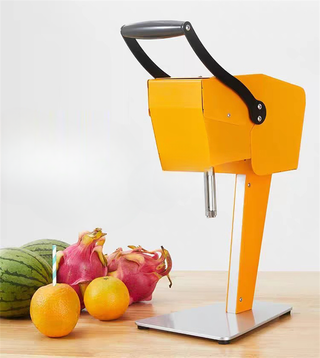
The in-fruit juicer is a presentation machine. A probe pierces a whole orange, pineapple or watermelon and blends the flesh inside, and the guest drinks from the fruit. It runs on 50 W, needs no cup, and suits beach bars, hotel pool service and events far better than a morning rush. Treat it as a menu item with its own price, not as your main juicer.
How many liters per hour does the morning queue need?
Work backward from your busiest hour. Count the juices you expect to sell in it, multiply by the cup size, and you have the liters the machine and the person feeding it have to produce. Sixty large orange juices at 350 ml between 7:30 and 8:30 is 21 liters.
Then turn liters into fruit. At a 45% yield, 21 liters of orange juice needs roughly 47 kg of oranges, which is somewhere around 230 to 260 medium fruit depending on size. That figure is the real sizing problem. On paper the citrus press above handles it with room to spare, since 23 oranges a minute is about five large glasses a minute. In practice the limit is the hopper, the peel bin and the person restocking both.
A few rules of thumb that hold up behind a real counter:
- Plan for peak output at about half the rated figure. Loading fruit and handing over cups eat the rest.
- Keep the peel or pulp bin large enough to last the whole rush. Stopping to empty it at 8:05 is where queues collapse.
- For cold press menus, press the base juices before opening and use the machine during service only for the drinks that must be fresh. A slow juicer cannot keep up with a queue drink by drink, and it is not designed to.
- If the rush runs longer than two hours, a compact slow juicer with a two-hour duty rating is the wrong size, however well it handles ginger.
For a smoothie-led menu the arithmetic moves to the blender, and our bar blenders are sized by jug volume and motor rather than by fruit per minute.
Cleaning between shifts decides which machine staff actually use
A juicer that takes a long time to strip gets cleaned less often than it should, and fruit sugar left in a screen or basket ferments quickly at room temperature. Before buying, find out how many parts come off, whether they come off without tools, and whether they fit in your sink.
Citrus presses are the most forgiving. The pressing cups and blades lift out and rinse clean, and the acid-resistant 304 steel on our model tolerates daily washing. Centrifugal machines have one weak spot, the mesh basket, which clogs with fiber from carrot and celery; a stiff brush and a soak are part of every close-down. Cold press juicers have the most parts, typically the screw or gears plus a screen and a housing, and fibrous produce packs into the screen if it is not brushed out after each batch.
Time the whole process once on a trial day and write the number down. If it is longer than the quiet window between your morning and lunch trade, you will either need a second set of parts, a second machine, or a menu that moves the fresh-pressed items to one part of the day. The self-cleaning cycle on our automatic fresh orange juice vending machine is one reason unattended juice works at all: it squeezes each order in about 45 seconds, holds 300 to 600 oranges chilled at 5 to 10 °C, and sanitizes itself with ozone.
Yield and waste, weighed rather than guessed
Yield is the share of the fruit's weight that ends up as juice. It sets your cost per glass more than anything else about the machine, and it varies with the produce and the season, and with the type of press.
The honest way to compare is a weigh test. Weigh a batch of the produce you will actually buy, run it through, weigh the juice and the pulp. A citrus press quoted at 40 to 50% is at the low end with small, thick-skinned winter oranges and at the high end with thin-skinned juicing fruit, which is why buying the right orange can matter as much as buying the right machine. With apples and carrots, slow presses usually leave a drier pulp than centrifugal machines, and damp pulp is juice you paid for and threw away.
Waste has a second cost besides the lost juice. A citrus press working through 47 kg of oranges an hour produces well over half that weight in peel, and that peel needs somewhere to go: a bin that fits under the machine, a route to the back door, and a collection contract sized to it. Pulp from carrot and apple is denser and wetter. Some venues use it in muffins or give it away as compost, but plan the bin before planning the reuse.
Matching a commercial juicer to the counter
| Venue | What it sells | Main machine | Second machine |
|---|---|---|---|
| Café or bakery | Orange juice at breakfast | Automatic citrus press | None needed |
| Juice bar, fresh to order | Citrus plus green and root juices | Citrus press | Cold press with a 24-hour duty rating |
| Juice bar selling bottles | Pressed juice in chilled bottles | Larger cold press, pressed in batches | Citrus press for the counter |
| Smoothie café or gym bar | Blended drinks with some juice | Centrifugal juicer | Commercial blender |
| Hotel breakfast | Self-serve juice | Citrus press used before service | Chilled bowl dispenser |
| Office, station or campus | Juice with no staff | Fresh juice vending machine | None |
Hotels usually press in the kitchen before breakfast and serve from a chilled dispenser. Our six-bowl juice dispenser holds 10 liters per bowl at 7 to 12 °C, and the rest of the range sits in self-serve drink dispensers. Unattended sites have a separate shelf in vending machines and kiosks.
Two purchases tend to disappoint. The first is a slow juicer bought for its juice quality and then expected to serve a queue drink by drink. The second is a centrifugal machine bought for speed and then used to fill bottles that turn brown and separate on the shelf by the afternoon. Both are good machines put in the wrong job. The full line-up is in our commercial juicers collection.
Not sure which press your menu needs? Send us your busiest hour, the drinks on the board and your power supply, and we will suggest a juicer and a backup that fit the counter.


