


In short: how to open a buffet restaurant is a replenishment problem. A guest's opinion of your food is formed by the tray in front of them, and that tray is only as good as the last time somebody filled it. Small pans refilled often beat large pans held for hours — on quality, on waste and on the records an inspector asks for.
A restaurant plates to order. A buffet plates to a guess, hours in advance, and then keeps guessing all evening. That is the whole difficulty of the format and the thing most first-time operators solve backwards.
The instinct is to fill the line generously, because an abundant buffet is the promise the format makes. What abundance actually produces is food that has been sitting: dried edges, a skin on the sauce, rice that has gone tight — none of it unsafe, all of it visibly tired, and all of it thrown away at close.
Small pans, refilled often
The counter-intuitive core of a good buffet is that the pans should be smaller than the space allows.
A half-size pan refilled four times looks fuller more of the time than a full-size pan emptied once, because a shallow pan looks generous when it is half gone and a deep one looks picked-over. It holds for less time, so the food is closer to when it was cooked. And when a service ends, what is left over is a smaller quantity.
The cost is labour: somebody has to be watching the line and walking to the kitchen. That person is not overhead, they are the product — a buffet with nobody minding it is a buffet that degrades from the first hour.
This one decision cascades. It sets the pan sizes you buy, the number of gastronorm inserts, the size of your production batches, and the layout of the pass so that a refill is a short walk rather than a journey.
The kitchen produces in waves, not in a service
A buffet kitchen has an unusual rhythm. There is a large production block before opening, then a sequence of small batches through service, then nothing.
That suits a combi oven better than almost any other appliance, because it cooks the bulk and then regenerates small quantities back to temperature without drying them — steam is the difference between a refilled tray and a reheated one.
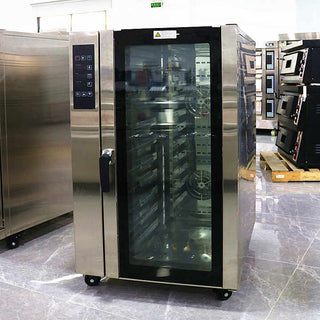
It also means the kitchen needs less burner width than a restaurant of the same covers and more oven and holding capacity. Specify against the batch plan rather than against the cover count, and the equipment list comes out noticeably different from an à la carte kitchen of the same size.
Hot holding runs on wet heat and a clock
Food on a buffet has to stay above a safe temperature — commonly cited as 63 °C in the UK and Europe and 57 °C in much of the US — and the method matters as much as the number.
A bain marie surrounds the pan with hot water, so the food holds at temperature without a hot dry surface cooking it further. That is why almost every serious buffet line is wet-heat, and why the dry-heat lamp is a garnish rather than a system.
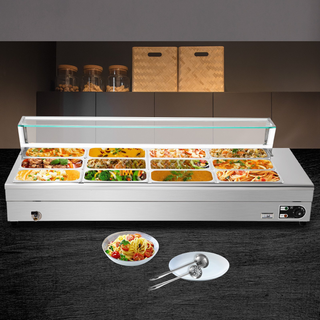
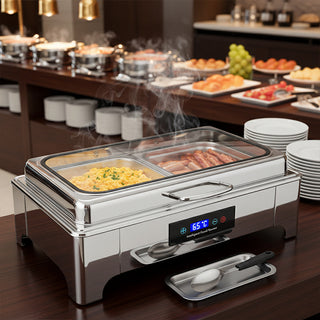
Chafing dishes do the same job with no plumbing, which is what makes them the format for a mobile or extendable line, and electric versions hold far more accurately than fuel gel.
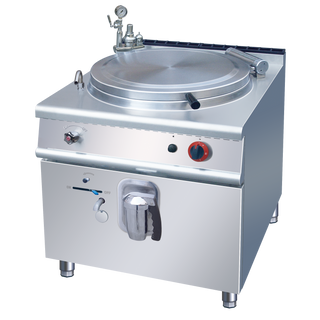
Soups and sauces are their own case: a jacketed kettle holds a large volume at an even temperature without a hot spot at the bottom, which is what stops a soup reducing itself into something saltier over four hours.
Where the food is the display — carvery, roasts, anything that sells by being visible — a heated showcase does the holding and the merchandising at once.
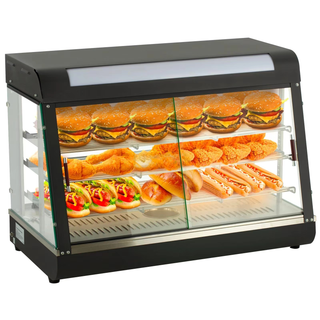
The clock matters as much as the equipment. Most regimes allow a limited window for food held outside temperature control and require records for food held within it; the practical discipline is that a pan has a time written on it and is discarded rather than topped up when that time is reached.
Cold on the line is harder than hot
Everyone plans the hot side. The cold side is where buffets actually fail inspections.
Salads, desserts, cut fruit and anything dairy have to stay below their limit — 8 °C in the UK, 5 °C in many other regimes — in an open display in a warm room full of people. That is a genuinely difficult thermal environment, and a cold well that holds at four in the morning may not hold at eight in the evening with the room at twenty-six degrees.
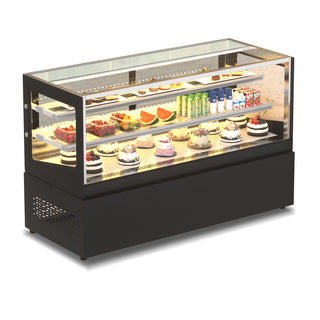
Two things fix most of it: buy refrigerated display with real capacity rather than a passive ice bed, and — the same rule as the hot side — use small vessels refreshed often rather than large ones sitting out.
What the public does to a line
A buffet is a food-safety regime with a dining room attached, and the risk is not the cooking. It is a hundred strangers with serving utensils.
The requirements are consistent across markets. A sneeze guard over every open food surface, positioned for the height of an average adult. Separate serving utensils per dish, with handles kept out of the food and changed on a written schedule. Clean plates for return visits, which is both a hygiene rule in several jurisdictions and the single most effective one. And a member of staff whose job includes watching the line rather than only refilling it.
Allergens are the awkward one, exactly as they are in a self-serve topping bar: cross-contamination between adjacent dishes is inevitable within minutes of opening. You cannot prevent it — you label clearly, keep the highest-risk items separated, and have accurate written information available for every dish.
Waste is the format's whole margin question
Price is fixed per head, so revenue is a function of covers and cost is a function of what you produce. Everything left on the line at close is margin that never existed.
Three levers, in order of effect. Pan size and refill discipline, which is the small-pans rule above. Batch sizing that tapers through service, so the last hour is produced in quarter batches rather than the same batch as the first. And menu design, where the expensive items are portioned or served by a staff member at a carvery point while the cheap, high-volume items are freely accessible.
The last one is where operators get squeamish, and it is entirely standard: a served station for the protein is not meanness, it is what lets the rest of the buffet be genuinely generous.
Flow: one line or islands
A single long line is simple and produces one queue that stalls at whichever dish is most popular. Islands — separate stations for salad, hot dishes, carvery, dessert — cost more floor space and remove the stall by letting guests take a different order.
Islands also make refilling easier, because staff can reach a station without crossing a queue. For anything above about eighty covers the island layout is worth the space, and below that the single line is usually fine.
One detail that decides more than the layout: plates at the start, and nowhere else. A guest who can pick up a clean plate mid-line will, and it doubles your crockery consumption for no benefit.
The dish pit is a station, not a corner
Buffets generate more crockery per cover than any other format, because return visits mean new plates. A hundred covers can easily be three hundred plates plus cutlery, in bursts.
That pushes warewashing past the pass-through machine that would serve a restaurant of the same size. A conveyor or tunnel machine takes racks continuously, so throughput is limited by hands rather than by cycles — which is exactly the shape of a buffet's dish load.
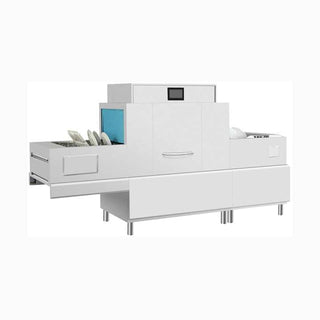
Plan the space as a line — soiled in one end, clean out the other — rather than a machine in a corner. We went through the sizing arithmetic in undercounter, hood or conveyor.
How to open a buffet restaurant: where the money goes
The service line is the item an à la carte restaurant does not buy at all: wells, guards, displays, the counters they sit in. It is a substantial number and it is fixed regardless of how busy you are.
The kitchen is cheaper per cover than an equivalent restaurant, because production is batched rather than plated to order. The dish pit is more expensive. Staffing is differently shaped: fewer chefs, more people on the floor keeping the line right.
The number that decides viability is average covers against the fixed cost of running the line. A buffet at 40 per cent capacity is losing money on food it produced for people who did not arrive — which is why the format lives or dies on predictable volume rather than on peak nights.
Licences, plus the rules the buffet adds
United States. Health department permit and food-handler or manager certification, plus a certificate of occupancy. Self-service is addressed directly in most state food codes: sneeze guards, utensil handling, and in many states a requirement for clean tableware on return visits. Time and temperature control for held food is documented, and the log is what gets inspected.
United Arab Emirates. A trade licence with F&B activity and eligible zoning, Dubai Municipality inspections covering ventilation and food handling, Civil Defence clearance, and health cards for every food handler. Buffet service is common and correspondingly well-scrutinised, particularly around holding temperatures during long service periods.
United Kingdom. Register the food business with the council at least 28 days before opening, then the hygiene inspection and Food Hygiene Rating. Hot holding at 63 °C or above and chilled at 8 °C or below, with limited exceptions for food out of temperature control for a defined period — and allergen information available for every dish on the line.
Australia. Council premises approval and food-business notification, a Food Safety Supervisor in most states, and the food standards code's requirements on temperature control and self-service display, which are checked at inspection.
Across all four, the document that matters is the temperature log. It is the difference between a line that is safe and a line that can be shown to be safe.
What breaks in month two
The pans got bigger. Somebody decided refilling was taking too long, the line went to full-size inserts, and the food started looking tired by eight o'clock.
The last hour is produced like the first, so closing waste is the same every night and nobody has connected it to the batch plan.
And the temperature log has gaps, filled in retrospectively at close. That is worse than not keeping one, because it is the record an inspector will ask to see and it will not survive a question about who wrote it and when.
Working out the service line and the kitchen behind it? Tell us your cover target and whether you want a single line or islands, and we will spec the hot and cold holding, the production kit and the dish pit together.


