


In short: size an ice machine by your busiest two hours, not your daily total. A countertop ice machine covers a coffee counter or a small kitchen; anything with a bar on it needs undercounter production plus a bin that carries the peak.
Ice does not run out gradually. It runs out at 21:40 on a Saturday, in the middle of the busiest ticket run of the week, and the bar spends the next forty minutes serving warm drinks while someone drives to a petrol station. Every operator who has lived through it sizes the next machine differently.
The mistake behind it is almost always the same: the machine was chosen against a daily figure. Daily output is what the spec sheet advertises, but a venue does not consume ice evenly across 24 hours. It consumes it in two or three concentrated bursts, and what carries those bursts is production plus whatever is sitting in the bin when they start.
How much ice does a venue actually use?
Plan on roughly 0.5 to 1 kg of ice per cover per day in a restaurant, and closer to 1.5 kg per head in a bar where most drinks are iced and glasses get chilled. Blended and frozen drinks push that higher again. These are planning figures rather than guarantees, but they are close enough to size against.
| Venue | Typical daily need | Sensible class |
|---|---|---|
| Coffee counter, small café | Under 25 kg | Countertop |
| Bistro, 40–60 covers | 40–80 kg | Undercounter |
| Bar or restaurant, 80–150 covers | 80–150 kg | Modular with bin |
| High-volume bar, club, hotel F&B | 200 kg and up | Modular, 400 kg class |
Then apply the peak correction. If two thirds of your ice goes out between 19:00 and 23:00, the machine has four hours to deliver what it advertises over 24 — it cannot. The bin is what closes that gap, which is why bin capacity is a specification and not an accessory.
Is a countertop ice machine enough?
For a coffee counter, a juice bar or a small kitchen that needs ice for service rather than for drinks, yes. A countertop ice machine producing 20–30 kg a day runs off tap or bottled water, draws around 110 W and sits on a bench without plumbing work. That is the entire appeal: no install, no drain line, no capital project.
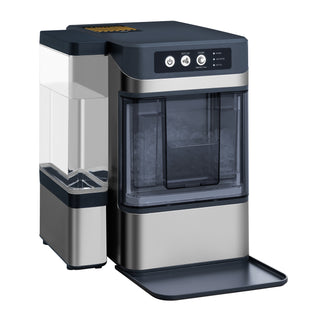
Where it stops working is the bar. A countertop machine has almost no storage, so it is producing into demand rather than ahead of it, and the first busy hour empties it. If ice goes into drinks you sell, the countertop class is a backup machine or a second point of service — not the primary source.
Past the countertop ice machine: undercounter and modular
Undercounter machines are the workhorses of mid-size venues: production and storage in one cabinet that fits under a back bar. A 68 kg/24h unit with 15 kg of storage covers a bistro comfortably, and the better ones offer both water-cooled and air-cooled condensing plus automatic defrost, so you are not locked into one install situation.
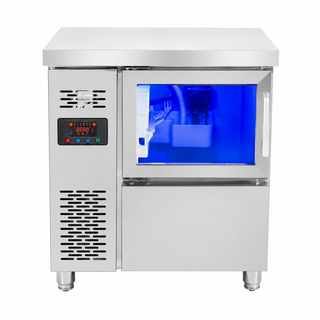
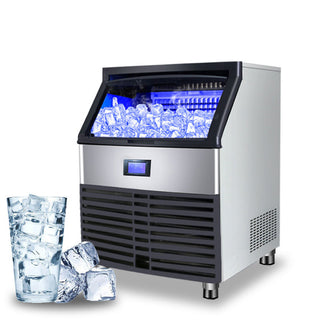
Above roughly 100 kg a day the format changes. Production heads sit on top of a separate bin, which lets you size the two independently — the same head over a bigger bin buys peak capacity without buying more production. An air-cooled cube machine in the 80–120 kg/24h band is the common step up for a busy bar.
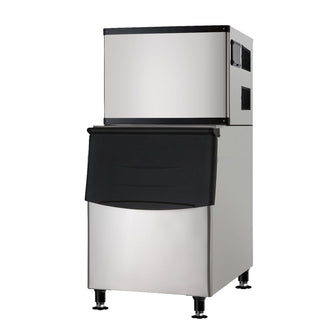
At the top end, a 450 kg/24h machine with a 125 kg bin and 22 mm cubes is hotel and nightclub territory. What matters at that scale is less the headline number and more the condenser choice and the compressor behind it, because both decide whether you get the rated output in August.
Ice shape changes the drink
Shape is not cosmetic. It sets how fast the ice melts, how much it dilutes, and whether it works in a blender or a display.
| Shape | Melts | Use it for |
|---|---|---|
| Full cube, ~22 mm | Slowly | Spirits, highballs, anything served long |
| Half cube | Moderately | Soft drinks, dispensing, ice wells |
| Nugget | Quickly | Chewable ice, soft drinks, iced coffee |
| Flake and snow | Fastest | Seafood display, bingsu and dessert, chilling |
Nugget ice is the one that surprises people. It is soft enough to chew, which makes it popular in iced coffee and soft drinks, but it melts fast and dilutes a spirit — good behind a café counter, wrong on a cocktail bar.
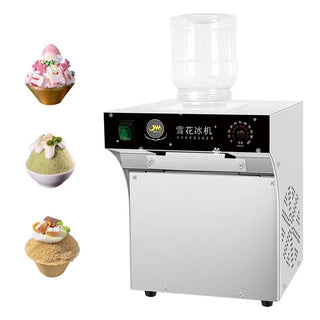
Flake and snow ice is a different job entirely. A snowflake machine turning out 90 kg a day on a roughly three-second cycle exists to fill a seafood display or to build bingsu, not to fill glasses.
Air-cooled or water-cooled?
Air-cooled is the default: no water line to the condenser, lower running cost, simpler install. It pays for that with heat and noise dumped into the room, and with output that falls as ambient temperature climbs. In a hot kitchen or an unventilated back bar, an air-cooled machine in August is not the machine you tested in March.
Water-cooled condensing holds output in high ambient temperatures and runs quieter, at the cost of continuous water use and a second connection to maintain. Choose it when the machine sits somewhere hot, enclosed, or acoustically sensitive — and check the local water charge before committing, because it is the running cost people forget.
Either way, the machine needs a drain, and it needs clearance around the condenser. Ice machines boxed into tight joinery are the most common cause of an underperforming unit that is otherwise faultless.
What the output figure does not tell you
Rated production is measured under laboratory conditions — moderate ambient temperature and cool incoming water. Real kitchens are warmer than the test bench and the mains water is warmer in summer, so the number on the sheet is a ceiling rather than an expectation. Size with headroom rather than to the exact figure.
Water quality is the other omission. Hard water scales the evaporator, and a scaled evaporator produces cloudy ice slowly before it fails early. A filter is cheaper than the service call, and machines with automatic defrost and self-cleaning cycles reduce, but do not remove, that maintenance.
Ice production is also the largest single electrical load behind many bars. Look at the power draw alongside the output when you compare two machines with the same headline figure — the gap between them is a running cost you carry every day the venue is open.
Mistakes that cost a service
- Sizing to the daily total. The peak two hours are what the machine has to survive.
- Treating bin capacity as optional. Storage is what carries a burst; production alone never does.
- One shape for every drink. Nugget in a spirits glass dilutes it; cube in a seafood display does nothing.
- Boxing an air-cooled machine into sealed joinery. It will underperform its rating and fail early.
- Skipping water treatment. Scale is the most common reason an ice machine dies before its time.
If you are specifying from scratch, start from the peak hour, pick the class, then choose the ice shape your drinks list actually needs. The ice makers range covers countertop through to the 450 kg class, and the wider ice and chilling section covers what sits around it.
Not sure what your peak hour needs? Tell us the covers, the drinks list and where the machine has to sit, and we will size it against your actual service rather than a daily average.


