

In short: a commercial coffee machine is chosen by drinks per hour and by who makes them. Traditional espresso needs a barista and rewards one; bean-to-cup removes the barista and caps the ceiling. The grinder and the water supply decide quality more than either.
At 8:15 the queue is eleven people deep. The barista pulls two shots, steams a jug, wipes, purges, and starts again. Somewhere in that loop is the constraint — and in most cafés it is not the machine.
It is usually the grinder, the milk fridge behind the barista, or the single person doing all of it. Which is worth knowing before spending several thousand on a bigger espresso machine that will not shorten the queue by a minute.
What actually decides which commercial coffee machine you need?
Peak drinks per hour, and whether a trained person is making them. Café size, seat count and floor area are proxies that mislead — a twelve-seat kiosk on a station concourse outsells a fifty-seat room in a quiet high street by a factor of three.
| Format | Peak drinks/hour | Machine | Staffed by |
|---|---|---|---|
| Office, small hotel lobby | Up to ~30 | Bean-to-cup, one hopper | Nobody — guests self-serve |
| Small café, bakery counter | ~40–60 | 1-group traditional or bean-to-cup | One person, coffee is part of the job |
| Specialty café, busy high street | ~100–150 | 2-group traditional, dual boiler | Dedicated barista |
| Station, drive-through, high volume | 200+ | 3-group, or 2-group plus batch brew | Two on bar, one on till |
| Self-service retail, forecourt | Variable, unattended | Self-service bean-to-cup, dual hopper | Nobody |
Work from the top row down. Buying a 3-group for a room that peaks at 60 drinks means paying for water and power you never use, in a footprint that eats the counter you needed for milk.
Bean-to-cup or traditional espresso?
This is the real fork, and it is a staffing decision disguised as an equipment one.
Traditional espresso puts the variables in a person's hands: dose, tamp, extraction time, milk texture. A trained barista makes better coffee on a traditional machine than any automatic will produce, and an untrained one makes worse. It also takes longer to train than most owners expect and the quality walks out of the door when the barista does.
Bean-to-cup removes the person. The machine grinds, doses, tamps, extracts and — on milk models — textures automatically, drink after drink, identically. The ceiling is lower, particularly on milk texture, but the floor is much higher, and the floor is what a hotel lobby at 6 a.m. actually needs.
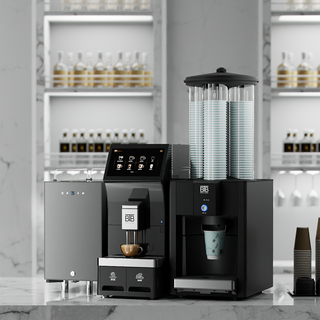
A touchscreen bean-to-cup with recipe presets covers a menu that would otherwise need training: each drink is a button, and the fifth flat white of the shift matches the first. For sites where coffee is a service rather than the product — hotels, offices, clinics, bakeries where the counter staff are also serving food — this is almost always the right answer.
Where the built-in format matters more than the free-standing one, a machine that drops into the counter keeps the sightline across the bar clear.
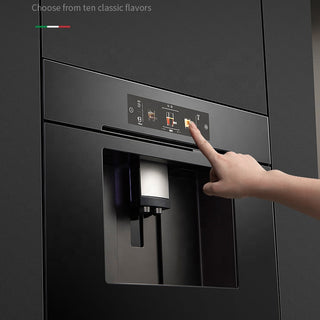
For unattended sites, the self-service format goes further: dual bean hoppers for two coffee profiles, and no assumption that anyone is standing behind it.
How many groups does a café counter need?
A group head is one simultaneous extraction. Two groups mean two shots at once, which in practice means a barista can pull for the next order while finishing the current one.
As a rule of thumb, one group serves up to around 50 drinks an hour, two groups take you to 100–150, and three are for the sites that measure output in hundreds. Above that the machine stops being the limit and the person becomes it.
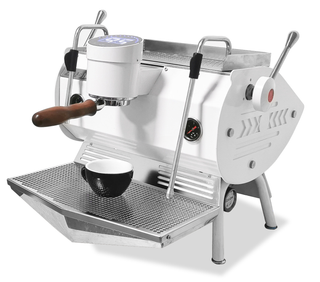
The dual-boiler layout is what makes a two-group hold up under pressure. One boiler holds brew water at extraction temperature; the other makes steam. On a single-boiler or heat-exchanger machine, steaming and extracting fight each other, and the sixth cappuccino in a row comes out cooler than the first.
For rooms that genuinely run at volume, the three-group is a different class of machine — more steam capacity, more recovery, and usually a power supply decision as much as a purchase decision.
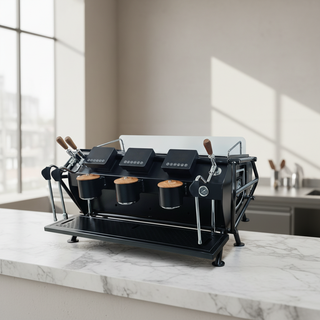
Worth checking before you order: a two-group typically wants a dedicated circuit, and most three-group machines expect three-phase power. Finding that out during fit-out is far cheaper than finding it out on delivery day. The full espresso machines range covers one-group through three-group builds.
Ignore the bar number on the box
Listings advertise 15, 19 or 20 bar. Espresso is extracted at about 9 bar, and it has been for decades — the higher figure is the maximum the pump can produce, not the pressure at the coffee. Machines with any competence regulate down to the working pressure regardless of what the pump is rated for.
What is worth reading on the spec sheet instead: boiler capacity, whether the boilers are separate, recovery time, and the steam wand count. Those numbers describe what happens during a rush; the bar number describes a pump in a laboratory.
The grinder and the water decide more than the machine
Two upgrades change the cup more than moving up a machine class, and both are routinely skipped.
The grinder. Espresso is unforgiving of an inconsistent grind — the same dose ground unevenly extracts unevenly, and no machine corrects for it. On a traditional setup the grinder deserves a real share of the budget, and it needs adjusting through the day as humidity moves.
The water. Limescale kills more commercial machines than use does. Hard water leaves deposits in the boiler and on the heating element until recovery slows and the machine fails, usually in the middle of a Saturday. Filtration and softening are not accessories: they are the difference between a machine that lasts eight years and one that lasts three. In a hard-water area, budget for treatment before you budget for a bigger machine.
What else belongs on a café counter
Espresso is not the whole menu, and the drinks around it are often the more profitable ones.
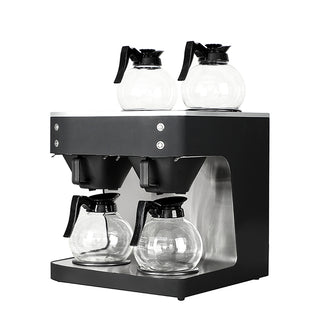
Batch brew is the cheapest cup on the counter to produce and the fastest to serve. In takeaway-heavy markets it does more volume than espresso, and it frees the group heads for milk drinks during the rush.
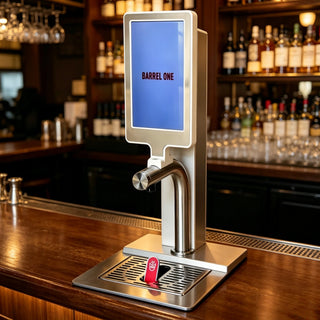
Cold brew has the opposite production profile: twelve to twenty-four hours of steeping, then a product that holds for days and pours in seconds. A dispensing unit turns that into a tap rather than a daily job.
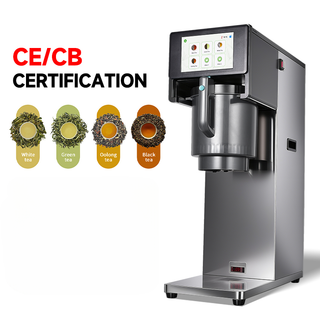
And tea is the drink most cafés serve worst. An automatic brewer holds a consistent infusion at temperature instead of a bag in a pot that has been sitting for twenty minutes.
For sites where coffee is also the marketing, an edible ink printer prints a logo or a guest's photo onto the crema — a novelty that photographs well enough to earn its counter space in hotels and event venues.
Where cafés buy the wrong commercial coffee machine
- Sizing by seats instead of by peak hour. The morning rush decides the machine; the seat count decides the furniture.
- Buying traditional without budgeting the barista. A good machine with an untrained operator makes worse coffee than an automatic.
- Skipping water treatment. The cheapest way to destroy an expensive machine in a hard-water area.
- Underspending on the grinder. It sets the ceiling for everything the machine does afterwards.
- Forgetting the power supply. Three-group machines usually want three-phase, and rewiring after fit-out costs more than the difference between models.
- Ignoring the milk fridge. If the barista turns around for every jug, the queue is longer than the machine's fault.
If you are specifying from scratch, start with the peak hour, decide whether a barista is standing there, then let those two answers pick the machine — and put whatever is left into the grinder and the water.
Not sure whether your counter needs one group or three? Tell us your peak hour, your drinks mix and whether coffee is the product or the service, and we will spec the machine and the grinder together.


