


In short: soft serve and frozen yogurt are the same machine with a different mix in the hopper. What you are really choosing is flavour count, how the mix is fed, how the machine is cooled — and whether your staff will do the clean-down that all of them require.
The most common question about this category has a disappointing answer. Frozen yogurt is not a different technology; it is a cultured mix run through the same freezing cylinder as ice cream mix. A machine that makes one makes the other, and switching between them is a matter of cleaning and changing what you pour in.
Which means the buying decision is entirely about hardware, and the hardware questions are unfamiliar to most people specifying one for the first time.
What actually separates soft serve from hard ice cream
Two things: temperature and air.
Soft serve is dispensed at around −4 to −6 °C, several degrees warmer than the −12 °C or colder of scooped ice cream. That is why it flows into a swirl rather than needing a scoop, and it is also why it tastes sweeter and more strongly of its flavouring — cold suppresses taste, and this is less cold.
The second difference is overrun: the air whipped into the mix as it freezes. Soft serve typically carries a lot of it, which is what makes the texture light and, not coincidentally, what makes the margin. A litre of mix with high overrun produces considerably more servings than the same litre at low overrun, and the difference between two machines on the same mix is real money over a season.
The catch is that overrun is a quality decision as much as a yield one. Push it high and the product is airy and melts fast; keep it lower and it is denser and richer. Where you sit on that scale should be a decision, not an accident of which machine you bought.
Flavour count is a hardware decision
Every flavour needs its own hopper and its own freezing cylinder. This is the single biggest structural choice, and it cannot be changed later without buying a different machine.
A single-flavour countertop machine is the right answer far more often than people expect — for a café adding a dessert, a bakery with a summer line, a takeaway, or any site where soft serve is an attachment rather than the reason people come. It is small, it is cheap to run, and one excellent flavour outsells three mediocre ones.
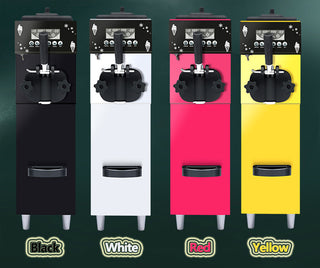
Two flavours plus twist is where most dedicated operators land. The twist is genuinely free merchandising: it is a third menu item that requires no extra hopper, no extra mix and no extra cleaning, and it consistently sells.
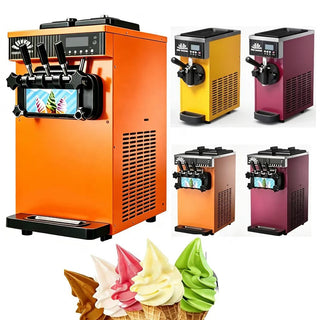
Three or more only pays where soft serve is the whole business and the queue justifies the footprint. Each cylinder is another daily clean, and that cost is paid every single day whether the flavour sold or not.
Gravity or pump, and why it changes the product
Mix gets from the hopper into the freezing cylinder in one of two ways, and the choice is not cosmetic.
A gravity-fed machine lets mix fall through under its own weight. Simple, fewer parts, less to clean, cheaper to buy and maintain. Overrun is limited by the physics — usually somewhere in the 30–40 per cent range — so the product is denser.
A pump-fed machine actively injects mix and air together, which lets it push overrun much higher, commonly 50–80 per cent. More servings per litre, lighter texture, taller cleaner swirls. The price is more components, more to strip and sanitise, and more to go wrong.
For most venues the honest recommendation is gravity: the yield difference matters at high volume and the extra cleaning matters every day. If soft serve is the business rather than a line on the menu, the pump machine pays for itself and the cleaning burden is somebody's actual job.
Air-cooled or water-cooled decides where it can stand
Every machine has to reject heat somewhere. Air-cooled units blow it into the room, which is fine given clearance around the vents — and not fine in a small enclosed counter area, where the machine heats the space it is trying to freeze in and then struggles on the hottest day of the year, which is also the busiest.
Water-cooled units are quieter, less sensitive to ambient temperature and more consistent in a hot room, at the cost of a water supply and drain — and, in most places, a meaningful water bill.
Two practical notes that decide more installations than the datasheet does. Check the clearance the manufacturer requires and treat it as a hard dimension, not a suggestion. And listen to one running before you buy: these machines have compressors that cycle, and a unit two metres from a seated customer in a quiet café is a different proposition from one in a busy shopping centre.
The clean-down is the real cost of ownership
This is the part that gets skipped in the showroom and decides whether the machine is still in use next summer.
A machine holding dairy at just below freezing has to be broken down, washed and sanitised on a schedule — daily for most mixes, with a full strip of the cylinder, beater, seals and dispensing head. Depending on the machine that is somewhere between twenty and sixty minutes, every day, done properly, by someone at the end of a shift.
Some machines have a heat-treatment cycle that pasteurises the mix in place overnight and extends the interval between full strips to a few days. It costs more up front and it is the single feature most likely to keep a machine in service, because the failure mode of soft serve is not mechanical — it is a rota that quietly stops doing the clean.
Before you choose, count the seals and O-rings in the dispensing head and ask how long a full strip takes. Then assume it will be done by a nineteen-year-old at half past ten at night, because it will be.
Mix: bought liquid, powder, or your own base
Three routes, and they suit different businesses.
Liquid mix in bag-in-box or carton is the standard: consistent, no preparation, and it needs refrigerated storage plus a delivery cadence that matches your usage. It is the most expensive per litre and the least work.
Powder is reconstituted with water or milk on site. Cheaper per serving, stores at ambient in far less space, and consistency depends entirely on somebody mixing it the same way twice.
Your own base — dairy, sugar, stabiliser, pasteurised and aged — is where a serious dessert business ends up. It is also a step change in regulation and equipment, because pasteurising your own mix brings process control, records and usually a pasteuriser into scope.
Whichever route, mix in the hopper is a chilled dairy product and lives under the same temperature discipline as any other. The hopper is refrigerated for exactly that reason, and it is not storage.
When the answer is a batch freezer instead
If what you actually want is dense, scoopable gelato or hard ice cream, soft serve is the wrong machine entirely. A batch freezer churns and freezes a batch at a time, producing a much denser product with low overrun that then goes into a display freezer to hold.
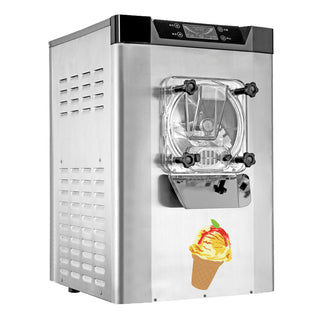
The trade is a different shape of business. Soft serve is continuous, unskilled and instant; batch production is a shift, a skill and a stock of finished product. Volume operations run floor-standing machines that turn out serious quantities per hour, which is a gelateria rather than a counter with a dessert on it.
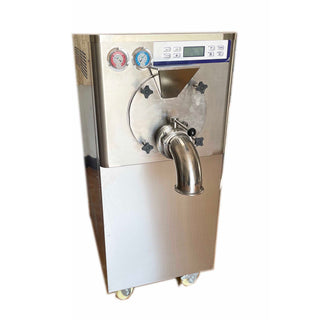
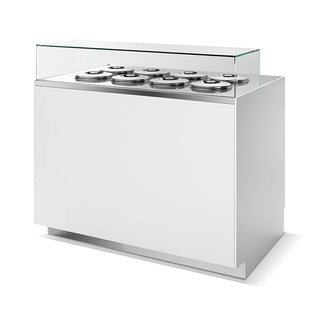
Hard product also needs somewhere to live at serving temperature. Pozzetti wells hold it covered at a stable temperature and, unlike an open display, do not dry the surface — which is why traditional gelaterie use them and why the product in them looks better at four in the afternoon.
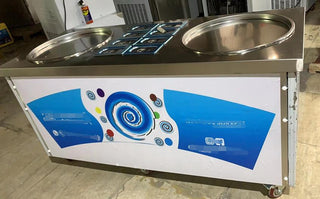
And where the product is the show rather than the flavour, rolled ice cream flash-frozen on a cold pan is a third category again — slower per serving, and it draws a queue that photographs itself.
Where venues buy the wrong soft serve machine
- Buying three flavours because the menu looked better. Every cylinder is another daily clean, paid whether or not that flavour sold. Twist gives you a third item for free.
- Ignoring the clean-down time before purchase. The usual way a soft serve machine dies is a rota that stops stripping it, not a compressor.
- Air-cooled in an enclosed counter. The machine heats the space it is freezing in, then underperforms on the hottest, busiest day of the year.
- Assuming frozen yogurt needs different equipment. It does not — it needs a different mix and a clean between.
- Treating overrun as a spec rather than a choice. It sets both your yield per litre and how the product eats. Decide where you want to sit before comparing machines.
- Buying soft serve when the product wanted was gelato. Different temperature, different density, different machine, different business.
Not sure whether you need one flavour, two and a twist, or a batch freezer? Tell us where it will stand and how many servings you expect on a peak day, and we will match the machine to it.


