


In short: pick a water boiler by the coolest tea on your menu, not the hottest. Then size it in liters per hour at your busiest hour, decide between a plumbed-in unit and a manual-fill urn, and plan the filter before the first scale builds up.
A sencha steeped at 98 °C turns bitter in under a minute, and a black tea poured at 80 °C tastes thin however long it sits. A single tea counter may pour both within the same two minutes. That is the job a commercial water boiler has to do behind a tea menu, and it is a harder job than the one a coffee machine's hot-water wand was built for.
Most cafés discover this after opening, when the boiler they bought delivers one temperature, fast, and the green teas start coming back half drunk. The fix is cheap if it happens at the planning stage and awkward once the unit is plumbed into the counter.
What water temperature does each type of tea need?
Green and white teas want water well below boiling, roughly 70 to 85 °C, while black tea and pu-erh, like most herbal blends, want it at or near a full boil. Oolong sits in between. The ranges below are the conventional ones most tea buyers work from; individual leaves and house recipes move them a few degrees either way.
| Tea | Water temperature | Typical steep | What goes wrong if the water is too hot |
|---|---|---|---|
| Japanese green (sencha, gyokuro) | 60–80 °C | 1–2 min | Bitterness and a grassy, stewed edge |
| Chinese green, white, yellow | 75–85 °C | 2–3 min | Flat, cooked flavor; delicate leaf loses its sweetness |
| Matcha | 70–80 °C | Whisked, no steep | Harsh, astringent bowl |
| Oolong | 85–95 °C | Several short infusions | Rolled leaf opens too fast and the later infusions go dull |
| Black tea, breakfast blends | 90–100 °C | 3–5 min | Rarely an issue; too cool is the usual fault |
| Pu-erh | 95–100 °C | Short infusions after a rinse | Rarely an issue |
| Herbal and fruit infusions | 95–100 °C | 5 min or more | None; low temperatures are a food safety concern for some dried botanicals |
Read the table from the top. If your menu runs no lower than black tea, a single hot tap near boiling covers it. The moment a sencha, a white or a matcha arrives on the board, the counter needs a second temperature, and the choice of boiler narrows quickly.
There are three ways to get that second temperature. Staff can pour boiling water into a cooling jug first, which works on a quiet afternoon and falls apart in a queue. A variable kettle on the counter handles a few cups an hour. Or the boiler itself can dispense at more than one setpoint, which is the only route that holds up when twenty orders arrive in ten minutes.
The under-counter dispenser below does the last of these. It has three buttons that can each be programmed to a different temperature, holds them to ±1 °C according to the maker, and puts only the tap and touch screen on the counter while the 8-liter boiler sits in the cupboard beneath.

How many liters per hour does a water boiler need at peak?
Work it out from your busiest hour, and plan for more water than the cups alone suggest. A tea counter uses hot water to warm pots, rinse leaf before the first infusion, top up refills and clean, so the cups themselves are rarely more than two-thirds of the draw.
Here is the arithmetic for a mid-sized tea room. Forty pots of 500 ml in the peak hour is 20 liters. Add a refill of hot water on half of them and a warm-up rinse on every pot, and the real draw heads toward 35 liters. Add Americanos or hot chocolate from the same tap and it passes 40.
Two numbers on a specification sheet matter here, and they measure different things:
- Tank capacity is how much hot water sits ready. It decides how big a burst you can pour at once, like six teapots filled in a row when a group sits down.
- Hourly output, sometimes called recovery, is how fast the element reheats fresh water. It decides whether the boiler keeps up for the whole hour or runs cool after the first rush.
A large tank with slow recovery serves the first wave well and then leaves staff waiting. A small tank with fast recovery handles steady trickle trade but struggles with a table of eight. The comparison below uses the machines in our tea brewers and water boilers range, with figures from their product specifications.
| Type | Example in the range | Output or capacity | Power | Fits |
|---|---|---|---|---|
| Countertop boiler with stepped heating | Stepped hot water dispenser | 30–50 L/h | 3 kW | Café or tea bar with one hot tap |
| Under-counter boiler with counter tap | 8 L touch-screen dispenser | 45 L/h, 8 L tank | 5 kW | Tea room pouring several temperatures |
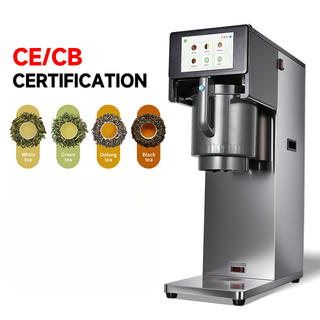
| Automatic tea brewer and boiler | One-button brewer | 70–100 °C range | 4.5 kW | Batch brewing for milk tea and iced tea bases |
| Automatic tea brewer, batch | 5.5 L brewer | 5.5 L per batch | 3 kW | Hotel breakfast, catering, milk tea shop |
| Instant-hot purifier dispenser | Ultrafiltration unit with UVC | Filters up to 1,892 L a day; hot water on demand | See product card | Staff room, meeting rooms, small breakfast bar |
The countertop boiler with stepped heating adds cold water in stages rather than all at once, so the tap does not drop in temperature when someone draws a large volume. At 30 to 50 liters an hour it covers the tea room in the example above with a little room to spare.

Batch brewers solve a different problem. A milk tea shop or a hotel breakfast needs liters of brewed tea, held and ready, rather than water poured cup by cup. The one-button brewer below brews and dispenses, then runs its own cleaning cycle, and it takes water at 0.1 to 0.4 MPa from the mains.

For a buffet or a banquet station, a 5.5-liter brewer with a timer and dosing control makes the same tea every batch, which matters when three different people refill it over a morning.
Plumbed-in water boilers against manual-fill urns
If the counter pours tea all day, plumb it in. A plumbed-in water boiler refills itself from the mains, so it never runs dry mid-service and nobody carries water across a busy floor. A manual-fill hot water urn earns its place when the service is mobile or occasional: a conference coffee break, or a breakfast room that sets up for two hours and packs away.
Plumbing brings its own list of conditions, and it is better to know them before the counter is built:
- A cold water supply at the boiler's rated inlet pressure, with an isolation valve so the unit can be serviced without shutting off the building.
- A drain or drip tray arrangement for units that vent or purge.
- Enough electrical supply. A 3 kW boiler draws about 13 amps at 230 V, while a 5 kW unit draws about 22 amps and needs its own circuit sized by an electrician. Confirm the voltage options on the product card, because several of these units ship in 220–240 V only.
- Space for a filter housing on the inlet line, which is the part most often forgotten.
Manual urns are simpler to buy and move, but they carry a quiet cost in labor and in the day somebody forgets to refill one before a function. If you choose one, pick a model with a low-water cut-out so the element cannot burn out when it runs empty.
How do you keep limescale out of a commercial water boiler?
Filter the water before it reaches the element, and descale on a schedule set by your local water hardness. Scale forms whenever hard water is heated, because the dissolved calcium and magnesium drop out as a crust on the hottest surface, which in a boiler is the element and the tank wall.
That crust does three kinds of damage. It insulates the element, so it runs longer and hotter to reach the same temperature and eventually fails. It flakes into the cup as white specks. And it changes the tea itself: hard water dulls the color of a black tea and leaves a film on the surface of the cup.
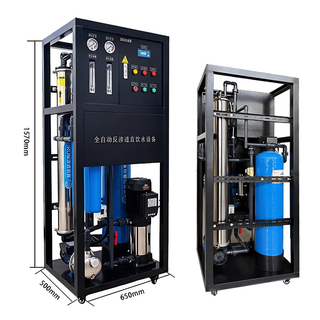
For a tea counter, the usual answer is a scale-reducing filter cartridge on the inlet, changed on the interval the filter maker gives for your water hardness. Where the supply is very hard, or where the whole site needs treated water, a reverse osmosis system does the job at scale. The unit below produces 250 liters an hour from feed water up to 1,500 ppm of dissolved solids.
One warning about reverse osmosis for tea. Water stripped of almost all its minerals brews flat, lifeless tea, and some tea buyers find it worse than moderately hard water. Sites that install RO for a tea menu often blend a little untreated water back in or fit a remineralizing cartridge after the membrane. Taste the result against your main teas before committing to a setting.
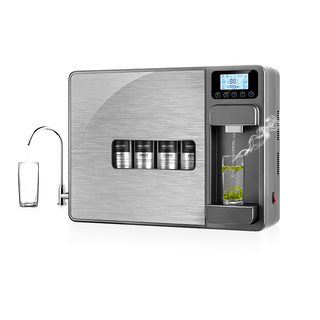
For a small room or a staff area, an under-sink or wall-mounted purifier with instant heating covers both jobs in one unit. The one in our water purification range pairs ultrafiltration with UVC LED sterilization and dispenses hot and cold-filtered water.
Whatever filter you fit, keep a log. Write the date of each cartridge change and descale on a label inside the cupboard door. Boilers that fail early almost always have a gap of many months in that record.
Matching the hot water setup to the counter
Match the boiler to the way tea leaves the counter rather than to the size of the room.
- Coffee shop with a short tea list. The espresso machine's hot-water tap or a small countertop boiler is enough if every tea on the list is black or herbal. Add a second temperature as soon as a green tea appears. Our guide to commercial coffee machines for cafés covers what the machine's own hot-water circuit can and cannot keep up with.
- Tea room with a long menu. An under-counter boiler with programmable temperatures, a filter on the inlet, and variable kettles for the few teas brewed at the table.
- Milk tea and bubble tea. A batch tea brewer for the base, and a separate hot tap for everything else. The rest of that counter is in our bubble tea machines range.
- Hotel breakfast and catering. Batch brewers and manual-fill urns that can be moved between rooms, with the water treatment on the kitchen supply rather than at each unit.
Two purchases tend to disappoint. One is a single-temperature boiler bought for a menu full of green and white teas, which forces staff back to cooling jugs within a week. The other is a boiler installed with no filter in a hard-water area, which works perfectly for a few months and then starts tripping, spitting and tasting of chalk.
Not sure how much hot water your menu draws? Send us your tea list, your busiest hour and the power available at the counter, and we will suggest a boiler and a filter that fit.


