


In short: how to open a bagel shop is a question about one pot. The boil is the step that makes a bagel a bagel rather than a bread roll, and it is the narrowest point in the production line — so the kettle, not the oven and not the mixer, sets how many you can sell before eleven.
A bagel is a stiff, low-hydration dough, shaped, held cold overnight, boiled for under a minute and then baked. Take out the boil and you have a roll with a hole in it: no gelatinised skin, no chew, no shine. It is the only mainstream baked good defined by a step that happens in water.
That step is also the one that cannot be parallelised easily. Mixing scales by buying a bigger bowl and baking scales by adding a deck, but boiling scales by adding surface area in a pot that has to stay at temperature while cold dough keeps landing in it. Plan the shop around that and the rest falls into place.
This guide sits under the wider how to open a bakery and covers the bagel case, which is stricter in both directions — a harder dough and a tighter sequence.
The stiffest dough in baking, and what it does to the mixer
Bagel dough runs low hydration — noticeably drier than bread dough, which is what gives the finished bagel its density and chew. It is also the load that destroys mixers.
A stiff dough is far harder on a machine than its weight suggests, and manufacturers derate capacity for it explicitly. A planetary mixer with a dough hook, dragging a dry mass around a static bowl, heats it and strains the gearbox; do that four times a morning and the machine has a shorter life than the lease. A spiral turns the bowl against a fixed hook, develops the gluten with far less friction, and is the machine this product is built for.
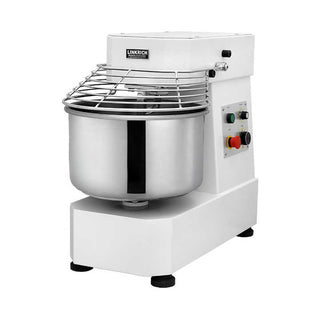
Size it by flour weight per batch rather than by bowl litres, and then derate again for the hydration. We went through the full comparison in planetary mixer or spiral, and bagels are the case where the answer is least ambiguous.
The overnight retard is the flavour, not a convenience
Shaped bagels are held cold — commonly twelve to twenty-four hours — before they are boiled. This is doing two jobs at once, and most shops only think about one of them.
The operational job is obvious: shaping happens the day before, so the morning starts at the kettle rather than at the mixer, and somebody gets to arrive at four instead of one.
The other job is flavour. A long cold ferment develops the sour, complex notes that separate a real bagel from a fast one, and it firms the skin so the ring holds its shape in boiling water. Skip it and you get a paler, blander bagel that also deforms in the pot.
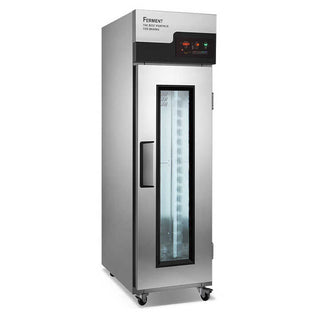
What the cabinet buys you is control: consistent temperature and humidity across trays, so the batch that comes out at four in the morning is the same as yesterday's. A walk-in fridge full of other people's food is not that, and it dries the skin on the outer trays.
The boil is your bottleneck, so size it first
Bagels go into water at a rolling boil for roughly thirty to sixty seconds a side. Short — but the pot has a hard limit: bagels need to float without touching, and every batch of cold dough drops the water temperature, which then has to recover before the next one.
That makes the useful number bagels per hour rather than litres. Work out your target for the morning, divide by the hours you have before the rush, and specify against that. A kettle sized to the average morning is the reason a shop sells out at nine on a Saturday and calls it success rather than lost revenue.
For most independent shops, a gas-fired kettle built for this job is the right answer. It recovers heat fast between batches, which is the whole specification, and it is simple enough that it never stops the morning.
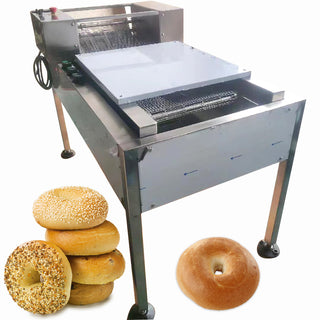
Above a certain volume the batch model breaks down and the answer becomes continuous: a chain machine that carries bagels through the bath at a set speed, so output is a function of belt speed rather than of how fast someone can fish rings out with a spider. That is a wholesale or multi-site decision rather than a first-shop one, but it is worth knowing the ceiling before you design around a kettle.
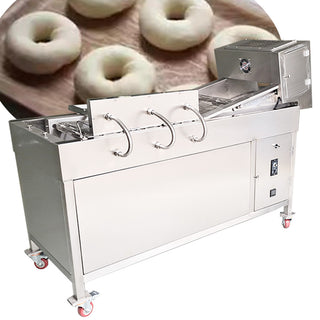
What goes in the water changes the bagel
Plain water works. Almost nobody uses it.
Barley malt is the traditional addition — it feeds browning, adds a faint sweetness and produces the characteristic burnished shine. It is the standard for a New York-style bagel and it is forgiving.
Baking soda raises the pH, which accelerates browning and gives a darker, slightly slicker crust. Cheap, safe, and a common shortcut to the look.
Food-grade lye goes further in the same direction and produces the deepest colour and the most pronounced skin, at the cost of handling a caustic solution — which means gloves, eye protection, a written procedure and a conversation with your inspector rather than an experiment on a Tuesday.
Whichever you choose, fix it and write it down. The water is a recipe ingredient, and a shop that changes it batch to batch has a product that changes with it.
Deck or convection: what the oven does after the water
A boiled bagel goes into the oven wet, and what it needs is bottom heat and steam management rather than a fan.
A stone-based deck oven is the traditional and the better answer: conductive heat from below sets the base while the boiled skin colours, and the mass of the stone holds temperature as tray after tray goes in. It is slower to load and it produces the bagel people are picturing.
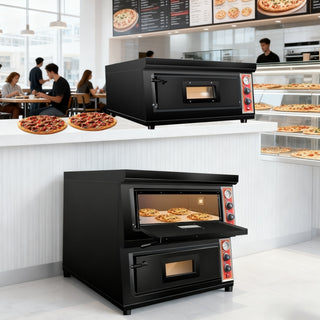
A convection oven is faster to buy, cheaper to install and easier to fit into a small kitchen, and it bakes a perfectly saleable bagel — slightly more even, slightly less characterful, and with a base that has not had the same contact heat. It also does everything else, which matters if the shop sells pastries and traybakes alongside.
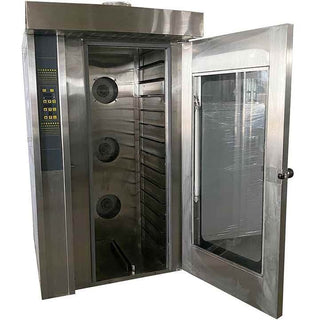
The practical test is what fraction of your revenue is bagels. Above about two thirds, buy the deck. Below it, a convection oven that serves the whole menu is usually the better allocation of the same money.
Four hours fresh, and one good second life
A bagel is at its best within a few hours of baking, and it stales fast — the same starch retrogradation that ages every other baked good, accelerated by a dense crumb.
The difference from a donut is that a stale bagel has an excellent second life. Split and toasted, a day-old bagel is not a compromise, it is most of the world's actual bagel experience. That single fact changes the economics of the format: the afternoon does not have to be discounted or binned, it has to be toasted.
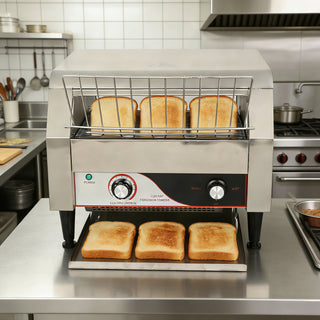
Which is why a bagel shop with a counter beats a bagel bakery without one. Bake the morning, sell fresh until the rush ends, then move the same product to a toasted menu at a higher price for the rest of the day.
The counter is where the margin actually is
A plain bagel is a low-value item made from cheap ingredients with a lot of labour in it. A bagel with cream cheese, cured salmon and capers is a meal at a multiple of the price, made from the same bagel in ninety seconds.
Design the filled menu before the bake schedule, because it decides your cold storage, your prep and your peak staffing. It also decides your queue: a shop selling bags of six moves people through fast, and a shop building sandwiches to order needs a second service point or the morning gridlocks.
Coffee attaches unusually hard here — a filled bagel is a breakfast rather than a snack, and breakfast wants a coffee. Treat the espresso side as a real programme with its own station rather than a machine behind the till; we covered choosing one in commercial coffee machines for cafés.
How to open a bagel shop that clears its morning
The spend concentrates in production: mixer, retarder, kettle, oven, extraction. The retarder is the item that first-time operators cut and then buy within a year, because without it the shaping shift starts at one in the morning and staffing it is the reason people give up on the format.
Rent should be judged on morning footfall rather than on prestige. A bagel shop takes most of its money before eleven, with a smaller toasted-and-filled trade running to mid-afternoon, and almost nothing in the evening — so a site that is busy at eight beats a site that is beautiful at eight.
Staffing has a distinctive shape too: a shaping shift the previous afternoon, a baking shift from very early, and counter staff for a sharp four-hour peak. That is three different rotas, and it is the part of the plan most likely to be underestimated.
Permits: food only, plus the water and the extraction
United States. Health department permit and food-handler certification per state, plus a certificate of occupancy. Two items are specific to this format: a boiling kettle at volume is usually a gas connection and a steam load that the mechanical inspection looks at, and if you plan to use lye, expect it to be treated as a hazardous substance with storage and procedure requirements attached.
United Kingdom. Register the food business with the council at least 28 days before opening, then the hygiene inspection and Food Hygiene Rating; Level 2 Food Hygiene for staff handling food is the practical standard. Steam and heat extraction over the kettle and oven is frequently a planning condition where there are neighbours above.
Australia. Council premises approval and food-business notification, a Food Safety Supervisor in most states, and fit-out plans submitted to council before work starts rather than after.
In all three the fixture most often missed at first inspection is the separate hand-wash basin, and the second is a written cleaning schedule for the kettle — standing water at temperature is exactly the kind of thing an inspector asks about.
What breaks in month two
Three failures show up quickly and all three come back to the sequence rather than the recipe.
The kettle turns out to be the ceiling, and it is discovered on the first genuinely busy Saturday when the shop sells out at half past nine. That is not a good problem — those were customers who now know you run out.
The retard schedule drifts, because trays go in at different times and nobody wrote down when. Bagels from the front of the cabinet and the back of it stop matching, and the shop develops an inconsistency it cannot explain.
And the afternoon is planned as a discount rather than as a second product. A shop that has a toasted menu ready on day one earns through the middle of the day; a shop that improvises one in month three has already trained its customers to come only before ten.
Working out how many bagels the morning has to produce? Tell us your target for the peak and whether you are baking on stone, and we will size the kettle, the retarder and the oven to match.


