


In short: a commercial induction range wins on control, speed to boil and a cooler kitchen, and suits sauce-led menus and open kitchens. Gas still wins wherever a round-bottomed wok is tossed over the flame, or where the building has no spare electrical capacity.
Put a round-bottomed wok on a flat induction hob and only a disc the size of a saucer gets hot. Lift it to toss the rice and the heating stops, because induction needs the pan sitting on the coil. Most of the argument about a commercial induction range versus a gas one is visible in that single pan, which is why the wok is the right place to start.
Away from the wok station the answer tilts the other way more often than chefs expect. Induction boils water faster and holds a low simmer without scorching. It also pours far less heat into the room, which cooks notice by the second hour of a busy service. Gas is simpler to repair and takes any pan, and in most existing kitchens it is already piped to the line. Which one fits depends on the menu and on what the building can supply.
Commercial induction range vs gas range at a glance
| Question | Induction | Gas |
|---|---|---|
| How it heats | A magnetic field heats the pan base directly | An open flame heats the pan and the air around it |
| Round-bottomed wok | Only on a dedicated curved-bowl wok unit | Native; the flame wraps up the sides |
| Heat-up and boil | Faster, since the power goes into the pan | Slower, as much of the heat escapes past the pan |
| Low simmer | Precise and repeatable | Harder to hold very low in a draft |
| Heat in the kitchen | Low; the hob stays fairly cool | High; the line runs hot all service |
| Pans | Magnetic base only (carbon steel, cast iron, clad stainless) | Any pan, any shape |
| Supply | Heavy electrical load, often three-phase | Gas line, gas safety checks, interlock with extraction |
| Repairs | Electronics that need a technician | Burners and valves; simple parts |
| Cleaning | Flat glass wipes down | Grates and burner heads need soaking |
Why is the wok the hardest test for induction?
Because a wok is cooked in the air as much as on the burner. A cook tosses the pan every few seconds, and a gas flame keeps heating it the whole time it hovers above the ring. On induction, the coil stops transferring energy the moment the steel leaves the surface, so every toss becomes a pause in the cooking.
Shape is the second problem. A gas wok burner throws flame up the curved sides, and the whole bowl of the pan becomes the cooking surface. A flat induction hob heats the small patch touching the glass, and the upper wall of the wok stays much cooler, so food pushed up the side to rest stops cooking.
Then there is the flavor Cantonese cooks call wok hei. Part of it comes from oil droplets catching the flame as food is tossed over the ring. Without a flame there is no flare, and an induction stir-fry comes out cleaner in a way regular diners of a good wok house tend to notice.
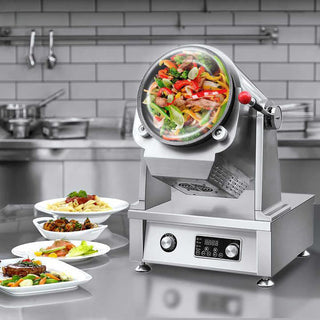
Dedicated induction wok units exist, and they fix the shape problem with a concave glass bowl and a coil curved to match the pan. They work for kitchens that stir-fry with a ladle rather than a toss, and for sites where an open flame is not allowed. The other induction route takes the wrist out of the job altogether: this stir-fry robot runs on a 5 kW electromagnetic heater and turns the food itself, which suits fried rice and noodles repeated in batches.
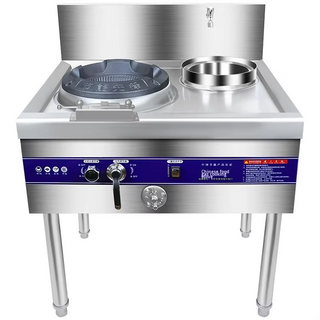
For a kitchen that lives on high-heat tossing, the gas wok range remains the tool. A high-pressure burner sits under a recessed ring that cradles the round bottom, and nothing on the electric side has replaced it yet for that style of cooking.
Does a commercial induction range heat faster than gas?
Yes, for almost every job done in a pan that stays put. The heat is generated in the base of the pan itself, so a stockpot reaches the boil sooner and a sauté pan recovers faster after cold food goes in. Commonly quoted figures put induction at around 85 to 90 percent of its energy reaching the pan, against well under half for an open gas burner.
The gap shows most at the two ends of the dial. At the top, pasta or blanching water comes back to the boil quickly between batches. At the bottom, induction holds a custard, a beurre blanc or a reduced stock at a steady low setting, where a gas flame turned right down either blows out in a draft or runs slightly too hot.
Gas keeps one advantage, and it is about feel. A cook sees the flame and adjusts by eye, with an instant response in both directions. Induction responds just as fast, but through a number on a display, and some cooks need a few weeks before they trust it.
For a conventional line of pots and pans, this six-burner commercial gas range is the reference point: 6 kW per burner, 36 kW in total, and flame-failure protection that cuts the gas if a burner goes out.

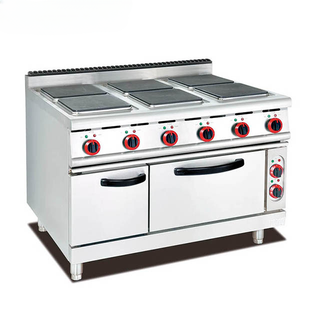
The electric alternative in the same format uses solid hot plates rather than induction coils, so it gives up the speed advantage and keeps the cooler flame-free line. Six 4 kW plates sit over a 4.8 kW oven, drawing 28.8 kW from a three-phase 380 V supply. It is the right electric commercial range for a site that cannot have gas but does not need induction precision.
What does each range do to the heat and air in the kitchen?
A gas line heats the room, and an induction line mostly heats the food. Every burner running at full flame sends a large share of its output past the pan and into the kitchen, which is why cooks on a gas line work in heat that a chef on an induction suite never feels. That heat has to be removed by the extraction and by air conditioning, and both cost money every hour the line runs.
Neither option removes the need for a hood. Searing and frying produce grease-laden vapor whatever the heat source, and the hood is sized to that vapor. What changes is the load around it. With gas, combustion products join the cooking fumes, and the extraction has to carry both.
Gas also brings rules that induction avoids. In the UK, a commercial kitchen with gas cooking needs an interlock that shuts off the gas supply if the extraction fan stops, and gas appliances need periodic safety checks by a registered engineer. Recirculating (ductless) hoods are, in many jurisdictions, accepted only over electric cooking equipment, so a basement or mall unit with no route for a duct is often an induction kitchen by default. Check that with the local fire or building officer before choosing either.
Our guide to sizing a kitchen exhaust hood covers airflow and make-up air in detail. For this decision, the relevant point is that an all-induction line usually lets the hood and the air conditioning be smaller, and that saving is part of the comparison.
The building often chooses between gas and induction
Often the building makes the choice before the chef does. A gas range needs a gas connection with enough capacity for every appliance on the line running at once. The six-burner range above draws about 0.6 m³/h of natural gas per burner, which is the figure an engineer adds up against the meter.
Induction and other electric cooking move that load onto the electrical supply, and it is a large load. A full line of commercial electric equipment usually needs three-phase power, and an older building on a small single-phase supply may need an upgrade from the utility before a single hob goes in. That upgrade can take months, so ask an electrician for the available capacity before designing the line.
Local policy is the third factor. A number of cities now restrict gas connections in new buildings, and a restaurant signing a long lease in one of them should expect induction to be the long-term answer. Where gas is available and already on site, the connection is usually the cheaper path in the short run.
Many gas ranges run on either natural gas or LPG, which matters for sites without a mains gas line. This gas cooking range comes in layouts from two to six burners for either fuel.

Which range suits which style of cuisine?
Match the heat source to how the menu cooks, station by station. A mixed line is normal, and many kitchens run gas at the wok or grill and induction everywhere else.
| Style of cuisine | Better fit | Why |
|---|---|---|
| Chinese stir-fry, tossed woks | Gas wok range | Flame up the sides, heat while the pan is in the air, wok hei |
| Dim sum and steaming | Either; induction steamers work well | Water boiling in a flat tank suits induction fine |
| French and sauce-led à la carte | Induction | Steady low simmer; fast recovery in sauté pans |
| Italian, pasta-heavy | Either | Induction brings water back to the boil faster; gas takes any pan |
| Chargrill and steakhouse | Gas | Lava rock and open-flame grills have no induction equivalent |
| Breakfast and griddle | Gas or electric flat top | Even contact heat matters more than the burner type |
| Hot pot and tableside cooking | Induction | No flame or gas line in the dining room |
| Hotel and open kitchens | Induction | Cooler, quieter front-of-house cooking with less extraction |
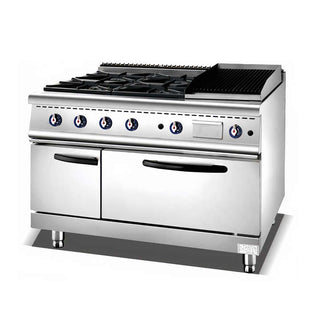
Two rows need products the ranges cannot replace. A chargrill line wants open flame over lava rock, and this four-burner suite combines the rock grill with burners and a gas oven in one footprint.
Hot pot is the clearest induction case of all, because the cooking happens on the guest's table. A built-in induction hob with downdraft extraction keeps open flame and most of the steam out of the dining room.

So which one should you install?
- A menu built on tossed woks needs gas at the wok station.
- If the site has no route for a duct, or gas is restricted, plan an induction line and check that the electrical supply can carry it.
- If the kitchen is open to the dining room or the cooks complain about heat, induction pays back in comfort and a smaller cooling load.
- If gas is already on site and the menu is a conventional mix of pots and pans, a gas range is the simpler and cheaper start, and single induction units can be added later for sauce and pastry work.
The full commercial stoves and ranges collection covers gas and electric ranges alongside dedicated wok burners. For the rest of the hot line, our overview of commercial kitchen equipment sets out what each station needs.
Planning a hot line and not sure which fuel it should run on? Send us the menu and covers, plus the gas and electrical supply the site has, and we will put together a range and extraction spec that fits both.


