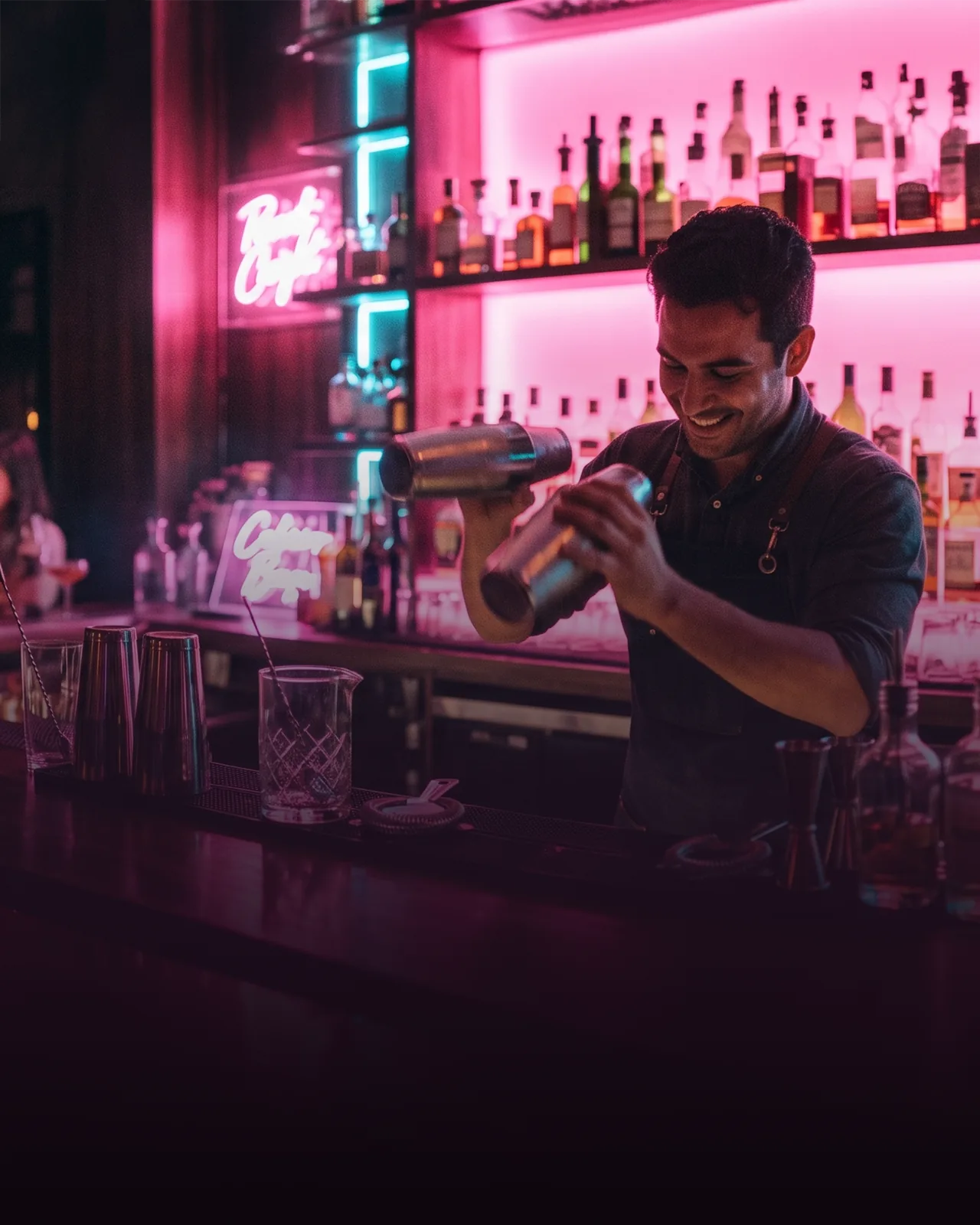


In short: stage lighting is how a venue controls apparent size. Pools of light and a dark ceiling make sixty people read as a crowd; flat even light makes the same sixty look like a room that failed. Beams need haze to exist at all, and lasers need paperwork.
Sixty people are in a room built for three hundred. Turn on the house lights and it is an empty hall with a cluster near the bar. Drop to four pools of light over the floor, leave the ceiling black, and it is a busy club with people at the edges.
Nothing changed except where the light went. That is the actual job of a lighting rig in a bar or club — not decoration, but control over how large and how full the room appears at every point in the night.
What stage lighting does to a room's apparent size
Three principles, and they hold in every venue regardless of budget.
Contrast makes crowds. People read density by comparing lit areas to dark ones. Concentrating light on the floor where people are, and leaving the rest dark, makes the occupied part the whole visible room.
A dark ceiling removes volume. A lit ceiling tells everyone exactly how big the space is. An unlit one makes the room end at head height, which is why almost every club in the world paints everything above the trusses black.
Light the walls to move people outward. Guests avoid dark edges, so a room with dark walls concentrates everyone in the middle and empties as soon as the middle thins. Uplighting the perimeter makes the edges habitable — which spreads a crowd rather than clustering it.
None of this needs expensive fixtures. It needs fixtures pointed deliberately, which is a different skill and a cheaper one.
The four layers of a club rig
A working rig is not one kind of light repeated. It is four layers doing four jobs, switched at different points in the night.
| Layer | Fixtures | The job | Running when |
|---|---|---|---|
| Architectural | Track lights, pendants, uplights | Makes the room usable and safe; sets the early-evening mood | From doors open; dimmed as the night builds |
| Effect | Beams, movers, washes | Motion and energy over the floor | Peak hours only |
| Atmospheric | Haze, low fog | Makes beams visible; softens the room | Continuously once effects start |
| Content | LED panels, projection, gobos, holographic fans | Branding, visuals, something to photograph | All night, at varying brightness |
The mistake almost every first rig makes is buying layer two and skipping layers one and three. Effect fixtures in a room with no architectural light and no haze produce a dark space with some moving dots in it.
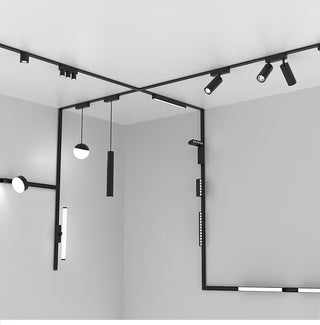
Track systems are the practical answer to the first layer in a venue that changes its layout. Fixtures move along the rail as the room does, which matters in any space that hosts different formats on different nights.
Why do light beams need haze to be visible?
A light beam in clean air is invisible. You see the fixture and you see the spot where it lands, and nothing in between. Every photograph of a club with visible shafts of light is a photograph of a room full of suspended particulate.
That is what a hazer does: it puts a fine, even, long-hanging mist into the air so beams have something to reflect off. It is not an effect in itself — it is the medium that makes every other lighting effect visible, which is why it belongs in the budget beside the fixtures rather than after them.
Fog is a different product for a different purpose: dense, short-lived clouds for a moment rather than an atmosphere. And low fog is a third thing again — chilled output that stays at floor level and rolls, which is the dance-floor and photo effect people usually mean when they describe fog.
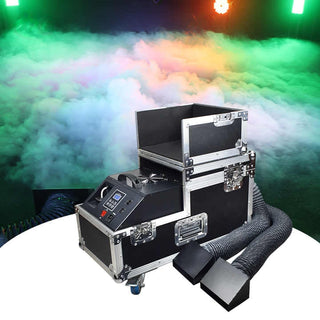
Two operational points that catch venues out. Optical smoke detectors read haze as smoke, so any permanent haze installation needs to be discussed with whoever maintains your fire alarm — detector types and isolation procedures are a design question, not something to solve on the night. And haze fights ventilation: a room with strong air handling clears it as fast as you make it, so the machine has to be sized against the HVAC rather than against the floor area.
Lasers: what is real and what is regulated
A laser does something no other fixture can. Its beam stays tight over distance, so it draws in mid-air rather than lighting a surface, and an animation projector can put shapes and text into the haze above a crowd.
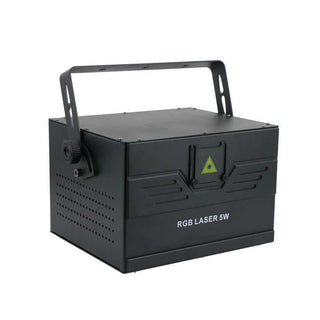
It is also the one category in a lighting rig with genuine safety regulation attached. Entertainment lasers of the power used in clubs can damage eyes, and the rules concern where the beam is allowed to go.
The short version: beams above head height, aimed at surfaces and structures rather than at people, are the normal permitted use almost everywhere. Deliberately scanning the audience is a separate category that is restricted or requires specific approval depending on the market — in the United States it needs a variance from the FDA's radiation-control program, and in the UK and EU it falls under laser-safety standards with a competent person responsible for the installation.
Practical advice rather than legal advice: install with the beam path physically limited by mounting position and stops, keep documentation of what was installed and by whom, and treat any supplier who tells you audience scanning is fine without qualification as a supplier to avoid. Confirm the current requirement with your local regulator before commissioning.
What does a gobo projector add to a venue?
A gobo projector throws a shaped image — a logo, a pattern, a texture — onto a wall, a floor or a ceiling. It is the least expensive fixture that changes how a venue reads, because it turns a blank surface into something intentional.
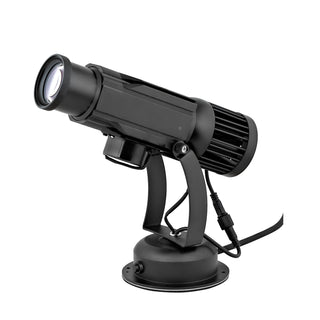
Indoor units at 15 to 35 W handle a bar wall or an entrance. The number that matters is throw distance against image size: a projector that is too weak for the distance produces a washed-out logo that looks worse than no logo, and this is the most common specification error in the category.
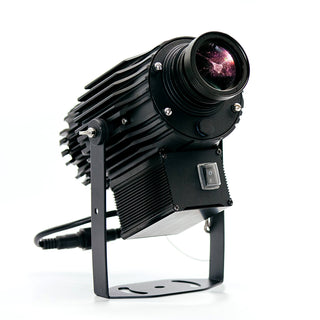
For long throws, outdoor surfaces and facades, output climbs into the hundreds of watts with an IP-rated body. Rotation and multi-slide models let one fixture cycle images through the night, which is a cheaper way to change a room than changing the fixture. Our guide to choosing a gobo projector covers throw, wattage and glass versus metal slides in detail, and the gobo projectors range covers indoor through facade-scale.
Screens, panels and the things people photograph
Content layers earn their place through phones. A wall that photographs well is marketing that guests distribute for you, and it works even in rooms where nothing else is moving.
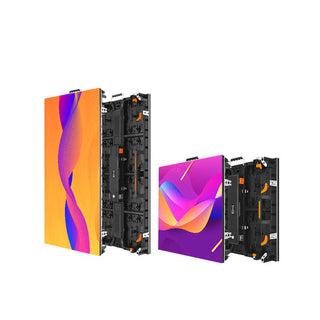
Modular LED panels build to whatever size the wall allows and take video, branding or slow ambient content. Pitch — the spacing between LEDs — decides the minimum viewing distance, so a panel behind a DJ can be coarse while one behind a bar cannot.
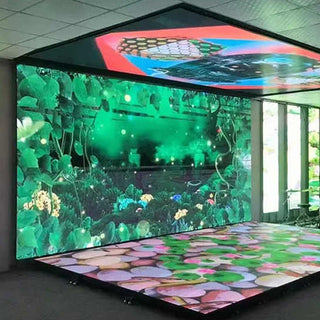
Interactive floors and walls react to movement, which turns a corridor or a queue area into something people stop at. In venues with an awkward dead zone, this is often a better spend than more lighting.
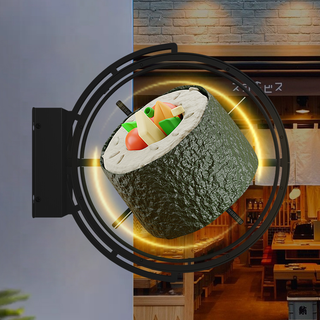
Holographic fans are the small, high-impact option: a spinning LED array that reads as an image floating in the air. They cost a fraction of a screen and they photograph far better than they have any right to.
Sound and light run on the same night
Almost every venue buys sound and light separately and then discovers they have to be operated together.
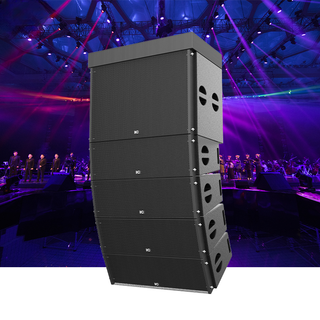
The rig question is not only how loud but how evenly. Line arrays distribute sound down a long room more evenly than point-source boxes, which matters when the far end of the floor should not be quieter than the near end.
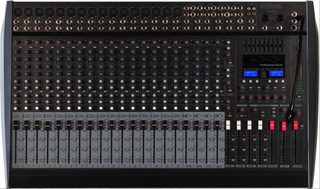
Control is where the two systems meet. Lighting speaks DMX, and one control universe carries 512 channels — enough for a moderate rig, not enough for an ambitious one. Deciding early whether a person operates the lights live or whether they run pre-programmed scenes triggered by the DJ changes what you buy: live operation wants a console and a sightline to the floor, automated scenes want fixtures that behave predictably without anyone watching.
Where venues get stage lighting wrong
- Buying effect fixtures with no haze. The beams do not exist without it, and the rig looks like a fraction of what it cost.
- Lighting the ceiling. It tells every guest exactly how much empty room there is.
- Ignoring the fire alarm. Optical detectors read haze as smoke; solve it at design stage, not at eleven at night.
- Under-specifying gobo wattage for the throw. A washed-out logo is worse than no logo.
- Assuming audience scanning is allowed. It is restricted or requires approval in most markets — design the beam path above head height.
- Nobody to run it. A rig with no operator and no programmed scenes ends up on one static setting all night.
If you are starting a rig from nothing, buy the architectural layer and a hazer first, add four effect fixtures pointed at the floor rather than twelve pointed everywhere, and put a gobo on the one wall everybody photographs.
Building a rig for a room that changes format? Tell us the floor size, the ceiling height and what the busiest night looks like, and we will spec the layers so the room reads full at sixty people and still works at three hundred.


