


In short: a commercial chef knife is chosen by steel grade, blade length and spine thickness, in that order. A 200 mm blade in 7Cr17MoV or high-manganese steel covers most of the line; anything under 140 mm is a second knife, not a smaller version of the first.
The knife that slows a prep line is rarely the blunt one. It is the 200 mm blade being used to turn radishes, or the 110 mm blade being pushed through a butternut squash because it was the only clean knife on the bench. Both cut. Both cost the cook time, and one of them eventually costs a fingertip.
Buying for a commercial kitchen is a different exercise from buying a knife for yourself. You are not choosing one favorite. You are choosing a set of blade lengths that covers every cut your menu makes, in a steel your team can maintain with the sharpening kit you actually own.
What makes a chef knife commercial-grade?
Three things: a steel that holds an edge through a full service, a spine thick enough not to flex under weight, and a handle joint that survives the dishwasher and the sanitizer. Everything else — the pattern, the choice of handle timber — is finish.
Domestic knives fail in commercial use for predictable reasons. The blade is stamped rather than forged, so the spine tapers to nothing and the knife flexes on a hard cut. The handle is glued rather than pinned, and the joint opens after a few months of hot water. Neither problem shows up in the first week, which is exactly why they get bought.
Chef knife steels, decoded
Steel grade decides two competing properties: how long the edge lasts, and how easily your team can bring it back. Harder steel holds longer and chips more readily; softer steel dulls sooner but takes three passes on a stone to restore. Neither is better in the abstract — it depends on who sharpens the knives and how often.
| Steel | Edge retention | Sharpening effort | Best suited to |
|---|---|---|---|
| 5Cr15 stainless | Modest | Low — easy to restore | Heavy chopping, bone work, high-turnover teams |
| 7Cr17MoV molybdenum | Good | Low to moderate | General line work, the default choice |
| 9Cr15 | Long | Moderate | Precision cuts, fish and garnish stations |
| High-manganese forged | Good, very tough | Moderate | Cleavers and heavy blades that take impact |
| Layered (Damascus-pattern) stainless | Set by the core steel | Moderate | Front-of-house visibility, chef's own knife |
One caution on layered blades. The visible pattern comes from the outer layers; the cutting edge is the core steel underneath, and that is what determines performance. A 57-layer blade is not automatically sharper than a plain one — it is a plain blade with a decorative jacket, and it should be judged on the core.
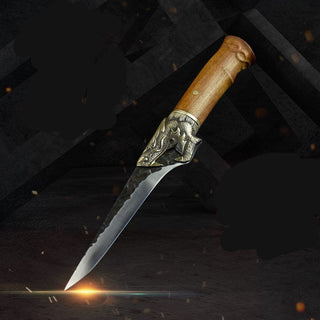
Molybdenum-bearing steels such as 7Cr17MoV are the pragmatic middle. They resist the acids that live in a prep kitchen, from citrus to brine, and they come back on a stone without a specialist. If you are standardizing a whole team on one steel, this is the one to standardize on.
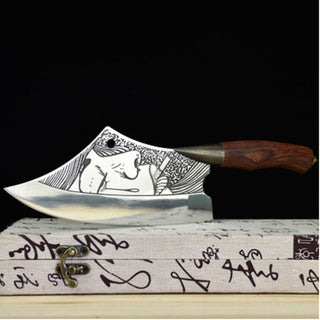
Blade length decides the job, not the price
Blade length is the single specification most often got wrong, because the instinct is that longer is more capable. In practice each length has a range of cuts it does well and a range it does badly, and a kitchen needs two or three lengths rather than one long one.
| Blade length | What it does | Station |
|---|---|---|
| 110 mm | Peeling and coring, turning vegetables, detail work in the hand | Garnish and pastry, bar prep |
| 140 mm | Shallots, herbs, small proteins — most tasks a cook does standing still | Utility knife on every bench |
| 165 mm | The compromise: fine enough for herbs, long enough for a cabbage | Small kitchens with one knife per cook |
| 200 mm | Full slicing stroke — portioning and breaking down large vegetables | The main chef knife on the line |
| 230 mm cleaver | Bone and joints, shellfish, hard squash | Butchery and heavy prep |
A 200 mm blade with a 30 cm total length is the working default — enough edge to slice through a whole cut in one stroke, which is what keeps the cut clean and the cook's wrist neutral. Both of the 200 mm knives in our catalog sit at that geometry, one in high-manganese steel with a 3 mm spine, the other in molybdenum steel at 2.5 mm.
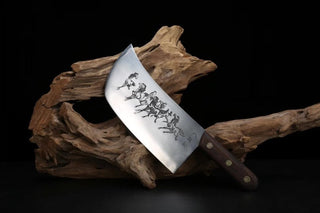
Below that, a 140 mm blade is not a small chef knife — it is a different tool with a different grip. It is the knife a cook picks up for shallots and puts down for a pumpkin, and every bench should have one.
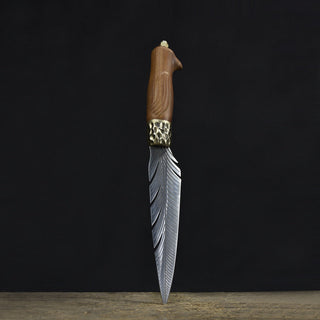
Spine thickness, and what it means at the board
Spine thickness is the number nobody asks for and everybody feels. At 2.5 mm a blade is light and quick, and it will wedge in dense root vegetables. At 3 mm it has enough mass to fall through a cut under its own weight. At 6 mm it is no longer a slicing knife at all — it is a cleaver, and the thickness is there to survive contact with bone.
That last category deserves its own knife rather than a heavy chef knife pressed into service. A 230 mm cleaver blade at 6 mm through the spine takes joint and shell impacts that would roll or chip a thinner edge, and it does so in a tough forged steel chosen for exactly that.
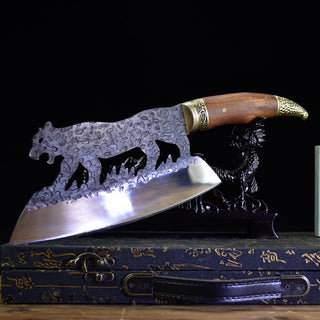
The corollary matters too: never buy one knife thick enough for everything. A 6 mm spine on the vegetable station is tiring to use, and it bruises anything soft rather than cutting it.
How many knives does a kitchen actually need?
Fewer than most opening lists suggest, and more than one per cook. The honest minimum is a 200 mm chef knife per active station, one 140 mm utility knife per bench, one 110 mm paring knife per prep cook, and a single cleaver for the kitchen.
A café doing sandwiches and cakes can run on the 140 mm and 110 mm pair and skip the cleaver entirely. A bistro turning 60 covers needs the 200 mm on the line plus utility knives behind it. A restaurant breaking down whole fish or poultry in house needs the cleaver and a dedicated boning blade, which is a separate purchase from the specialty and fish knives range rather than a chef knife at all.
Buy in whole sets only when you are opening and every station starts empty at once. After that, replace by role — a kitchen that loses its utility knives every three months does not need another full cutlery set, it needs four more 140 mm blades.
Handles and tangs: the parts that fail first
The handle is where a commercial knife dies. Wood handles in rosewood or walnut are comfortable and grip well when wet, but they are not dishwasher components: repeated hot cycles swell the timber, and the joint against the bolster opens up. Hand-wash and dry them, and they outlast the blade.
Look for a visible tang running through the handle and pinned rather than glued, and for a brass or copper bolster that is fitted rather than decorative. Those two details separate a knife that survives three years on a line from one that loosens in six months.
Weight distribution follows from the same construction. A knife balanced at the bolster pivots naturally through a rocking cut; one balanced too far back forces the cook to push, which is where fatigue and slips start.
Five mistakes buyers make with a chef knife
- Buying one length. The most common and most expensive error — it costs time on every cut that length does badly.
- Choosing steel harder than the team can sharpen. A hard edge nobody can restore is a blunt knife within a month.
- Paying for the pattern. Layered blades are judged on the core steel; the layers are finish.
- Putting wood-handled knives through the dishwasher. This ruins good knives faster than any amount of use.
- Skipping the cleaver and using a chef knife on bone. One joint is enough to chip an edge that then needs regrinding.
If you are equipping from scratch, start with the 200 mm blade and the steel, decide the utility lengths after, and add the cleaver only if the menu breaks down whole product. The chef knives range is where the first decision gets made.
Not sure which lengths your menu actually needs? Tell us what your kitchen prepares and how many stations run at once, and we will put a knife list together against it.


