

A cafe takes most of its money in three hours. This guide to how to open a coffee shop builds the counter around that peak — what the queue is really waiting for, where the budget lands, and which permits gate your opening day.
At ten past eight on a weekday there are eleven people in front of your counter, and nine of them want milk in something. That queue is the business. A cafe takes the bulk of its day's money in the two or three hours either side of nine, and the average check barely moves — so the only real variable is how many people you serve before the ones at the back give up and walk to the chain across the road.
Which is why a coffee counter gets specced backwards from its peak rather than forwards from a mood board. The beans and the tiling belong to the brand; the queue belongs to the steel behind the counter — how fast the machine recovers between shots, whether one grinder is feeding two baristas, whether an iced-latte order lands in the same square meter as the espresso. That kit is also the one launch cost you can pin down early: rent and fit-out swing with the postcode, but a counter is a known build. This guide walks it in the order the rush tests it, then covers the money and the paperwork.
A coffee shop is a three-hour business
Settle which kind of cafe you are opening before you buy anything, because the format decides the shape of your peak, and the peak decides the kit. Four models dominate, and they spend very differently.
A specialty espresso bar puts most of its budget into the machine and the grinders, because the coffee is the product and the menu is deliberately short. A high-street cafe spreads the same money wider — espresso, cold drinks, a food display, back-of-house storage, warewashing — and earns across all of it. A grab-and-go kiosk buys speed and display, skips seating almost entirely, and lives or dies on the hand-over. A drinks-led shop selling smoothies, fresh juice, and iced everything leans harder on blenders and ice than on espresso.
Then write your menu out as timings rather than as drinks. A flat white is under a minute of barista attention. An iced latte adds a trip to the ice bin. A smoothie ties up a blender and a rinse. A toasted sandwich pulls the same person away from the group head for a minute and a half. Do that arithmetic against the peak you expect and the bottleneck names itself — usually not the machine everyone frets about, but the second grinder nobody budgeted for or the ice bin that empties by eleven.
Format also sets what has to sit behind the counter, not just on it. A seated cafe needs dry and cold storage plus warewashing that a kiosk can skip; a real food offer pulls you into refrigeration and display that a coffee-only bar never touches. Settle this before you sign a lease, because a room with no back-of-house makes the decision for you.
Where does the queue actually stall?
In five places, in this order: the grind, the group head, the cold-drink station, the food display, and the hand-over at the till. Each has a piece of kit behind it, and under-speccing any one of them caps the whole counter — a cafe serves at the speed of its slowest station, never the average of all five. Our coffee bar collection is arranged along the same line.
Espresso: the machine and the grinder are one decision
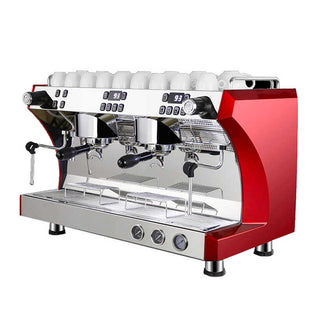
Buy for your peak hour, not an average one. Recovery time between shots is what a queue feels, and a machine that needs to reheat after four drinks turns a twelve-person line into a fifteen-minute wait. Two groups suit most cafes, because two baristas can work at once through the morning; a quiet kiosk copes on one, a high-traffic site steps up to three. Our professional 2-group espresso machine is the standard workhorse for a cafe counter, and the full espresso machine range covers the tiers either side of it.
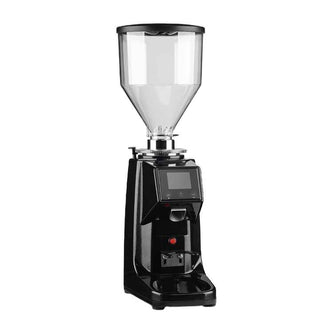
Match the grinder to it in the same purchase. A weak grinder wastes a good machine outright: grind consistency is what makes the shot, and burrs that heat up and drift mid-rush will hand you four different espressos out of one hopper. Give each bean its own unit — house espresso on one, decaf or a single origin on the other — so nobody stops the line to re-dial. A commercial grinder with conical burrs holds its grind through a busy service; size the burrs to your throughput from the coffee grinder collection.
Water is an ingredient, not a utility
A double espresso leaves the group head as roughly forty grams of water carrying a couple of grams of dissolved coffee, which makes your mains supply most of what the guest tastes. Hard or heavily chlorinated water flattens the cup and scales up the boiler of the machine you just bought, and a scaled boiler is a repair bill and a warranty argument at the same time. Test the hardness of your supply before anyone plumbs anything in, then size filtration or softening to that number and to your daily volume. Budget it inside the espresso station rather than as a plumbing afterthought — it is the cheapest protection available for the most expensive thing behind your counter.
Cold drinks stopped being a summer sideline
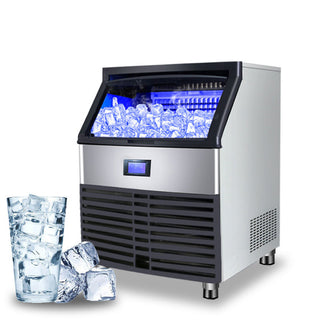
Iced coffee and cold brew now sell year-round in most markets, and they reshape the counter more than owners expect. Ice comes first, and it is the most under-sized machine in the trade: every iced drink, every blended one, every jug of cold brew draws on the same bin, and a hot week can double the draw overnight. Our commercial automatic cube ice maker produces 80 to 120 kg a day depending on the model — size it against the hottest day you can expect, with headroom, from the ice maker collection, and give the bin a home the barista reaches without turning around.
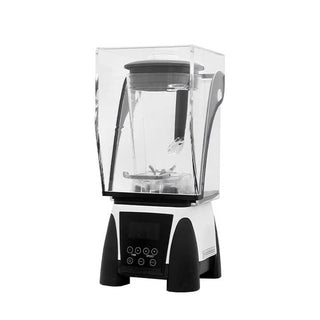
A blender covers everything blended — frappés, smoothies, iced-coffee slushes — and it needs enough motor to crush ice back to back for an hour without stalling. Domestic units die in weeks on that duty. A 1800 W commercial heavy-duty blender takes the rush, and if blended drinks are a real part of the menu rather than a courtesy, spec a second jug so one is always rinsed and ready. The rest of the blender range scales up from there.
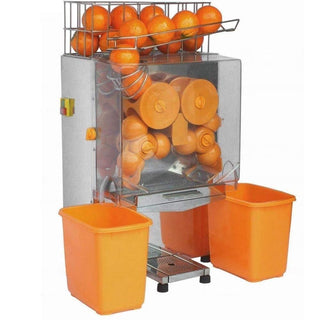
Fresh juice is the strongest add-on a cafe has: it reads as premium and carries a higher ticket than filter coffee. A dedicated citrus press squeezes to order without tying up the blender or the barista who is already building drinks. Our automatic orange juicer takes whole fruit and presses to order, so a breakfast run of fresh orange juice never queues behind the espresso.
The display sells while the barista's back is turned
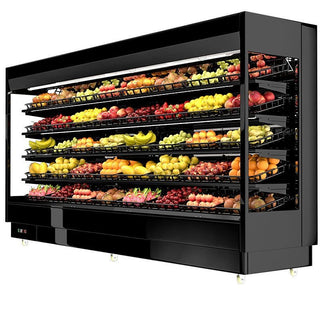
Food and cold drinks on show are the closest thing a cafe has to a second member of staff. They sell on impulse, at the moment someone is already committed to paying, and they lift the average check without costing a second of barista time. An open multideck chiller puts bottled drinks and sandwiches at eye level where a guest simply takes one, and its air curtain holds temperature with the front open, which is what makes self-serve work at all. Our open multideck display chiller handles that wall; the wider refrigeration collection covers the rest.
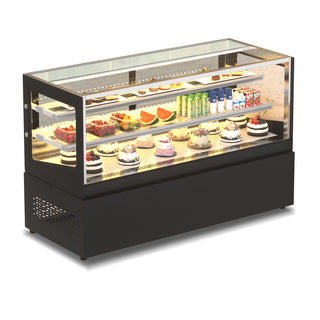
The pastry case does the same job at the till, where the decision gets made in the last two seconds before payment. A refrigerated cabinet keeps cream cakes and cold food both safe and visible, which a wicker basket manages neither of. Our commercial refrigerated display cabinet puts the bakes where the impulse happens. Behind the counter, keep bulk milk and stock in their own fridge from the preservation range — the day the display gets raided mid-service for a milk jug is the day you learn why that matters.
One machine worth photographing
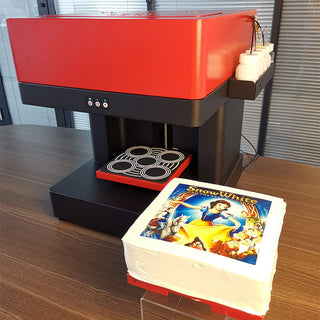
Every cafe needs a reason to be posted, and a single piece of kit can carry it. An edible-ink printer lays a photo, a logo, or a face onto the foam of a latte or the top of a cookie, which turns a standard drink into a talking point and a birthday into a booking. It takes little counter space and asks nothing of the barista's technique — we broke down how it works and where it earns its place in our guide to coffee and cookie printers, and the coffee printer collection has the range.
Roasting in-house is the bigger version of the same idea: it puts the craft on show and gives you retail bags to sell at the till. That is a second business rather than a starter purchase, though — the coffee roaster collection is there when the shop trades well enough to want it.
The last ten seconds: cups and the till
The hand-over is where a fast counter can still lose its queue. To-go cups and lids are a running cost you buy branded and in volume, and running out of medium lids at nine in the morning is its own small disaster. Ceramics and glassware pay for themselves in a seated room, in how it reads and in packaging you never buy — go deep on the pieces you use most from the cups and plates collection and the glassware collection, because breakage in a cafe is constant rather than occasional. Then size the POS to your peak: two card terminals and a pre-order screen move a morning queue that one till and a chatty payment flow will hold up.
The counter is a loop, not a line
Layout decides service speed more than any single machine standing on it. The test is simple: a barista should build a drink inside one turn, without taking a step. Grinder beside the group head, milk fridge under the steam wand, cups above the machine, ice within reach of the working end. Every extra pace is a second, and a second gets multiplied by two hundred drinks.
Run the guest one way and keep the barista in place. Order and pay at one end, build in the middle, collect at the other, so nobody arriving crosses somebody leaving. Keep the cold-drink station — ice, blender, juicer — off the espresso line rather than in it, or one smoothie order stalls three coffees behind it. On a busy site, separate payment from collection entirely: two short queues that move beat one long one that doesn't, and the pickup crowd stops blocking your door.
Then draw the whole thing for the peak, on paper, before anyone fixes plumbing or power. The machine, the ice maker, and the multideck all want dedicated services — the espresso machine usually its own circuit and a treated water line, the ice maker a drain — and moving any of them after the fit-out is the most expensive change on the build. Leave clear bench either side of the machine while you are at it, because a cramped counter slows a good barista as surely as a slow grinder does.
How much does it cost to equip a coffee shop?
Cost the build by format rather than by shopping list, because the same total lands in very different places depending on what you are opening. Two purchases dominate almost every cafe — the espresso setup and refrigeration — while everything else scales with how much food and how many cold drinks you sell. Cups and ceramics are cheap individually and permanently recurring, which is the line most first budgets forget.
| Format | Has to be there on day one | Add when the trade pays for it | Biggest single spend |
|---|---|---|---|
| Grab-and-go kiosk | Two-group machine; one grinder; ice maker; grab-and-go chiller; cups | Second grinder; blender | Espresso setup |
| High-street cafe | Espresso setup; ice; blender; multideck chiller; pastry case; back-of-house fridge; warewashing | Citrus juicer; edible-ink printer | Refrigeration as a whole |
| Specialty-led shop | Two- or three-group machine; a grinder per bean; water treatment; ceramics | Small-batch roaster; retail shelving | Grinders and water |
| Drinks-led shop | Heavy-duty blender; oversized ice capacity; citrus juicer; cold storage | Second blender; slush or soft-serve | Ice capacity |
Read that as an order of purchase, not a wish list. Everything in the second column is a hard stop on service, so it has to be there when you open; everything in the third can wait until trade tells you it is worth buying. Equipment is also only one line of a launch budget — the fit-out, the rent, the permits, and your opening stock sit on top, and they vary far more by location than the kit does. Each product card carries its live price when you are ready to cost a real list.
Which permits does a coffee shop need before it can trade?
A cafe clears a shorter list than a bar, because there is no alcohol licence to wait on and that is the slowest step in hospitality licensing. What remains is a registered or notified food business, a premises and fire sign-off, and two permissions cafes routinely forget: one for the music you play, one for the tables you put outside. The food registration and the premises approvals are what actually gate your opening date, so lodge them while the fit-out is still unfinished.
| Market | Core registration | Easy to miss |
|---|---|---|
| United Kingdom | Register as a food business with the council at least 28 days before you trade (free, but legally required); Food Hygiene Rating inspection; fire risk assessment | TheMusicLicence from PPL PRS for any music played; a council pavement licence for outdoor tables |
| Australia | Notify the council as a food business; a certified Food Safety Supervisor under Standard 3.2.2A (adopted state by state — confirm yours); ABN, business name, and GST registration | OneMusic Australia licence for recorded music; council outdoor-dining permit |
| United States | Business license and EIN; health-department food service permit with food-handler or ServSafe certification; certificate of occupancy and fire sign-off | ASCAP, BMI, and SESAC music licenses; sidewalk-seating permit; requirements stack at state, county, and city level |
| United Arab Emirates (Dubai) | DET trade licence covering F&B activity; Dubai Municipality food establishment permit with an approved food safety supervisor and staff health cards; Civil Defence clearance | Municipality approval for outdoor seating; no liquor licence while you serve no alcohol |
Two things are worth planning for even if they are not on your list today. If you ever want an evening service with wine or beer, that licence is a separate application with its own lead time and often its own conditions on trading hours — our guide on how to open a bar covers what it involves. And if the food offer grows past pastries, then extraction and waste handling come into the premises approval, which is a build decision rather than a form you sign later.
Treat all of the above as a map rather than legal advice. The exact documents, fees, and timelines differ by council, state, and emirate, and they change; confirm your own list with the local licensing authority before you commit to an opening date, because the food and premises approvals are the ones that move it.
What we would change on most cafe equipment lists
Equipment lists reach us most weeks from people opening their first cafe. Four gaps show up in nearly all of them.
The grinder is under-specced against the machine. People spend carefully on a three-group flagship, then pair it with one entry-level grinder — which caps the counter at the grinder's speed and hands the barista a drifting shot on top of that. The fix costs a fraction of the mistake: one grinder per bean, burrs sized to the throughput you actually expect.
The ice maker is sized to an average day. Ice is not a summer line any more, and a machine that copes in May runs dry by eleven in a July heatwave, at which point every iced drink on your menu is off. Size against the hottest week you can imagine, and check bin volume separately from daily output — production per day means nothing if the bin empties mid-rush.
Water treatment is missing entirely. It appears on almost no first list, and it is the cheapest way to protect the most expensive machine you own while holding the cup steady from open to close. Ask about hardness at the site viewing, not after installation.
Storage arrives last, if at all. A cafe needs a fridge the customers never see, plus dry storage for beans, cups, and syrups. Without it the display case becomes the milk fridge, and the display is your best salesperson. The same instinct explains the deeper problem with most lists: they are drawn as shopping lists rather than as counters. Sketch the workflow first, put each machine where the hands already go, and the list rewrites itself around the rush it has to absorb.
Where a coffee shop stops being a coffee shop
Narrow the menu and you get an espresso bar. Change the drink and the kit changes: a juice bar, smoothie bar or bubble tea shop runs on blenders and cold, and a tea house on brewing time. Add food and it becomes a deli, sandwich shop or brunch restaurant.
Not sure what your counter has to absorb? Tell us the kind of coffee shop you are opening — specialty bar, high-street cafe, kiosk, or a drinks-led menu — and roughly how many drinks you expect in your busiest hour. We will come back with an equipment list and a budget built around that peak, not a generic starter kit.


