

In short: five minutes from order to handoff is the whole brief. To open a fast casual restaurant that holds it, split the time across the three stages of an order, size each to your peak orders per hour and equip the slowest stage first.
Five minutes, measured from "next, please" to a name called at the pickup shelf. That is roughly the promise a fast casual restaurant makes, and it is what separates the format from a sit-down room with a counter. Knowing how to open a fast casual restaurant comes close to designing a small production line with three stations: the point where orders come in, the line where food is made, and the shelf where it goes out.
Each station has its own speed. The slowest one sets how many guests you can serve in the lunch hour, and no amount of speed elsewhere makes up for it. A kitchen that can make 120 bowls an hour, fed by a single cashier who takes 90 seconds per order, serves 40.
Where do the five minutes go?
A workable split is about one minute to order and pay, about three minutes to make the food, and under a minute to hand it over. Treat it as a budget. If one stage runs over, another has to give time back, and in practice the kitchen is the stage that absorbs everyone else's delays.
The arithmetic behind orders per hour is simple, and worth doing on paper before you sign a lease. One person taking orders at 60 seconds each can handle 60 orders an hour at most. One builder assembling a bowl in 45 seconds can finish 80. A fryer basket that takes three minutes per load, with room for four portions, turns out 80 portions an hour per basket. Put the numbers for your own menu side by side, and the smallest one is your real capacity.
That is also why the format rewards a short menu. Every extra item with its own cooking method adds a station, and every station is another place where the five minutes can leak. Most successful fast casual concepts are built around one base (a bowl, a wrap, a burger, a flatbread) with toppings that change, because a single assembly line can then make everything on the board.
Before choosing any equipment, write down three numbers: the orders you expect in your busiest hour, the longest cook time on the menu, and how many of those items the average order contains. Everything below sizes against them.
The order point, and how many ways in
Orders reach a fast casual kitchen through three doors: the counter, self-order kiosks, and phone or delivery apps. The counter is the only one you need on day one. The others add capacity when the counter becomes the slowest station, which usually happens once the lunch queue reaches the door.
What matters for throughput is that every order, whatever door it came through, arrives at the kitchen in the same place and in the same format. A kitchen reading tickets from the till, a second printer for the kiosks and three delivery tablets on a shelf will lose orders at peak. One POS routing everything to a kitchen screen at each station keeps the line reading from a single queue.
The hardware side of that stack (counter terminals, kiosks, kitchen displays and menu boards) has its own buying guide, including a simple test for when a kiosk pays back. You can browse the POS systems and self-order kiosks collections directly.
One layout rule for the front of house applies whatever you install. Guests who are ordering and guests who are waiting should stand in different places. If the kiosks sit next to the pickup shelf, the two crowds merge, and staff spend the rush asking who is waiting for what.
How do you plan a fast casual restaurant by orders per hour?
Plan a fast casual restaurant by the number of orders it has to serve in its busiest hour, because that number decides how many order points, assembly lines and cooking stations you build. The table below is a planning sketch for three sizes of site, not a rule. Your menu and cook times will move the lines.
| Peak orders per hour | Order points | Make line | Cooking | Handoff |
|---|---|---|---|---|
| About 60 | One counter terminal; a handheld for the queue at peak | One assembly line, one builder plus a runner | One griddle or oven; one fryer if the menu needs it | One pickup shelf, names called |
| About 120 | Counter plus one or two kiosks; app orders | One longer line with two builders, or separate hot and cold lines | Double fryer; clamshell griddle or speed oven; kitchen screen per station | Pickup shelf with an order-ready screen; separate shelf for delivery drivers |
| 200 or more | Kiosks and app orders as the main channel; counter as backup | Two parallel lines, one reserved for digital orders | Duplicated hot equipment so one breakdown does not stop service | Dedicated expeditor; delivery pickup away from the main queue |
The jump from the first row to the second is where most new operators get caught. A site planned for 60 orders an hour that turns out to be popular cannot simply work faster, because the line is physically one person wide. Leaving space and power for a second builder, or a second fryer, costs little at the fit-out and a great deal later.
Where the budget goes
The biggest single spends are the hot line and the refrigeration around it, because they set the ceiling. Extraction comes close behind, and it is the one cost that grows with every piece of gas or fryer equipment you add. The front-of-house technology is cheaper per unit but multiplies with the number of order points, and the software behind it is a recurring cost rather than a purchase.
The places to save are the ones that do not limit orders per hour. Smallwares and dining furniture can start modest and be upgraded. The places not to save are the station you identified as the slowest, and the refrigeration that keeps the line stocked. Current prices for everything below are on the product pages, and the full restaurant equipment catalog is organized by zone.
The make line: cook ahead, hold, assemble to order
A fast casual kitchen works in two speeds at once. Proteins and grains are cooked in batches before and during service, held at temperature, and then assembled to order in under a minute. Only a few items are cooked from raw when the order comes in, and those are the ones that decide your equipment.
Cooked to order
If the menu includes burgers, melts or pressed sandwiches, a clamshell griddle is the piece that makes the five-minute promise realistic. It cooks both sides at once, and the maker rates it at about half the cook time of a flat top, with nobody standing over the patty to turn it. The electric model below has a 545 × 450 mm lower plate and a 225 × 410 mm upper platen, and draws 12 kW on a 380 V supply, which your electrician needs to know before the fit-out.

Fries and fried sides are the most common bottleneck in the format, because almost every order includes one and the cook time cannot be shortened. Size the fryer to the busiest fifteen minutes, not the hourly average. Two separate tanks also let you keep plant-based and meat items apart, which matters more every year on a fast casual menu. This double fryer has two 25-liter tanks and comes as either gas or electric.
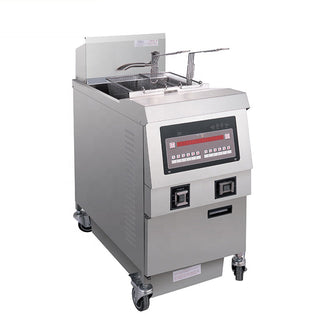
Oil life is a throughput issue too. Tired oil cooks slower and darker, and changing it mid-service takes a fryer offline. A mobile oil filtration cart cleans the oil at the fryer between rushes, and the rest of the range is in deep fryers.
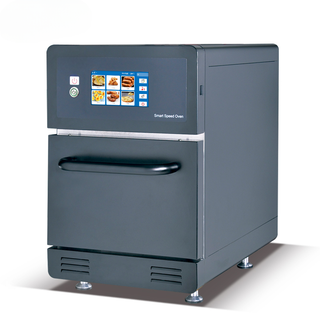
For toasted wraps and reheated components, a speed oven does in a minute or two what a convection oven does in ten. It adds convection and radiant heat to the microwave, so food browns instead of steaming. The unit below runs from 1 kW to 3 kW on a single electric supply and fits on a counter at 658 mm wide. Larger models are in the microwave and speed oven collection.
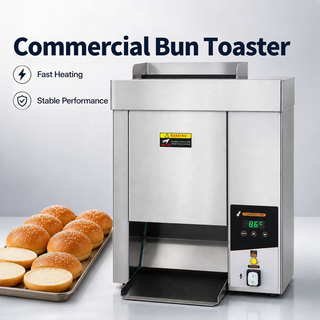
Burger concepts need one more machine that is easy to forget. A toasted bun is expected, and toasting buns on the griddle takes space from the patties. A conveyor bun toaster rated at up to 1,400 buns an hour runs beside the line with nobody attending it, and needs only a standard 2 kW electric supply.
The rest of the hot line, including flat-top gas griddles and ranges, sits in gas ranges and griddles.
Held hot
Batch-cooked rice, grains, braised meats and sauces are held in a bain marie at the assembly line, where the builder can reach every pan without stepping away. The 12-pan electric unit below holds between 30 and 85 °C, with each pan at 325 × 176 mm and 150 mm deep, which is enough for a full lunch base menu in one run of counter.
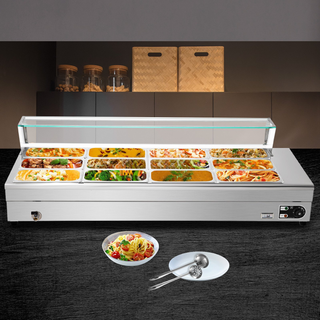
Holding is where quality quietly slips, because food held too long dries out long before it becomes unsafe. Short batches cooked often beat big batches cooked early. Our guide to choosing hot holding equipment compares bain maries, chafing dishes and heated displays in detail.
Held cold, and the assembly line itself
The cold side of the line is a refrigerated prep counter: pans of toppings and dressings on top at 2–8 °C, backup stock in the cabinet underneath. The builder refills from below without leaving the station. The model below comes in lengths from 1.2 to 2.0 meters, so you can match it to the number of toppings rather than the other way around.

Under the hot side, a drawer chiller holds raw patties or portioned proteins at 0–5 °C directly beneath the griddle, so the cook never leaves the station to restock. Drawers are faster to work from than doors at knee height. The undercounter GN drawer chiller takes full-size gastronorm pans, and more models are in undercounter and worktop refrigeration.
Prep before the doors open
Everything on the line was cut, sliced or shredded earlier in the day, and in a fast casual kitchen that prep volume is large. A vegetable cutter saves hours of knife work each morning, which is the difference between a prep cook who starts at 7:00 and one who starts at 9:00. The benchtop model below is rated at 300 kg an hour and ships with five blades, including 2 and 4 mm slicing discs and an 8 mm dicing grid.
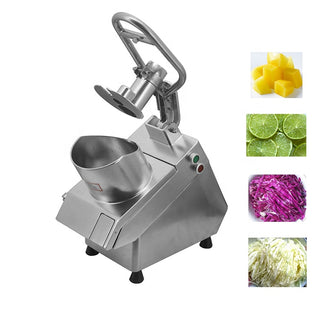
Heavier-duty cutters and processors are in food processors and cutters.
What happens at the pickup shelf?
The handoff is the last minute of the five, and it is lost when guests cannot tell whether their order is ready. A clearly signed pickup point, separate from the ordering area, with a screen or a called name for each finished order, keeps it under a minute. Without that signal, guests crowd the counter and staff stop making food to answer questions.
Delivery changes the handoff more than any other part of the building. Drivers arrive in bursts, want to be in and out in seconds, and should not queue with dine-in guests. A shelf or a pass-through by a side door, with orders bagged and labeled, keeps them out of the line. Our guide to opening a ghost kitchen covers packaging and dispatch for food that has to travel.
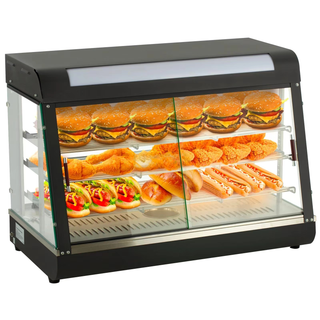
Pre-made items can skip the line entirely. A heated display at the counter sells wraps, pastries or boxed sides that were made in quiet moments, and each one is an order the make line never sees. The three-tier unit below holds food between 30 and 85 °C behind glass and is 1.2 meters wide.
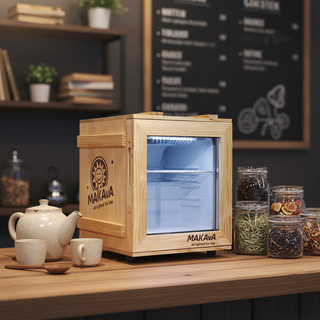
Drinks work the same way. A grab-and-go beverage fridge next to the till lets guests add a drink themselves, which lifts the check without adding seconds to the order. The countertop cooler below holds 52 liters at 0–10 °C, and its transparent door plays video or promotions while the drinks stay visible. Larger glass-door fridges are in display fridges.
Behind the line: the dish area and the air
Two systems that guests never see can still stop service. The first is warewashing. A fast casual kitchen washes fewer plates than a full restaurant but far more pans and inserts, and the line runs out of clean hotel pans at exactly the moment the bain marie needs refilling. A hood-type dishwasher such as the commercial hood-type dishwasher, which takes 16 dish sets per cycle, keeps pace with a busy lunch. The range is in commercial dishwashers.
The second is extraction. Every fryer and griddle needs a canopy over it, sized to the equipment underneath, and the canopy's size follows the hot line you just planned. Adding a second fryer later often means a bigger hood and new ductwork, which is why the table above suggests leaving room at the fit-out. Canopies and ventless recirculating units are in exhaust hoods and extraction.
Drains and power follow the same logic. Floor drains belong under the dish area and the prep sinks, and a clamshell griddle on 380 V needs a three-phase supply that many small retail units do not have. For the full list of kitchen zones, our guide to commercial kitchen equipment goes through each one.
What licenses and permits does a fast casual restaurant need?
A fast casual restaurant needs the same core approvals as any restaurant: business registration, a food-safety permit or registration, and premises approvals for fire and occupancy. Alcohol and music add separate licenses. Here they are in the order you would normally start them, with what applies in the US, the UK and Australia.
- Register the business. In the US, that means a business license and an EIN before anything else can be issued in the company's name. In the UK and Australia, set up the business entity first as well, since the food and premises applications below are made in its name.
- Get the premises approved. In the US, the site needs a certificate of occupancy and has to meet fire-code occupancy limits, which also caps how many guests you can seat. In the UK, you need a fire risk assessment for the premises. In Australia, the council approves the premises and a fire safety statement covers the building.
- Register or permit the food business. In the US, the local health department issues the permit, and your team needs food-handler or ServSafe certification. In the UK, register with the local council at least 28 days before opening, then expect an Environmental Health inspection under the Food Hygiene Rating Scheme. In Australia, notify or register the food business with the council, and in several states name a Food Safety Supervisor.
- Check late-night trading. This step is specific to the UK and easy to miss. Selling hot food or hot drinks between 11 p.m. and 5 a.m. counts as late-night refreshment and needs a Premises Licence from the council, even if you never serve alcohol.
- Add alcohol only if the concept needs it. In the US, the liquor license comes from the state Alcohol Beverage Control board and often the county, and it is the slowest approval of all; a beer-and-wine license is usually simpler than a full one. In the UK, alcohol needs a Premises Licence plus a Personal Licence for the Designated Premises Supervisor. In Australia, apply to the state or territory liquor regulator, and every staff member serving alcohol needs a current RSA card.
- License the music. Background music in a public space is licensed separately: through ASCAP, BMI and SESAC in the US, TheMusicLicence from PPL PRS in the UK, and OneMusic Australia.
This is an overview, not legal advice. Requirements and processing times vary from one council or state to the next, so confirm each step with your local authority before you commit to a lease or an opening date. Steps two and three sit on the critical path for most fast casual openings.
Mistakes that cost orders per hour
Most problems in a new fast casual restaurant show up in the first busy week, and almost all of them are about a station that turned out slower than planned.
| Mistake | How it shows up in the rush | What to do instead |
|---|---|---|
| Sizing the fryer to the hourly average | Fries arrive last, and finished bowls wait on the pass for them | Size to the busiest fifteen minutes; two tanks rather than one |
| One cashier for the whole queue | The kitchen stands idle while the line reaches the door | A handheld for queue-busting, then kiosks once the numbers justify them |
| Kiosks next to the pickup shelf | Ordering and waiting guests merge into one crowd | Order at one end of the room, collect at the other |
| Cooking big batches early | Dry rice and tired proteins by 1:30 p.m. | Smaller batches, cooked more often, with the bain marie right at the line |
| Delivery tablets on the counter | Missed app orders and drivers waiting among guests | Every channel into one POS; a separate delivery shelf |
| No room to grow the line | A popular site cannot add a second builder or fryer | Leave space for one more station, with the power and hood capacity to run it |
If you are still deciding between formats, our guide to how to open a restaurant covers the full-service kitchen behind the pass.
Planning a line for a lunch rush? Send us the menu, the orders you expect in your busiest hour and the space you have, and we will size the hot and cold line to match.


