


In short: how to open a karaoke bar is a question about where sound escapes. Four leak paths decide whether the venue survives its neighbours, and the licence people forget is the music one, not the alcohol one.
The complaint does not come from the room next door. It comes from the flat above, at 1:40 a.m., about a bass line that the person complaining cannot even identify.
Karaoke bars close over noise more often than over trade. The format puts amplified music and enthusiastic amateur singing into a building at exactly the hours when everyone around it is asleep, and the venues that last are the ones that treated that as an engineering problem before opening rather than a complaints problem afterwards.
So this guide is built around the sound: where it gets out, what stops it, and what the paperwork demands in return.
The four places sound escapes
Noise leaves a venue through four distinct paths, and they need four different fixes. Treating them as one problem — "we'll soundproof it" — is how budgets get spent on the wrong surfaces.
| Path | What escapes | What stops it | Cost to fix later |
|---|---|---|---|
| Room to room | Mid and high frequencies through partitions | Double stud walls, mass, no shared air gap, solid-core doors with seals | Moderate — walls can be rebuilt |
| Room to structure | Bass, through floors and beams | Isolated floors, decoupled speaker mounts, subwoofers off the structure | High — this is why bass complaints are the serious ones |
| The entrance | Everything, in bursts, when the door opens | An acoustic lobby: two doors, never open at once | Moderate, but needs floor space you may not have |
| The street | Guests, smoking, taxis, goodbyes at closing | Door staff, signage, a managed dispersal routine | Free to fix, and the most common actual complaint |
Note the last row. Operators plan for the first three and are then reported for the fourth, because a group of people saying goodbye outside at two in the morning is louder to a bedroom window than a sealed room full of singing.
Note also the second. Bass travels through structure rather than air, so it goes where insulation does not: down through joists, along beams, into the flat above. A subwoofer sitting directly on a timber floor is a transducer bolted to somebody's ceiling. Getting it off the structure — isolation pads, decoupled mounts, or simply choosing a room on a concrete slab — does more than any amount of foam on the walls.
Private rooms or one open floor?
This is the format decision, and it changes the acoustics, the revenue model and the staffing all at once.
The Japanese-style karaoke box model sells private rooms by the hour. Groups book, drink, sing to each other, and never perform for strangers — which is the entire appeal for the majority of the market. Revenue is room-hours plus drinks, it is bookable in advance, and it fills on weekday evenings that an open bar cannot.
The Western open-floor model puts one stage in a bar. Revenue is drinks alone, the room lives or dies on whether a crowd forms, and the singing is a performance rather than a private activity.
Acoustically the box model is harder and safer: many small sources needing many partitions, but each source is contained. The open floor is one large source, which is simpler to treat and impossible to turn down when someone is singing badly at full volume.
A hybrid — rooms plus a small open bar — is what most successful venues end up as, because the bar catches walk-ins and the rooms carry the margin. It also needs the most careful layout, since the corridor between the two is exactly where room noise and bar noise meet.
The A/V rig a karaoke bar actually needs
Karaoke is a live vocal application, which makes it more demanding than a bar playing recorded music and much less demanding than a live music venue.
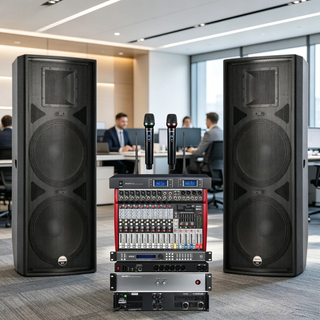
An all-in-one PA with speakers, amplification and wireless microphones covers a main floor or a large room without assembling components. What matters more than raw wattage is headroom: a system running near its limit distorts, and distortion is what makes a room sound loud without being intelligible — which in turn makes people shout over it.
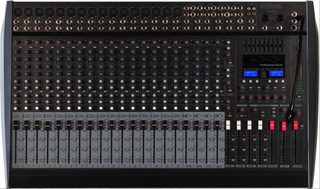
A mixing console earns its place the moment you have more than two microphones and a music source. It is also where the single most useful karaoke feature lives: reverb on the vocal channel. A little of it flatters an average singer enormously, and a venue where guests sound better than they expected is a venue they come back to.
The unglamorous detail: microphones are consumables in this business. They get dropped, sung into wetly, and occasionally taken home. Buy more than you need and expect to replace them.
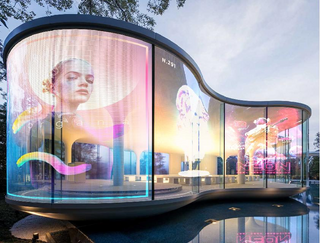
Screens carry the lyrics, and the specification is about viewing distance rather than resolution. In a private room the screen is two meters from the singer; on an open floor it has to be readable from the back, which usually means a larger panel than the room's size suggests.
Lighting does the same job here as anywhere: it decides whether the room reads full. In a karaoke bar it does one more thing — it lets a nervous singer feel less exposed, which measurably increases how many people get up.
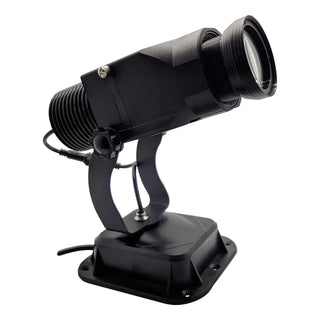
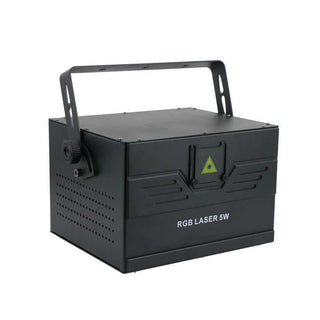
Our guide to stage lighting, lasers and haze covers the layers, the haze that makes beams visible, and the rules on where a laser beam is allowed to point. The screens and lasers ranges cover the display and effect side.
The bar still has to be a bar
Karaoke venues consistently under-build the bar, on the theory that the singing is the draw. The singing is the draw; the drinks are the revenue.
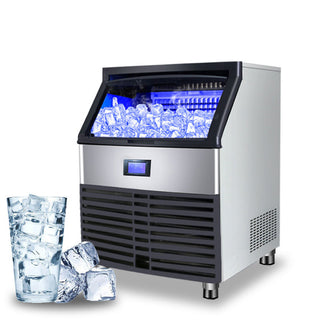
Ice is the constraint nobody plans for. A karaoke bar sells long drinks in volume over a compressed few hours, and running out at eleven means selling nothing until the machine catches up. Size it against the peak two hours rather than the day.

Frozen and blended drinks sell disproportionately well in this format, and a blender behind the bar is loud enough to matter acoustically — put it away from the microphone feed, or it will appear in the room.
Room service is the other bar question. In a box venue, drinks have to reach rooms without a member of staff standing in a corridor waiting: a call button or an app order, a tray, and a route that does not cross the entrance. Get this wrong and the drink spend per room-hour halves. The bar equipment range covers the service side.
How to open a karaoke bar without a noise complaint
Five decisions, in the order they have to be made.
Choose the building for its neighbours. A unit under flats is a different business from one in a commercial block or a basement on a concrete slab. This is the single most consequential decision, and no amount of later spend reverses it.
Get a noise assessment before the lease. An acoustic consultant measuring the existing background level and modelling your output costs a fraction of what the licensing objection process will, and in many jurisdictions it becomes the evidence you submit anyway.
Design the acoustic lobby into the floor plan. Two doors with a space between them, so the street never hears the room directly. Retrofitting this means losing floor area you have already paid rent on.
Set limits in the system, not in the rules. A sound limiter that caps output physically works; a sign asking guests to keep it down does not. Some licences require one.
Manage the pavement. Dispersal is a staffing routine — someone at the door after midnight, a smoking area away from windows, taxis called to a specific spot. This is the cheapest of the five and the one that prevents the most complaints.
How does a karaoke bar make money?
Two revenue lines, and the ratio between them is the whole business model.
Room hire is the predictable one. A box venue sells time — an hour, two hours, a package with a drinks minimum — and it can be booked in advance, which means Tuesday is sellable. That is the advantage no open-floor bar has: a karaoke bar with rooms has inventory, and inventory can be filled with pricing rather than with luck.
Drinks are the elastic one. In a private room, spend per head rises with how easy it is to order and falls off a cliff if somebody has to walk to a bar and queue. This is why the service route matters as much as the drinks list: a call button that reaches a member of staff turns a two-hour booking into three rounds instead of one.
Food is the third line most operators eventually add, and the honest version is small: things that can be eaten between songs without cutlery, delivered to a room, and that do not smell through a corridor. A full kitchen rarely pays in this format, but a fryer and a short menu often do.
Then there is the pricing pattern that separates the good operators. Peak hours — Friday and Saturday late — sell themselves and should be priced accordingly, with minimum spends rather than discounts. The money to be made is in the empty hours, and those fill on corporate bookings, birthday packages and afternoon rates that cost you nothing except being open. Most karaoke venues discount their busiest hours and leave their quietest ones untouched, which is exactly backwards.
One caution on packages: an all-you-can-drink package is common in some markets and heavily restricted or prohibited in others, because it conflicts with responsible-service rules. Check before advertising it.
Licences: the music one is the one people miss
Every karaoke bar needs the ordinary set — a registered business, food-safety sign-off if you serve food, an alcohol licence, premises and fire approval. Then it needs one more that a normal bar guide will not mention: permission to play and perform music publicly. That is a separate licence from a separate body in most markets, and karaoke counts twice over, since guests both play recorded backing tracks and perform the songs.
United Kingdom. A Premises Licence from the local council covers alcohol and regulated entertainment, with a Personal Licence holder as Designated Premises Supervisor. On top of that, TheMusicLicence from PPL PRS Ltd covers playing and performing music, priced on factors including floor area and how often karaoke runs. Register as a food business and complete a fire risk assessment. Noise conditions are commonly attached to the premises licence, and neighbours can trigger a review of it.
Japan. The home market, and the most tightly regulated. A bar needs a Food Business License under the Food Sanitation Law from the local public health center. Late-night alcohol service and entertainment-style operation fall under the Fūeihō — the Act on Control and Improvement of Amusement Business, revised on 28 June 2025 to clarify late-night operating rules — with permits handled through the police. Confirm which category your rooms fall into before fitting out, because the category decides your hours.
Australia. Apply to the state or territory liquor regulator for an on-premises or small bar licence, and every person serving alcohol needs a current RSA competency card — in NSW these now renew every two years from 2026. A separate OneMusic Australia licence covers karaoke and recorded music, and council premises and food approvals apply. Noise is regulated at state level and enforced by councils.
United States. Alcohol licensing is state and often county-level through the ABC board, and it is the slowest step — frequently months. Add federal TTB registration, a health department permit and a certificate of occupancy. For karaoke you need public performance licences from ASCAP, BMI and SESAC to cover their catalogs, and some cities require a separate entertainment or cabaret permit.
Treat this as an overview rather than legal advice, and confirm current requirements with your local licensing authority — documents, fees and noise conditions differ by council, state and country. The pattern worth internalizing: the alcohol licence is the slow one, the music licence is the forgotten one, and the noise condition attached to either is the one that can close you.
Song libraries, screens and the thing guests actually judge
Every karaoke venue is judged on one thing before the drinks or the room: whether the song they wanted was there. A library that misses a guest's request twice in an evening is a venue they describe as "not very good" without ever being able to say why.
Two practical points follow. Licensed karaoke library services carry the catalog and the updates, and they are worth the subscription over assembling tracks yourself — both for coverage and because it keeps the licensing picture clean. And the library needs to match the local audience rather than a generic chart: a venue in a neighbourhood with a large diaspora community and no songs in that language is leaving its best midweek trade on the street.
The interface matters more than operators expect. Guests searching on a tablet in the room order more drinks than guests queuing at a console in a corridor, simply because they never leave the room. It also removes the member of staff who otherwise spends the evening typing song numbers.
One more detail that costs nothing: get the vocal level right at handover and lock it. Rooms where guests can turn the microphone up themselves end up at feedback volume, and feedback is both the loudest sound the system can make and the one most likely to reach the flat upstairs.
One complaint, start to finish
It is worth walking through how this actually unfolds, because the sequence surprises people.
A resident is woken twice in a fortnight. They do not call the venue — almost nobody does — they call the council. An environmental health officer visits, usually unannounced, usually at the hour of the complaint, and takes a measurement from inside the complainant's home rather than in the street.
If the level is judged a statutory nuisance, the venue receives a notice requiring abatement. That notice is not a negotiation: it specifies what must stop, and failing to comply is an offence rather than a fine to be budgeted for. Meanwhile the complaint sits on the record, and at licence review — which a resident or the council can request — that record is the evidence.
What changes the outcome is what happened before any of it. A venue that can produce a pre-opening acoustic assessment, a limiter set to the level in that assessment, a dispersal policy and a log of previous contacts is in a completely different position from one that says the music was not that loud.
The practical lesson: keep records from day one, and make it easy for neighbours to reach you directly. A phone number given to the three nearest flats prevents more licence reviews than any amount of insulation, because a complaint made to you is not a complaint made about you.
Building the wider venue rather than the singing side of it? Our guide to opening a bar covers the bar build, and opening a nightclub covers what changes when the whole room is the dance floor.
Working out whether a building can take karaoke at all? Tell us what is above and beside it, how many rooms you want and what hours you plan to trade, and we will spec the A/V around the constraint rather than around the catalog.


