


In short: an outdoor bar trades past September when three purchases are right: heat sized to the terrace, shade that copes with wind and rain, and a counter that can live outside or roll in. The rest is deciding what gets stored over winter.
Most terraces close for the same reason in the same month. The evening drops to 12°C, the parasols are flapping, and the guests who sat outside in August order one drink and move indoors. An outdoor bar that keeps trading into October and November isn't running on better weather; it's running on kit bought for the shoulder season rather than for the three sunny months.
The order of decisions matters. Heat is the one guests feel first, so start there, then cover, then the counter, and finish with a plan for the four months when half of it goes into storage.
How do you heat an outdoor bar terrace?
With radiant heat aimed at people, not air. Wind strips warm air off a terrace in seconds, so the heaters that work outdoors are the ones that warm skin and surfaces directly: a propane flame behind glass, an infrared element, or a radiant diesel unit. Which fuel suits you depends on how many hours a week the heaters run and whether you can store gas on site.
| Heater type | Fuel | Where it fits | What it asks of you |
|---|---|---|---|
| Glass tube tower | Propane cylinder in the base | Open terraces, gardens, event lawns | Cylinder swaps and gas storage; free-standing, so it can move with the tables |
| Diesel radiant | Diesel, 50 or 70 L tank | Marquees, semi-enclosed patios, large covered areas | Fuel handling and a flue; high output from one unit |
| Electric infrared (wall or canopy mounted) | Mains power | Covered terraces, under a pergola or awning | A dedicated circuit and an electrician; nothing to refill |
A glass tube tower is the one most patio bars buy first, because it doubles as a light source and can be moved where the bookings are. The commercial glass tube model we carry puts out 37,500 BTU (11 kW) and burns about 800 g of propane an hour at full output. Run that against a 13 kg cylinder and you get roughly 16 hours of heat per bottle, which is two to three busy evenings. That arithmetic tells you how many spare cylinders to keep and where the gas cage goes.
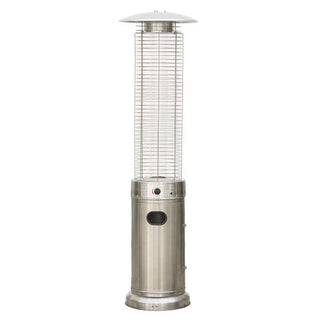
If one terrace needs a lot of heat in one place, the higher-output tower at 42,000 BTU (13 kW) closes the gap with fewer units. Both ship in sets of 20, which is about right for a terrace running a heater per table or two, and a lot for a courtyard with six tables; if you need fewer, ask before ordering. Browse the full range of commercial patio heaters for other finishes.
For a marquee, a winter tent or a big covered deck, a diesel radiant heater makes more sense than a row of towers. The unit in our catalog comes in versions from 13 to 19 kW, and the manufacturer rates it for 91 to 137 m² from a single 50 or 70 L tank, with a thermostat, tip-over cut-out and overheat protection. It needs a flue and somewhere sensible to keep diesel, so it belongs to venues with a back-of-house yard rather than a pavement strip.

Two rules apply to every outdoor heater. Keep the clearance the manufacturer specifies between the flame and any canopy fabric above it, and check with your local fire authority and landlord where gas cylinders may be stored overnight; many insurers have their own opinion on this too.
Parasols, cantilevers or a louvered roof
Shade is where outdoor budgets split in two. An umbrella is furniture: you open it, close it when the wind picks up, and take the canopy off for winter. A louvered pergola is a structure, and it is the one piece of kit that lets a garden bar keep selling through a shower.
For a café terrace or a pavement run of two-tops, a straightforward 3 × 3 m market parasol covers one table and its chairs. The one we stock uses a 250 GSM PU-coated polyester canopy rated 2,000 to 3,000 mm waterproof, on an aluminum pole with a metal cross base, in colors that can be printed with your logo. Neither of our umbrellas comes with a published wind rating, so treat them the way experienced terrace managers do: closed and strapped when gusts start moving glasses.

A cantilever (offset) parasol puts the pole beside the table instead of through it, which frees up seating and lets one canopy cover a larger lounge group. Our cantilever model runs on a 102 mm powder-coated aluminum pole with a crank lift, a manual tilt that follows the low evening sun, and a double-top vent that lets gusts escape through the canopy. It also has LED lights in the ribs, so the same unit lights the table after dark. Choose the base to match the floor: a cross base for a terrace you can ballast, a water tank for a rooftop where you can't drill, marble where weight and looks both matter.

When a pergola earns its footprint
An adjustable louvered (bioclimatic) pergola is the difference between a summer terrace and a three-season one. The blades open for sun and close to form a roof, and the aluminum version in our range is rated for winds up to 220 km/h and a snow load of 200 kg/m², with drainage built into the frame. Sizes run from 3 × 3 m up to 6 × 6 m or custom, and the add-on list is what turns it into a room: zip blinds on the windward side, integrated LED, and a heater mounted in the frame.

It's a building project, though. A pergola is either free-standing on anchored posts or fixed to your wall, and in many places a permanent structure over a trading area needs planning or landlord consent before it goes up. Budget time for that conversation. Everything under cover in the shade and outdoor structures collection is worth comparing side by side before you commit.
What should an outdoor bar counter be made of?
Stainless steel on wheels, for most venues. A fixed timber bar outside looks good for a season and then spends the winter absorbing water, while a stainless counter on casters can be hosed down, locked, and rolled under cover at closing. Grade matters: ask for 304 stainless for anything left outdoors, since the cheaper 201 grade marks and rusts faster in rain and near the coast.
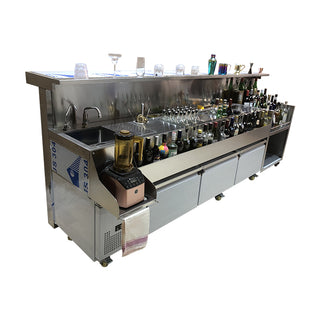
Our outdoor mobile bar counter is a stainless station 180 cm long and 80 cm deep on caster wheels, built to order for 110 V or 220 V power so you can run a blender or lighting from it. It works as the main bar on a small terrace or as a second service point on a big one, which is often what stops the queue at the indoor bar on a warm Friday.

If the terrace sits a long way from the cellar, pick a counter with its own cold. The refrigerated mobile bar station has a chilled section built in, so garnish and mixers stay cold at the point of service instead of being carried out by the crate. Sizes are made to order. Both counters sit in our cocktail stations and underbar range, alongside fixed bar counters if you'd rather build something permanent under a pergola.
Guests need something to lean on as much as somewhere to sit. High tables at 105 cm let a patio bar hold standing drinkers without the footprint of full seating. The wood-plastic composite table in our range looks like timber but doesn't rot or need oiling, and comes in lengths from 120 to 200 cm at 60 cm deep, so one long table can run along a railing. More options live under tables and chairs.

Storage you'll wish you'd planned
An outdoor bar needs a lockable place for everything that can't stay outside overnight: cushions, menus, the POS terminal, glassware, spare cylinders (in their own ventilated cage, never indoors). Measure that space before you buy furniture. A counter on wheels only helps if there's a door wide enough to roll it through.
What can stay out over winter, and what goes into storage?
Aluminum, stainless steel and composite can stay outdoors if they're cleaned and covered; fabric and cushions come in, and so does every gas cylinder. The table below is the list most garden bars end up writing after their first winter.
| Item | Winter plan | Why |
|---|---|---|
| Louvered pergola | Stays; blades closed or angled to shed rain | Rated for snow load, and it's the reason the terrace can open on a dry day in February |
| Parasol canopies | Removed, dried, stored flat | Wet fabric folded for months mildews; frames can stay with covers on |
| Propane heaters | Stay on covered terraces; cylinders out, stored to local rules | The heater is the product people come for in the cold months |
| Stainless counters | Rolled under cover or wrapped | Keeps the power sockets and any chiller dry |
| Loungers and sun furniture | Stacked and stored | Nobody books a sun lounger in December, and stacked they take a fraction of the floor |
| Cushions, textiles, menus | Indoors | Water damage is fast and permanent |
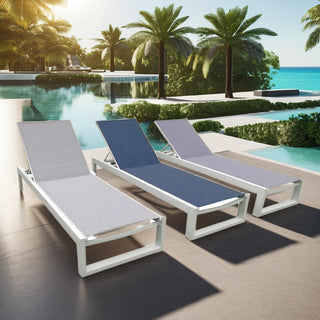
Stackability is worth checking before you buy anything seasonal. The aluminum and Textilene sun lounger we carry stacks, resists UV, and carries a three-year manufacturer warranty, so a terrace that switches from sunbathing to heated drinks in autumn can clear the deck in an afternoon. The poolside furniture collection has daybeds and folding loungers built the same way.
Where outdoor bar budgets go wrong
- Buying the parasols before the heaters. Shade sells July; heat sells October, and October is the month that decides whether the terrace paid for itself.
- Heaters without a fuel plan. Six towers each burning through a 13 kg cylinder in two or three evenings means a delivery schedule and a storage cage, not an occasional swap.
- Indoor electrics outside. Lights and screens on a terrace need an IP65 rating or better; our guide to choosing a gobo projector covers what the rating means for a logo on the terrace floor.
- A fixed bar where a mobile one would do. Anything bolted down has to survive every storm in place.
- Forgetting the permit for the structure. A pergola or fixed windbreak over a trading area often needs consent, and waiting for it can cost the first autumn.
For the full picture of setting up a garden bar at home or for a small venue, the garden bar collection groups heaters, shade, outdoor kitchens and loungers in one place. If you're building a whole venue rather than a terrace, start with our guide to opening a bar.
Planning a terrace that trades into winter? Send us the square meters, whether it's covered, and how many months you want to open, and we'll size the heating and shade to it, along with a counter that fits the space.


