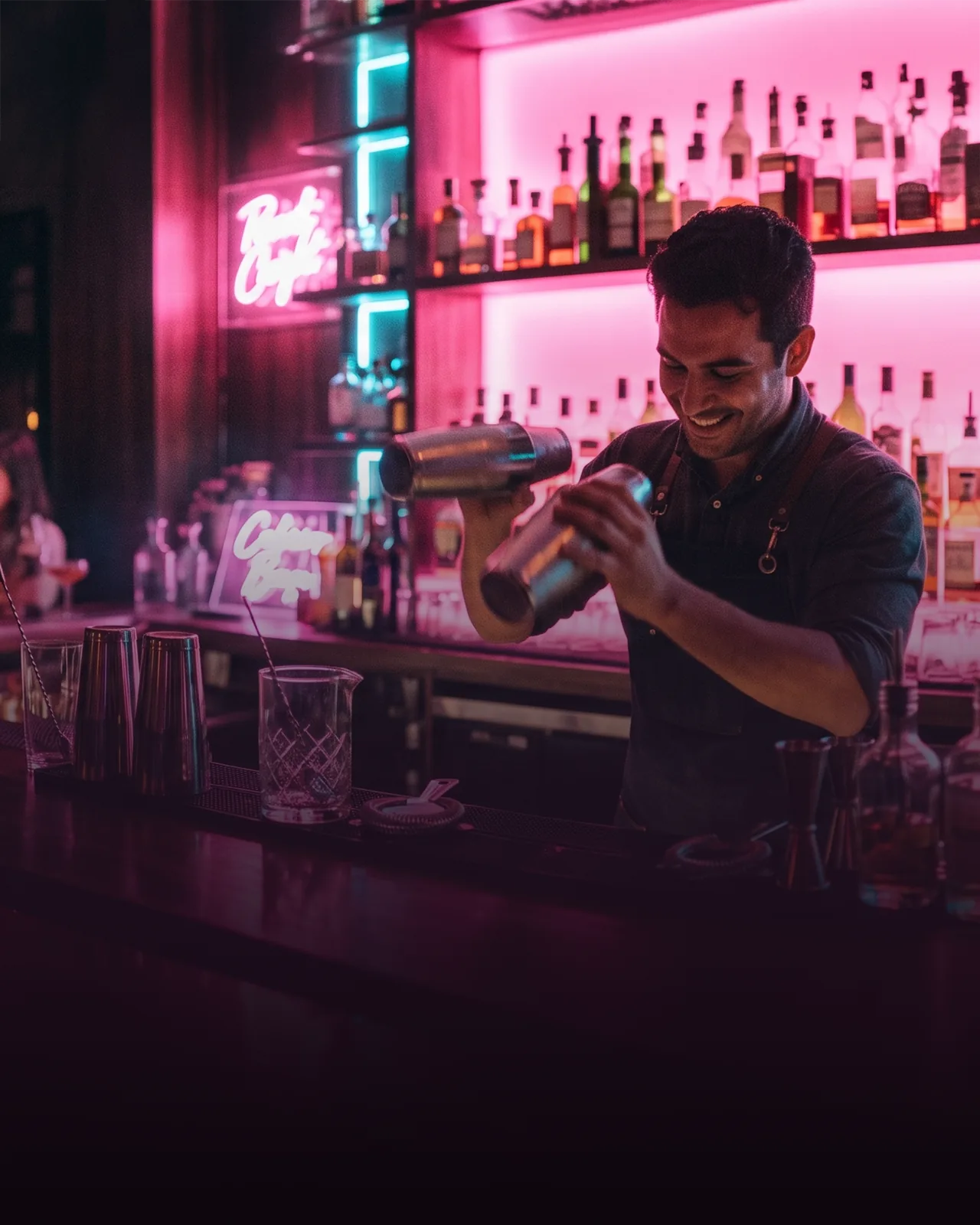


In short: write the wine list before you buy a cabinet. When you work out how to open a wine bar, the list size and the share poured by the glass set how many bottles you store, at which two temperatures, and whether a dispenser is needed.
Sixty wines on a list means about a hundred and eighty bottles in the building on opening night, if you keep three of each. Those bottles need to sit at two different temperatures, some of them are open at any moment, and the whole collection is paid for before the first guest sits down.
That is why anyone working out how to open a wine bar should write the list before signing the lease. Every piece of equipment that matters in this format follows from it: the size of the cabinets, the number of zones, whether open bottles go under gas, how many glass shapes you rack, and how much of your starting cash is standing on shelves.
A cocktail bar is designed around a station, and a pub around its taps. A wine bar is designed around a stock of bottles, and the rest of the room serves it. If you are still weighing the wider bar format, our guide to how to open a bar covers the full build zone by zone. What follows is the wine-led version.
How many wines should a wine bar list on day one?
Between twenty and sixty for most first wine bars, with eight to twelve of them poured by the glass. Below twenty the list looks thin to anyone who came specifically for wine; above sixty the stock ties up more cash than a new venue can comfortably carry.
The number that matters as much as the length is the glass share. A bar that sells mostly bottles can run a long list on modest storage, because each bottle is opened and finished at the same table. A bar that sells mostly glasses has many bottles open at once, each draining slowly, and that changes the equipment more than list length does.
Decide the style next, because it sets the balance of colors. A natural-wine bar leans toward chilled reds, orange wine and pet-nat, so its cold storage has to be bigger than a classic list would suggest. A bar built around Burgundy or Barolo needs more space at cellar temperature and more decanters. A sparkling-heavy list needs the coldest zone of all and a stopper or dispenser that holds the mousse.
Write it down as a count by style: how many sparkling, whites, rosé, light reds, full reds and sweet wines. That table becomes the brief for everything below.
Two service temperatures, one small room
Nearly every wine bar ends up running two temperatures, whatever the list says. The cold side, for sparkling and white wines with rosé among them, runs at roughly 6–10 °C. The cellar side holds reds at about 14–18 °C, which is cooler than most bar rooms and warmer than any drinks fridge is designed to run.
Getting both wrong is common and easy to taste. A red pulled from a warm back bar at 24 °C tastes hot and jammy; a white served straight from a beer fridge at 3 °C tastes of nothing. Guests who order wine by name notice both, and they are the guests a wine bar is built for.
Long-term storage adds a third number if you hold serious stock. Bottles you plan to keep for months sit best at a steady 12–14 °C in the dark, and the steadiness matters more than the exact figure, because repeated warming and cooling pushes wine past the cork.
The practical answer for most rooms is dual-zone cabinets. One cabinet with two compartments covers both service temperatures in a single footprint, and a bar with a longer list simply adds cabinets, zoned by style, as the list grows.
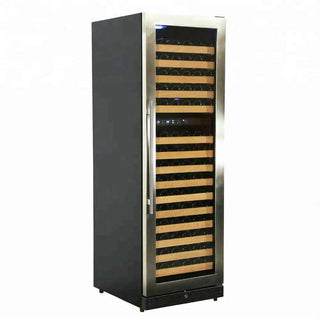
This one holds 166 bottles across two independent zones between 5 and 18 °C, in a 600 mm-wide stainless steel cabinet 1820 mm tall. That is enough for the working stock of a sixty-bin list, or the whole list of a twenty-bin bar with room left for backups.
How to open a wine bar at 20, 60 or 150 bins
The table below takes three list sizes and shows what each one asks of the building. Bottle counts assume three of each wine on hand, which is a sensible minimum for anything that sells more than once a week.
| List size | Bottles on hand | Cold side | Cellar side | Glass pours | Preservation |
|---|---|---|---|---|---|
| 20 bins | About 60 | One zone of a dual-zone cabinet | The other zone of the same cabinet | 6–8 wines | Stoppers, plus one small dispenser for the slowest pours |
| 60 bins | About 180 | A full cabinet or a large dedicated zone | A second cabinet, or a zone in a large dual unit | 10–15 wines | A 4–8 bottle dispenser for the glass list |
| 150 bins | 450 and up | Several cabinets by style, or a walk-in section | A custom cellar wall or storage room at 12–14 °C, plus service cabinets | 15–25, rotating | Two dispensers, one per temperature |
The twenty-bin bar is the easiest to open well. One good dual-zone cabinet behind the counter holds the list, and the budget can go on glassware and the room itself.
At sixty bins, storage splits into working stock and reserve. The working bottles, one or two of each wine, sit in service cabinets within reach of the pour point. The reserve can live further away, in a back room or a basement, as long as it holds a steady temperature.
At a hundred and fifty, the cellar becomes a room or a wall of its own. Here a cabinet built to your dimensions often makes more sense than a row of freestanding units, and it can double as the room's main visual feature.
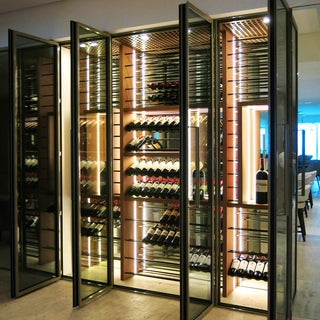
The full range, from slim built-in units to double-door display cabinets, is in our wine cabinets and coolers collection.
Where should the cellar live?
Where it stays cool and dark, then as close to the pour point as that allows. The bottles you open every night should be one step from the bartender; the reserve can be a flight of stairs away.
Heat is the main enemy inside a bar. A glasswasher and the compressors of other fridges dump warm air behind the counter, and a cabinet in that corner works harder and holds its temperature less steadily. Give wine cabinets their full ventilation clearance, or choose built-in models designed to vent from the front.
Light is the second. Sunlight and strong fluorescent light damage wine over weeks, which is why proper cabinets use tinted or UV-filtering glass. A lit wall of bottles looks wonderful, but if it faces a south window, the bottles in it should be ones that sell within days.
That points to a useful split between display and storage. An open rack on the back wall shows the list off and holds the bottles that turn over fastest, while the slow sellers and anything precious stay in a closed, cooled cabinet.

This rack is built to order at 295 cm tall and 20 cm deep, in widths from 60 to 300 cm, which makes it a back-bar display rather than a cellar. Other options are in the back bar units and bottle shelving collection.
What does a by-the-glass program need?
A way to keep open bottles tasting right for longer than two days. Recorked and chilled, most still wine is fine the next evening and tired by the third, and every glass you pour after that either disappoints a guest or goes down the sink.
A wine dispenser solves this by replacing the air in each open bottle with argon or nitrogen, then pouring through a tap. Makers rate opened bottles at weeks under gas. The 6-tap unit below quotes up to 30 days and runs between 5 and 28 °C, with a glass tray on top so the pour happens at the machine.

Most dispensers are single-zone, which ties back to the two temperatures. One cabinet pouring four whites and two reds has to pick a setting, and the usual compromise is around 12 °C. When the glass list is big enough, the cleaner answer is two units, one at white temperature and one at red.
Some units split the job inside one cabinet. The one below chills six bottles in reserve and pours three through its spouts, all in a freestanding 68-liter cabinet, which suits a bar that wants the backups and the open bottles in one place.

A dispenser also fixes the pour. A set dose delivers the same measure every time, and on a busy night that consistency protects the margin on the glass list more than any stock count. The range is in the wine dispensers and preservation collection.
Stemware, and the washer that keeps it in one piece
Glassware is the one piece of equipment every guest touches, and in a wine bar they judge it. Thin rims, a clear bowl and enough room to swirl are the baseline; heavy, thick-rimmed glass reads as a restaurant that does not take wine seriously.
Most bars settle on three shapes. A large bowl serves fuller reds, a medium bowl serves whites and lighter reds, and a flute or tulip handles sparkling. Some bars run a single all-purpose shape for everything except fizz, which saves on rack space and breakage; it works best on a list without much old or delicate red.
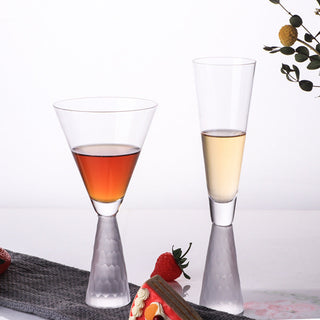
These hourglass-shaped glasses hold 200–300 ml, a size that suits whites and sparkling by the glass. For the full range of bowls, see our wine and champagne glasses, and our guides to crystal glassware for bars and choosing champagne glasses go into shape and material.
Order more than you think. Stemware breaks at a steady rate in any bar, and a wine bar that runs out of its red glass on a Saturday ends up pouring Barolo into whatever is clean. Two to three glasses per seat for each shape you use is a workable starting stock.
Decanters earn their place on a red-heavy list. A young, tannic wine opens up with air, and an older one needs separating from its sediment; pouring either into glass at the table also signals care, which is part of what a bottle price pays for.

The rest of the range is in our decanters collection.
Washing is where stemware is lost. Tall glasses need a machine with rack clearance for your tallest stem and a gentle spray pattern, or they chip against each other and come out streaked. A front-loading glasswasher under the counter keeps the dirty-glass route short.
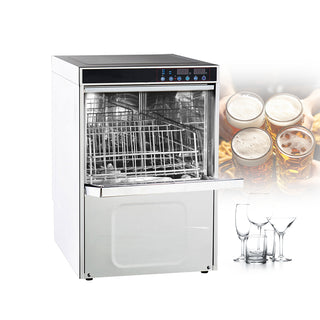
This unit runs 30 baskets an hour with an 85 °C sanitizing rinse and uses about 3 liters of water per cycle. Hand-polishing still finishes most wine glasses, and a glass polisher saves that job from eating a bartender's evening.
Is the cheese board worth a second fridge?
Usually yes. A short food menu of cheese and charcuterie raises spend per head and keeps tables ordering a second bottle, and none of that food belongs in a wine cabinet, which runs too warm for it.
A general bar fridge behind the counter holds the food, the sparkling water and any beer you carry, at the colder 0–5 °C these items need. Keeping it separate also stops staff opening the wine cabinet for a lemon and letting the temperature swing.
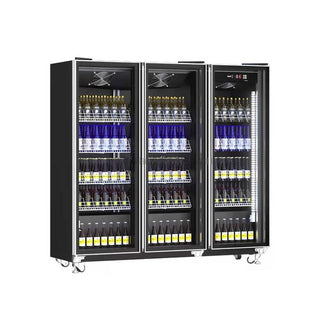
This three-door unit runs from 0 to 20 °C with fan cooling behind glass doors. Other sizes are in our display fridges collection.
Keep the food simple enough to plate at the bar. A cheese and charcuterie board needs a knife and a fridge, and no extraction canopy. The moment the menu needs a stove, the wine bar has become a small restaurant, with a kitchen, a chef and a much larger fit-out.
Where the money goes when you open a wine bar
The stock is the largest opening cost in most wine bars, often larger than all the equipment together. A sixty-bin list with three bottles of each is a sizable sum sitting on shelves, and some of those bottles will take months to sell.
That shapes the equipment budget. Cabinets are the big-ticket equipment, and they are worth buying properly because they protect everything else you have paid for. A cheap cabinet that drifts two degrees in summer ages the stock faster and makes the reds taste wrong.
Dispensers come next in cost and are the easiest to phase in. A bar can open with stoppers and a short glass list, see which wines guests order by the glass, and add a dispenser once the numbers show open bottles going to waste.
Glassware is modest per piece but recurring, and it is the line most first-year budgets underestimate. A glasswasher and a POS system that handles glass and bottle pricing separately complete the list; the POS matters more here than in most bars, because a list that changes weekly is hard to track on paper. See the POS systems collection for options.
Rent and fit-out sit on top, and a wine bar has one advantage there. It needs no gas line, no extraction and no drainage for a tap system, so it can take a small unit that would not suit a kitchen-led venue. For current prices on anything mentioned here, each product card carries its live price.
Licensing a wine bar, market by market
An on-premises alcohol license, a food business registration, and the usual premises and fire approvals. In several markets, pouring only wine and beer puts a bar in a simpler or cheaper license class than a full spirits bar. Four wine-strong markets show how that works.
United Kingdom. A Premises Licence from the local council covers the venue, and a Personal Licence holder has to act as Designated Premises Supervisor. The Personal Licence needs an accredited Level 2 Award for Personal Licence Holders (APLH) and a basic DBS check. Register as a food business with the council at least 28 days before opening, and expect a food hygiene inspection and a fire risk assessment. There is no separate wine-only license class.
France. Anyone running a venue that serves alcohol completes the permis d'exploitation, a training course of about three days. A bar serving fermented drinks such as wine and beer needs a Licence III. Spirits require a Licence IV, which is scarce and usually bought from an existing holder, so a wine-only bar has a real advantage here. Food service adds a declaration and a HACCP plan.
Italy. You file a SCIA for food and drink service through the municipality's SUAP one-stop desk, and the person running the business needs the SAB qualification. A HACCP plan is required. Since January 2026, the separate customs fiscal license step for serving alcohol has been removed.
Australia. You apply to the state or territory liquor regulator for an on-premises license. In New South Wales, a Small Bar licence covers venues up to 120 patrons, which fits most wine bars. Every person serving alcohol needs a current RSA competency card, which in NSW renews every two years from 2026. Council premises approval and food business notification apply, and some states require a Food Safety Supervisor.
Treat this as an overview rather than legal advice, and confirm current requirements with your local authority. Start the alcohol license first everywhere, because it sets the earliest date you can open.
Where new wine bars lose money in the first year
The most expensive mistake is a list built to impress rather than to sell. A hundred wines looks generous on paper, but half of them move once a month, and the cash in those bottles was needed for the slow first winter. Opening at forty and growing toward what guests actually order is safer than opening at a hundred and cutting back.
Close behind is running the whole list at one temperature. It usually happens because a bar buys a single-zone cabinet to save money and sets it somewhere in the middle, so the whites are too warm and the reds are too cold. Guests rarely complain; they order a beer next time.
Then there is the glass list that grows faster than the preservation behind it. Twelve wines by the glass with stoppers alone means pouring out part of several bottles most nights. The waste rarely appears in any report because nobody records it, and it only shows up as a gross margin that never matches the costings.
Stemware is the quiet leak. Bars open with exactly enough glasses, lose a few every night to the washer and the floor, and a month later are short of the red glass on weekends. Budget replacement glassware as a monthly cost from the start.
Last, many owners apply for a bigger license than the concept needs. Where a wine-and-beer class exists, it is often faster to get, and a bar that later wants spirits can apply then, with a trading record behind it.
Have a list but not yet a cellar? Send us the number of wines, how many you will pour by the glass and the size of the room, and we will size the cabinets and dispensers around it.


