
Legality first, then air: how to open a hookah lounge depends on whether your city lets guests smoke shisha indoors, how much air the building can move, and where the coals burn. The menu and the furniture come after those three are settled.
A hookah lounge can fail before it sells a single bowl. The lease is signed, the booths are ordered, and then the council explains that shisha cannot be smoked in an enclosed room at that address, or the building's landlord refuses a roof penetration for an extract duct. Both happen more often than new operators expect.
That is why anyone working out how to open a hookah lounge should read the law for their city before they look at a single sofa. In most markets the smoking rules decide whether the business is an indoor lounge, a covered terrace or nothing at all. The air system then decides how many pipes the room can hold, and the coal station decides whether the staff go home with a headache. The drinks list and the furniture matter too, but both can change after opening.
Can guests smoke shisha indoors where you plan to open?
It depends entirely on the country and often on the city. The UAE licenses shisha cafés as their own category, parts of the US allow indoor hookah under a narrow exemption, the UK bans it indoors outright, and Germany leaves it to each state with strict carbon monoxide rules on top. Here is how the four largest markets for the format handle it.
United Arab Emirates
Dubai and Abu Dhabi treat shisha cafés as a regulated activity of their own, separate from a normal restaurant. You need a trade licence with the right food-and-beverage activity and eligible zoning, then municipal permission specifically to serve shisha. Dubai Municipality rules have set minimum distances between a shisha café and residential buildings, schools and places of worship (reported as 150 meters from homes and schools and 100 meters from mosques), limited the floor area, and required the shop to face a main street with its own entrance. Dubai Municipality and Civil Defence both inspect ventilation and fire safety, and food handlers need health cards. Because the distance rule removes most mixed-use streets, check it against a specific address before you negotiate rent.
United States
Most states ban smoking in enclosed workplaces and restaurants, so an indoor hookah lounge usually operates under a specific exemption for tobacco or hookah bars. The conditions vary by state and city, but they tend to follow a pattern: a large share of revenue has to come from tobacco (often around 60 percent), entry is limited to guests over 18 or 21, food service may be restricted or banned, and the ventilation has to meet a defined standard. On top of the exemption you need a retail tobacco permit, a business license and EIN, a health department permit if you serve food or drinks, and a certificate of occupancy with fire-code sign-off. Some cities have stopped issuing new exemptions altogether, so an existing lounge's permit can be worth more than its fit-out.
United Kingdom
Shisha falls under the smoking ban, which makes it illegal to smoke it in any enclosed or substantially enclosed space, with fines of up to £2,500 for the business. A shelter counts as substantially enclosed if more than half of its wall area is closed, so UK shisha venues trade from terraces and covered shelters with at least half the sides open. Private members' clubs get no exemption, which rules out the "cigar club" workaround people sometimes suggest. The Tobacco and Vapes Act, which received Royal Assent on 29 April 2026, adds a licensing scheme for selling tobacco and nicotine products, with personal and premises licences expected. You still register as a food business with the council at least 28 days before opening and complete a fire risk assessment, and a Premises Licence covers alcohol and hot drinks served after 11 pm.
Germany
Smoking rules are set by each Land, and many allow shisha in a separate smoking room or in small single-room venues that serve no prepared food, while others restrict it further. What unites them is carbon monoxide. After a run of CO poisonings, Baden-Württemberg ordered shisha operators in 2018 to install CO warning devices in the rooms guests use, and Hamburg passed a dedicated law in 2019 that caps indoor CO at 35 mg/m³. Cologne's guidance asks for a detector in every occupied room and at least one per 25 m². Serving drinks still needs a Gaststättenerlaubnis tied to both the operator and the premises, plus business registration (Gewerbeanmeldung) and the IHK hospitality briefing.
Treat this as an overview, not legal advice. Tobacco law changes often, and the local authority's reading of "enclosed" or "separate room" is what an inspector will apply. Get the smoking position for your exact address in writing before you sign anything, because it decides whether you are building a room or a terrace.
Why a hookah lounge plans ventilation before the menu
Every occupied pipe produces smoke and carbon monoxide for as long as the guest sits there, which is usually two hours or more. A bar has a peak and a lull; a hookah lounge has a steady load of combustion for the whole evening, and the air system has to remove it continuously.
Three consequences follow for the build. The first is that the lounge needs mechanical supply and mechanical extract, balanced against each other. Extract alone pulls the room into negative pressure, and the replacement air then leaks in through doors, ceiling voids and neighboring units, dragging smoke into the ceiling void and the unit next door. A landlord who hears smoke complaints from the flat upstairs will not renew the lease.
The second is that recirculating purifiers are not a substitute. Electrostatic and HEPA filters catch particles, activated carbon catches odor and together they make the room look and smell better, but none of them removes carbon monoxide. CO leaves the building only through a duct to outside air, so a recirculating unit can make a room look clear while the CO level keeps climbing.
The third is that air volume, not floor area, sets your capacity. A mechanical engineer sizes the system from the number of pipes that will be lit at once, the coal station's output and the local code, and the answer becomes the real seat count. If the building cannot take a duct big enough for forty pipes, the lounge has twenty-five, whatever the floor plan says.
Put a CO monitoring system in the brief at the same time. Detectors that display the current reading and give an early warning, placed at seated head height and near the coal station, let staff see the trend before an alarm goes off. In Hamburg the 35 mg/m³ cap is a legal limit; elsewhere it is a sensible number to design against.
If the lounge also runs a kitchen, that is a separate extract system with its own duct. Our guide on how to size a kitchen exhaust hood covers the airflow math for the cooking side.
The coal station is where the danger sits
Most CO incidents in shisha venues start at the coals, not at the tables. Natural coconut coals are lit on an electric coal heater or a gas burner, often dozens at a time, and a heater full of glowing coals in a small back room produces far more carbon monoxide than any single pipe.
Treat the coal station as a piece of kitchen equipment. It needs its own ducted hood that exhausts to outside, on a non-combustible surface, away from the stock of shisha tobacco and paper goods. A wall-mounted stainless hood rated at 21 m³ a minute or more, ducted outdoors, is the usual starting point for a counter-top coal heater, with the final size set by the number of burners.
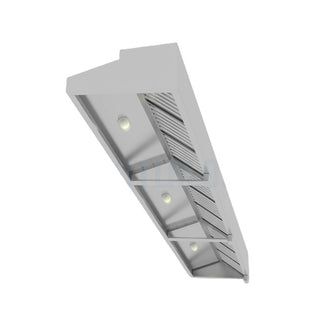
Around the hood, a few rules hold in every jurisdiction. Spent coals and ash go into lidded metal bins, never plastic or cardboard, and stay there until they are cold. The coal runner carries coals in a tray with a handle, and the route from the station to the tables avoids the main walkway. A CO detector sits in the coal room itself, and the heater is switched off whenever the room is left unattended. Fire extinguishers suitable for electrical fires sit by the door, not behind the heater.
The ventilation collection covers hoods in several sizes. Ductless models there are built for kitchens that cannot vent outside, and for the reason above they are the wrong choice over a coal heater.
How many stations can a hookah lounge carry?
The room carries as many stations as its air system can clear and its coal station can feed in the busiest hour. Floor area comes third. The table sets out what changes as a lounge grows from a small room to a large one.
| Stations lit at once | Typical format | Air system | Coal station | Bar side | Staff on a Saturday |
|---|---|---|---|---|---|
| Up to 15 | Single room or covered terrace, often a café by day | Engineered supply and extract for one room; on a terrace, open sides do most of the work | One counter-top heater under a ducted hood | Tea boiler, fridge, small ice machine | Two to three, with the shisha maker also running coals |
| 15 to 40 | Dedicated lounge, booths, evening trade | Ducted system sized by an engineer, CO monitoring in every room | Separate coal room with its own hood and detector | Soda gun, juicer, cube ice maker, back-bar fridge | Four to six, including a dedicated coal runner |
| 40 and more | Large lounge or terrace, sometimes with a kitchen | Zoned system, often with extraction above each seating area | Coal room with several heaters, run by one person all night | Full drinks bar, possibly alcohol where allowed | Seven or more, with at least one person on coals all night |
Most new lounges start in the middle row. Fifteen stations rarely cover rent on a main street, and above forty the air system becomes a building-services project with its own planning drawings. If a site can only be ventilated for twenty, it is a twenty-station lounge, and the business plan should be built on that number.
What does the bar sell to a guest who stays three hours?
It sells a slow sequence of inexpensive drinks, usually tea first and then soft drinks and juice over plenty of ice. A guest who orders one pipe and sits for three hours will usually add two or three drinks, and in markets where the lounge is alcohol-free those drinks are the only margin besides the shisha itself.
Tea is often the anchor, served by the pot and refilled through the evening, and a boiler that dispenses water at a set temperature stops a kettle from being the bottleneck at nine o'clock. The under-counter unit below delivers 45 liters of hot water an hour with ±1 °C accuracy and three programmable buttons, so black tea and green tea each get their own temperature.

Soft drinks follow. Buying cola and tonic by the bottle costs far more per glass than post-mix, and a lounge pours the same few drinks all night. A post-mix system with ten buttons and an under-counter chiller that holds 2 to 6 °C covers every soft drink on a typical lounge menu from one tap. Our article on post-mix soda guns explains how syrup ratios work.

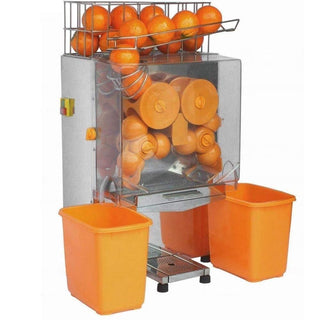
Fresh juice sells at a much higher margin than anything from a can, and it gives a dry lounge a drink worth photographing. An automatic citrus juicer takes 23 oranges a minute, fed whole, which is fast enough for a table of six ordering at once. More models are in commercial juicers.
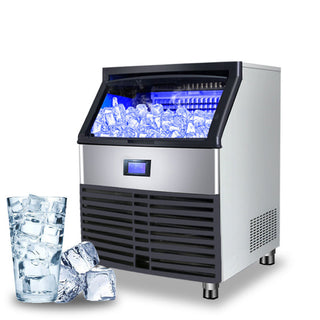
Ice is used twice in a hookah lounge, once in the glasses and once in the pipes, since many menus offer ice in the base or an ice hose for a cooler smoke. That adds up quickly across forty stations. An air-cooled cube machine producing 80, 100 or 120 kg a day covers most mid-size rooms. Our ice machine guide shows how to size one against the busiest night.
Where alcohol is allowed and the smoking exemption does not forbid it, a lounge can add a full bar. Check how the two permits interact first. In several US cities, alcohol sales count against the tobacco revenue share the exemption requires. Our guide to opening a bar covers the draft and spirits side if you go that way.
How should a hookah lounge clean pipes between guests?
Every guest gets a clean hose and a fresh mouthpiece, and the base is washed after each use. The standard in well-run lounges is a disposable plastic mouthpiece or tip for every guest, a clean hose for every order, and bases emptied and washed between uses. A shared pipe goes from mouth to mouth, and inspectors check this. Washable silicone hoses have replaced the old leather-wrapped ones in most venues for this reason, since they can go through a hot wash.
That turns the back of house into a small washing operation. Plan a sink big enough to take a glass base upright, drying racks with airflow, and a clear split between dirty and clean parts so a washed hose never touches a used one. A glass washer or small commercial dishwasher handles bowls and coal trays along with the drinks glassware; the dishwashers range covers undercounter models that fit behind a bar.
Count the kit generously. A lounge with thirty stations needs noticeably more than thirty sets of hoses and bases, because at any moment several are drying and a few are broken. Running out on a Saturday means serving a pipe that has not been properly cleaned.
Seating and light for a three-hour visit
Guests pay for time in a hookah lounge, so the seating has to stay comfortable for three hours. Low booths and sofas are the norm, and the choice of upholstery matters more than in a restaurant, because smoke settles into fabric. Wipeable leather or vinyl with high-density foam keeps its shape and loses the smell much faster than woven textiles.

Booths also help the air. Seating areas divided by high backs can each take an extract grille above them, so the smoke is caught close to where it rises. Tell the engineer where the booths go before the ducts are drawn, not after.
Light should be low and warm at the tables and brighter at the coal station and the bar, where staff handle hot coals and glass. A haze of smoke scatters light, so a room that looks well lit empty will look darker when full; plan dimmable circuits and test them on a busy night. The lighting collection has pendants and track systems for zoned light.
In the UK and anywhere else shisha moves outdoors, heat is the season. A covered shelter with half its sides open loses heat fast, so radiant heaters keep the terrace usable from October to April. Keep gas and diesel heaters away from any area that is partly enclosed, since they add their own combustion gases, and follow the same CO monitoring you would use indoors. The patio heater range lists outputs and fuel types.
Four numbers to check before you sign the lease
The expensive mistakes in this format are nearly all made before opening, and each one comes down to a number someone could have checked in advance.
- The distance to the nearest home, school or place of worship. In Dubai, minimum distances decide whether a site can host shisha at all. Measure from the actual door, and check the rule in writing with the municipality before paying a deposit.
- The share of revenue that must come from tobacco. Where a US exemption applies, a lounge that sells mostly drinks and food can lose it. Model the menu so tobacco stays above the threshold even on a slow night.
- The carbon monoxide reading on a full Saturday. A design is only proven once the room is full and the coal station is at its busiest. Log readings for the first month, and compare them with 35 mg/m³, the Hamburg limit, even where no such cap applies.
- How much of the shelter is open. In the UK a covered area with more than half its walls closed counts as enclosed, and smoking in it is illegal. Measure the walls, the retractable screens included, before you order heaters or furniture.
If the concept leans toward a membership model with a smoking terrace, our guide on opening a private members' club covers the licensing side of a members-only venue.
Working out the bar and back-of-house for a lounge? Tell us how many stations you plan, whether you run indoors or on a terrace, and whether you serve alcohol, and we will put together the bar and back-of-house kit for that room, coal-station hood included.


