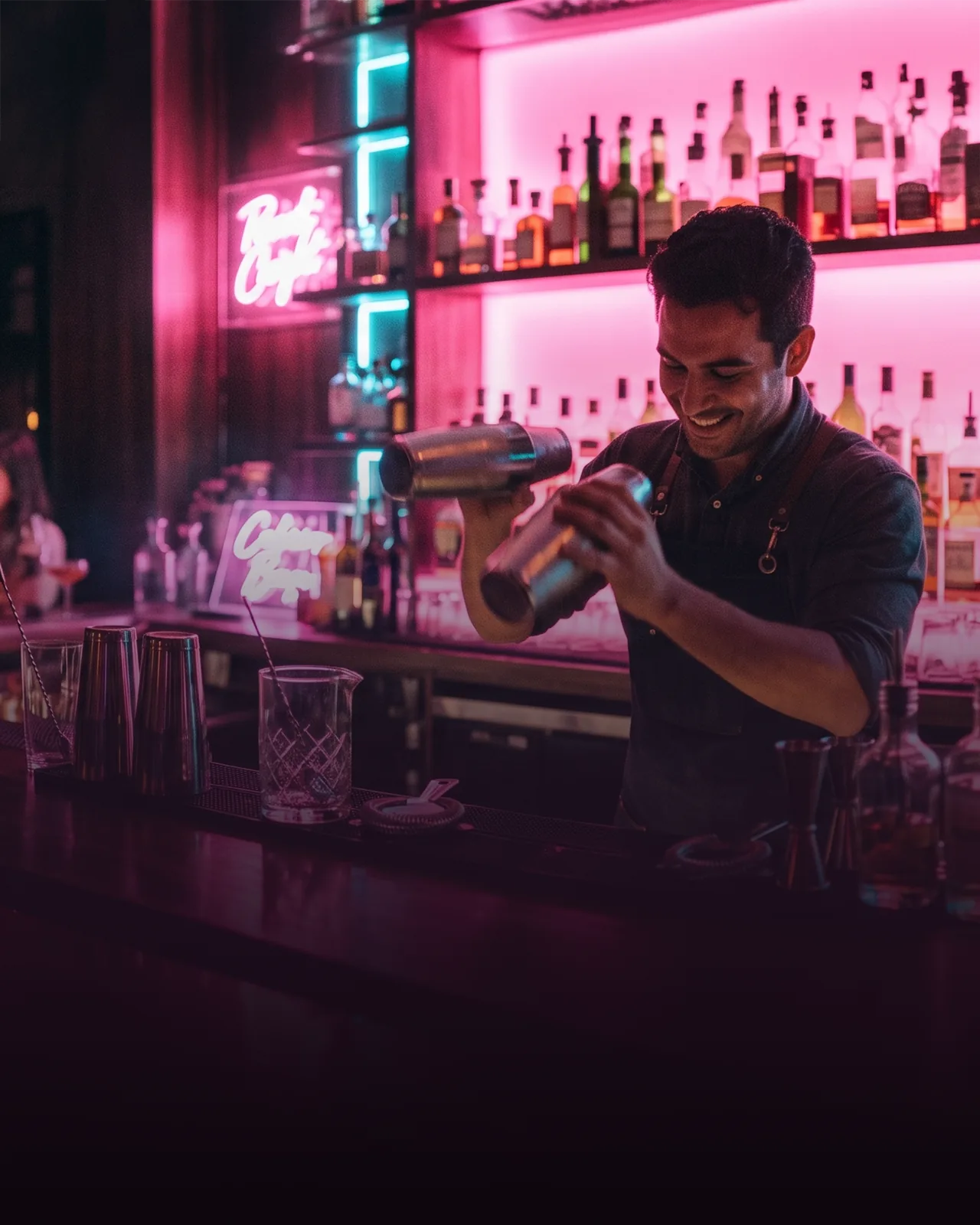


Light the liquid first and the label second. Good back bar LED lighting is warm (2700–3000 K), renders color at CRI 90 or better, sits on its own dimmer circuit, and keeps its heat away from the bottles it is meant to sell.
A guest at the rail usually orders a spirit they can point at. On most back bars that means one of a dozen bottles standing in a pool of light, while the rest of the wall sits in shadow and sells only when a bartender recommends it. The fixtures decide which bottles those are, far more than the shelf order does. Nearly every new bar now fits LED lighting behind the counter, so the real choice is where the light enters the bottle.
There are three ways to put it there. Each one makes the wall look different, and each one fails in its own way when the bar gets busy.
Shelf strips, spotlights or a backlit panel
Most back bars end up with two of the three methods working together. A strip hidden in the shelf gives the glow, spots pick out the bottles you want sold, and a backlit panel turns a whole section of the wall into a light source.
| Method | Where the light goes | What the guest sees | Best on | Where it goes wrong |
|---|---|---|---|---|
| LED strip in the shelf | Down the front of the bottles from under the shelf above, or up through them from the shelf edge | Every bottle in the row lit evenly | Long runs of working stock | Visible dots without a diffuser channel; spills onto the counter |
| Spotlights (recessed or on track) | A cone aimed at one section or one bottle | Contrast, with a few bottles clearly featured | Premium shelves and feature bottles | Glare in mirrors; hot spots if aimed straight on |
| Backlit panel behind the bottles | Through the liquid from behind | Glowing color, labels in silhouette | Walls with a wide spread of spirit colors | Labels unreadable unless something lights the front |
LED strip lighting in the shelving
A strip fixed under the front edge of each shelf lights the row below it from above and slightly in front, so both the liquid and the label read. Set the strip in an aluminum channel with a frosted cover. Bare strips show as a line of bright dots in every bottle, and the channel also carries the heat away from the tape. On a shelf deeper than one bottle, angle the channel back toward the wall, otherwise the front row casts the second row into shadow.
The strip has to be designed in with the shelving, because the cable runs and the driver need somewhere to live. A made-to-order counter and back bar package can be built with LED strips already set into the shelves.
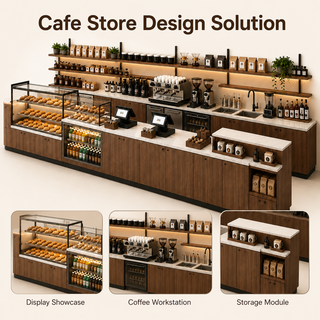
Shallow shelving makes strip lighting work better. This wall-mounted rack is 20 cm deep, enough for one row of bottles with nothing hiding behind it, and comes in widths from 60 to 300 cm on a 295 cm frame, which gives a lighting designer fixed shelf lines to fit channels to.

Spotlights
Spots do the selling. A narrow beam on the top shelf, or on the four bottles that carry the best margin, puts them a step brighter than everything else on the wall, and the eye goes there first. Aim from the ceiling at roughly 30 degrees off vertical. Straight down flattens the bottles, and a low angle bounces off the glass into the eyes of guests at the rail.
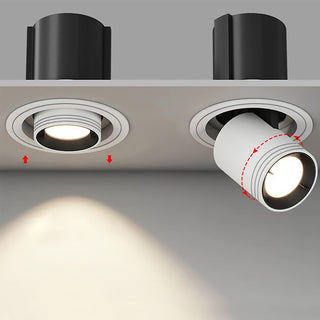
This recessed spot is a sensible reference for a back bar. It delivers 1,100 lumens from 30 W, has CRI 90, a 24° or 36° beam, and anti-glare optics, and it comes in 3000 K for spirits. It is not dimmable, which matters for the section on service below.
Backlit panels
A panel lit from behind makes the liquid glow. Amber turns to gold and a green gin bottle reads bright green from across the room, which is why backlit walls work so well for bars known for their range. The cost is the labels, which face the room and stay dark. Pair a panel with a low front light or a shelf strip, or keep it for the upper shelves where bottles are displayed rather than poured.
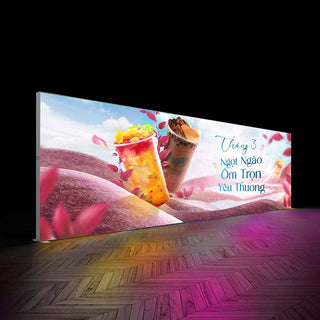
A fabric light box does this with little depth. The frame is 60 to 120 mm thick, uses edge-lit LEDs, and can be built up to about 6 × 3 m, so one panel can cover a whole bay.
If the bar's name or logo belongs on the back wall, put it in the same lighting plan rather than adding it afterwards. An illuminated logo sign in acrylic or metal is IP65 rated and can be cut to any shape, and it is the brightest object on a wall that guests will photograph.
For more sizes, the light boxes and backlit displays collection lists frame depths and faces.
What color temperature keeps whiskey looking like whiskey?
Warm white at 2700 to 3000 K suits a back bar built around brown spirits. Whiskey and aged rum look amber under that light and drift toward flat brown under 4000 K or cooler. Clear spirits and blue or green gin bottles hold up at 3000 K too, so one warm temperature for the whole wall is the safe default.
Color temperature is only half of it. Color rendering, measured as CRI, says how faithfully a light shows color, and cheap LED strip often sits around 80. At that level reds and deep ambers lose saturation, which on a back bar means a Campari bottle reads orange and a sherry-cask whisky reads muddy. Ask for CRI 90 or above and, if the data sheet gives it, an R9 value (saturated red) that is positive and preferably above 50.
Colored RGB strips are the other temptation. A back bar washed in blue or magenta photographs well once and makes every spirit on the wall look the same color. If the room needs color, put it on the ceiling or the front of the bar, and keep the light on the bottles white.
| Setting | Effect on amber spirits | Effect on clear and colored bottles | Use it for |
|---|---|---|---|
| 2700 K, CRI 90+ | Rich amber, candle-warm | Slightly warm but accurate | Whiskey bars, lounges |
| 3000 K, CRI 90+ | Amber with clear definition | Accurate | Most cocktail and hotel bars |
| 4000 K | Flatter and slightly gray | Crisp, reads as retail | Service lighting over the working counter only |
| RGB color | Tinted, bottles lose their own color | Tinted | Ceiling or bar-front effects, not bottles |
Does LED lighting heat or fade the bottles?
Much less than the halogen and fluorescent fittings it replaced, but it still needs planning. An LED throws almost no infrared forward, so a bottle 30 cm from a spot does not warm up the way it did under a halogen lamp. The heat is released at the back of the fitting, through the heat sink and the driver, and that is where problems start. A strip glued straight onto a wooden shelf with no channel runs hot and fails early. It can also discolor the wood.
Spirits themselves are stable under light, but their packaging is not. Paper labels fade over months under strong light, and the bottles on the top shelf are often the ones that stay longest because they are expensive. Standard white LEDs emit very little ultraviolet, which is the main fading agent, so the biggest risk on most back walls is actually daylight from a window facing the bar.
Beer and wine are more sensitive than spirits. Light in the blue and near-UV range reacts with compounds in beer and wine and produces the stale, skunky note known as lightstrike, and clear glass gives no protection. White LEDs do emit a blue peak, so keep bottled beer and wine in clear glass off permanently lit shelves, or turn the display lights off after close. A lit back bar display fridge with an LED interior is designed for chilled bottles and runs its light only when needed.
Water and steam are the last hazard. The glasswasher and the ice well are usually a meter or two from the lowest shelf, so strips there should be sealed to IP65 and drivers mounted where they can be reached without taking the shelf down.
Dimming the back bar through a night of service
A back bar needs at least three levels in one evening. It should be bright during set-up and stock count, slightly lower for early evening, and noticeably brighter than the room at the peak, when the house lights come down. At last call it drops again with the rest of the room.
The wall should always be brighter than the surrounding room. Lighting designers work with contrast ratios, and an accent roughly three to five times brighter than its surroundings is visible, while ten times or more reads as dramatic. A back bar that is brilliantly lit in a bright room looks like a shop shelf, and the same fittings in a dim lounge look like a display case.
Plan the circuits before the fixtures, with the strips on one channel, the feature spots on another and any backlit panel on a third. Each needs a dimmable driver that matches the dimming system of the room, whether phase-cut, 0–10 V or DALI. Fixtures that are not dimmable, like the 30 W spot above, can still work on a separate switched circuit, so they come on for service and go off after close. A panel of scenes behind the bar (Setup, Evening, Peak, Close) means the bartender presses one button instead of four dimmers during a rush.
Low-voltage track is the easiest way to keep the plan flexible. A 48 V magnetic track lets you move and swap spot heads without an electrician, and most systems in the commercial LED lighting collection offer dimmable drivers and several color temperatures on the same rail.
How much LED lighting does a back bar need?
Plan one continuous strip per shelf plus one spot for every 60 to 90 cm of wall you want to feature. That covers a typical back bar of three to five shelves, and the numbers below scale it to the format of the bar.
| Bar format | Typical wall | Main method | Accent | Color temperature |
|---|---|---|---|---|
| Neighborhood or sports bar | 2–3 m, working stock only | Shelf strips | Two or three spots on the top shelf | 3000 K |
| Cocktail bar | 3–4 m, split between speed rail and display | Shelf strips on the working shelves | Spots on the house specialties | 3000 K |
| Whiskey or rum bar | Full back wall, 200+ bottles | Backlit panel or glowing shelves | Spots on the rare shelf, plus front light for labels | 2700 K |
| Hotel lobby bar | Freestanding display or island | Backlit panel | Spots matched to the lobby lighting | 2700–3000 K |
Mirrors behind the bottles double the apparent stock and double every mistake in the lighting. If there is a mirror, test the spot angles with a guest's eye height before the ceiling is closed, because a reflected spot in a mirror catches the guest at the rail in the eye all night.
The last check is the one the bartender makes. Work lights over the counter should be separate from the display lights, so a bartender can see a jigger mark at 1 a.m. without the whole back wall turning up to full. Our article on the lighting mistake that empties a dining room covers the rest of the room, and the back bar units and shelving collection has the frames the lighting mounts on.
Designing the back wall and the lights at the same time? Send us the wall width, the shelf count and a photo of the room, and we will put together shelving and lighting that work as one plan.


