


In short: a commercial tandoor oven is a clay chamber inside some kind of body. Pick the body for heat retention, the fuel for your site and staff, and the chamber size for your busiest half-hour of bread orders.
The first naan of the night comes off the wall blistered and charred at the edges. The fortieth, baked while eight skewers of tikka hang in the same chamber, comes off pale, because the clay has given up more heat than the burner can put back. Every tandoor oven eventually meets that moment. Where it arrives, early in service or never, depends on three choices made before the unit is ordered: the body around the clay, the fuel under it, and the size of the pot.
Those choices also decide the less visible parts of the job. How much the kitchen extraction has to pull, whether the floor needs reinforcing, how long the oven takes to reach heat before lunch, and how many years the clay lasts before it has to be relined.
Clay, steel drum or insulated cabinet: how tandoor bodies differ
Every tandoor cooks the same way. Food bakes on or near a clay wall that has soaked up heat, while hot air and radiant heat from the fire at the bottom finish it from the inside. What differs is what surrounds the clay, and that surround decides how well the heat stays in the chamber and how hot the outside of the oven gets for the cook standing next to it.
| Body | How it is built | Heat retention | Where it suits | Watch out for |
|---|---|---|---|---|
| Traditional clay (masonry) | Clay pot set into brick or plaster, built in place | Very high once saturated | A permanent tandoor station in a restaurant that will not move for years | Weight, long heat-up, cannot be relocated |
| Steel drum | Clay pot inside a steel drum, gap packed with insulating fill | High | Most restaurant kitchens; can be delivered as one unit | Fill quality varies; a thin drum runs hot outside |
| Insulated stainless cabinet | Clay chamber in a square or round stainless body with refractory insulation | High, with a cooler shell | Busy lines where staff work beside it all shift; hotel kitchens | Check chamber size, not cabinet size |
| Rotary flatbread oven | Gas-fired chamber that carries dough through the heat | Not relevant; continuous heat | High-volume roti and pita production | Bakes bread only; no skewers, no char |
The masonry version is what many older Indian restaurants still run. It holds heat superbly once saturated, but it is built into the room, weighs a great deal, and belongs in the plans before the floor is poured or reinforced.
For most new openings the choice is between the steel drum and the insulated cabinet, which are variations on the same idea. Both are delivered as a finished unit and sit on the floor rather than inside it. The cabinet type adds more insulation and a stainless shell that stays cooler to the touch, which matters when a cook stands at the mouth of the oven for six hours.
Here is one built like that, a square stainless body around a clay chamber with a thickened insulation layer, offered in three chamber sizes and set up for built-in installation at 96 × 96 × 110 cm.
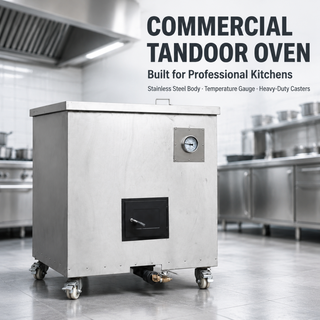
The round format does the same job in a smaller footprint. This one is 560 mm across and 810 mm tall, with a clay wall over refractory lining, and it stands on castors so the station can be pulled out for cleaning behind it.

Gas or charcoal: what heat do naan and tikka actually need?
Naan and tikka need the same thing from a tandoor oven: a wall hot enough to set dough the moment it is slapped on, and a fire that recovers quickly after the lid comes off. Charcoal and gas both deliver that. They differ in everything around it.
Charcoal gives the flavor purists talk about, because fat from the skewers drips onto the coals and the smoke rises back through the meat. It also asks for skill: the fire has to be lit well before service and fed through the rush, and heat output rises and falls with how recently someone fed it. Some city authorities also regulate or restrict solid-fuel cooking in commercial premises, so check what your local council or building control allows before the charcoal version goes on the order.
Gas is the practical answer for most restaurant kitchens. It comes up from cold faster and holds a steady temperature, and in the quiet hour between lunch and dinner the burner simply turns down. The round unit above runs a 75 MJ/hr burner, roughly 21 kW, on natural gas or propane; that figure is the one to compare between models, because it tells you how fast the chamber recovers after a batch of cold skewers goes in.
Some kitchens drop a few wood chips into a gas tandoor for aroma. Ask the manufacturer first, because it can void the burner warranty.
Whichever fuel you choose, a qualified gas engineer (or, for charcoal, the fire officer) should see the station before the first service. The oven's rating plate and the site supply have to agree on gas type and pressure, and this is where a stainless steel unit bought on price occasionally turns out to be set up for the wrong gas.
How big should a tandoor oven be for your covers?
Size a tandoor oven to the busiest half-hour of bread orders, not to seats. A 60-seat room that sells naan with every curry needs more wall area than a 120-seat grill house where bread is a side.
The arithmetic is short. Count covers in your peak window, multiply by the breads each cover orders, and add the skewers that will share the chamber. Eighty covers turned over ninety minutes at one and a half breads each is 120 naan, plus tikka and seekh kebabs hanging in the same space. A single small chamber can handle that with a fast, experienced tandoor cook. A new cook, or a menu where most tables order stuffed breads that bake more slowly, pushes you to the next size up or to a second unit.
Chamber size is the specification to read. Cabinet dimensions tell you what fits the kitchen; the diameter and depth of the clay pot tell you how many breads fit the wall at once. The square unit above comes in S, M and L chambers inside the same design, which is how most suppliers handle it.
Two small tandoors often serve better than one large one. The second can be kept for skewers so breads never wait behind meat, and a cracked pot mid-season leaves the kitchen with an oven still working.
If bread volume is the real constraint, as in a takeaway selling hundreds of roti or a catering kitchen feeding a wedding, a rotary oven changes the math. This natural gas model is rated for about 300 to 700 flatbreads an hour depending on configuration, at thickness from 0.3 to 5 mm.
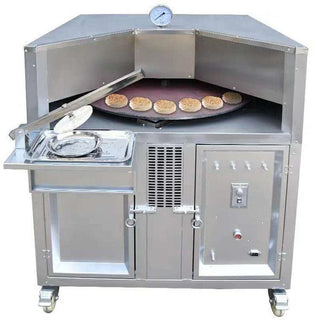
It bakes bread only, so it sits beside a clay tandoor rather than replacing it. The full tandoor and clay oven collection shows the three formats side by side.
Installing a commercial tandoor around its smoke and weight
A commercial tandoor is one of the heaviest heat and smoke loads in any kitchen, and the installation has to be planned around it before the unit arrives.
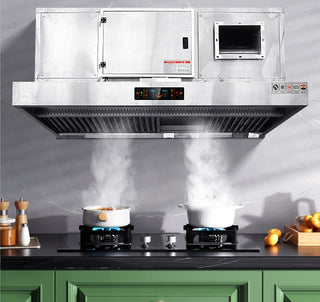
Extraction. The oven belongs under the canopy, with the canopy extending past the mouth on the side where the cook works, because every time the lid comes off a column of hot air and smoke goes straight up. Size the canopy for the whole cooking line, not the tandoor alone; our guide on how to size a kitchen exhaust hood walks through the calculation. A wall-mounted canopy like this one is rated for 6,000 m³/h and comes in a 2 m width that covers a tandoor and the burner range beside it.
Floor. A clay pot is heavy, and a masonry tandoor even more so. Ask the supplier for the operating weight, check it against the floor, and on an upper floor or an old timber structure get it confirmed by an engineer. The floor around the mouth also gets hot and greasy, so a non-slip tiled surface with no wooden threshold nearby is worth specifying.
Clearances. Keep the distances to walls and other appliances that the manual asks for. The cook reaches into the chamber hundreds of times a shift, so they need to stand square to the mouth with a clear route to the pass, not lean in from a corner.
Gas. Match the oven to the site's gas type before ordering, and have the connection made and tested by a qualified engineer. Castors, if the unit has them, need a restraint so the flexible gas hose is never the thing holding the oven in place.
How do you cure and care for tandoor walls?
A new clay tandoor must be cured before it cooks anything. Curing drives moisture out of the clay slowly and builds up a seasoned surface that dough sticks to and releases from cleanly. Skip it, or fire the oven straight to full heat, and the clay can crack in the first week.
The usual method is a coating on the inner wall followed by several days of small, gradually larger fires. Recipes for the coating vary by region and by maker, so follow the curing schedule in the manual for your unit rather than a generic one.
After that, the walls need a few habits rather than maintenance:
- Never splash cold water on a hot wall. Thermal shock is the most common cause of a cracked pot.
- Scrape off stuck dough and burnt fat while the wall is warm, with a metal scraper, and leave the chamber to cool slowly with the lid on.
- Hairline cracks are normal in clay and usually close with heat. A crack that widens, or a piece of wall that sounds hollow, needs patching before it spreads.
- Bring the oven up to temperature gradually each morning. Rushing the heat-up on a cold day is the second most common cause of cracking.
- Empty the ash or clean the burner tray daily; a blocked burner loses heat long before anyone notices.
A clay pot is a wearing part. With good habits it lasts years, but it will need relining eventually, so ask any tandoor oven supplier whether a replacement pot is available for the model and how it is fitted.
Custom tandoor ovens and what to ask a supplier
Standard units cover most kitchens. A custom build makes sense when the tandoor has to be set into a counter in the dining room as a show station, when the kitchen needs a chamber size that nobody lists, or when a gas type or voltage is unusual for the country. Professional tandoor ovens built to order are normal in this trade, and a good supplier will quote them.
Whether you buy standard or custom, get these answers in writing before paying:
- The clay pot's diameter and depth, and whether it is replaceable.
- The burner rating and the gas type it is set up for.
- What insulation sits between clay and shell, and how hot the shell gets in use.
- The operating weight, for the floor and for delivery.
- The curing instructions, and whether the pot arrives pre-cured.
Opening a whole Indian kitchen rather than replacing one oven? The wider extraction range covers the canopy side, and our guide to opening a restaurant covers the rest of the build.
Need a chamber size or gas setup that is not in the catalog? Send us your peak bread count and the gas your site runs on, and we will source a tandoor built around them.


