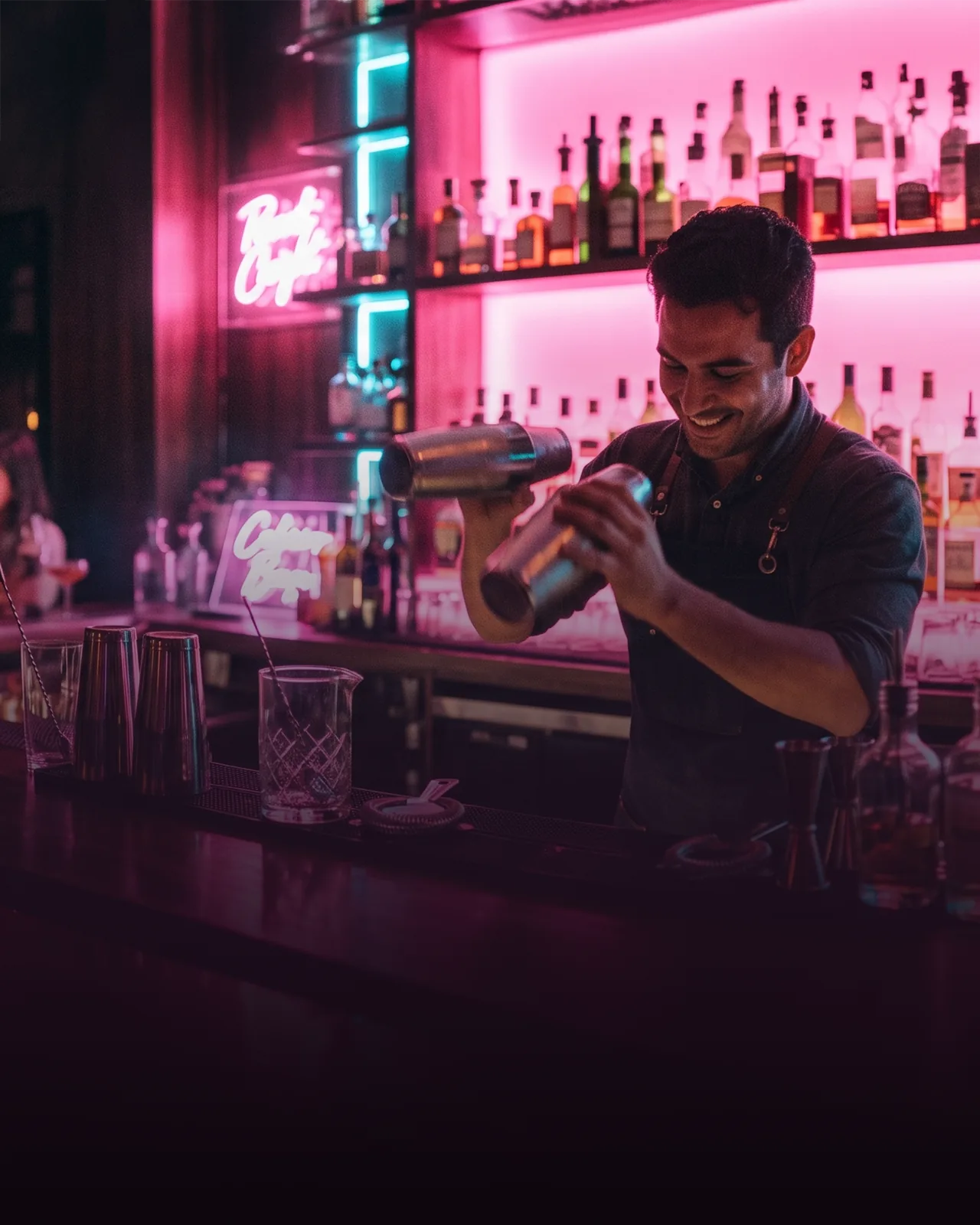


In short: a display fridge behind a bar has to keep bottles cold through the rush and sell them from across the room. Size it to your busiest night, choose doors for how often staff open them, and light the product rather than the shelf.
At twenty past nine on a big match night, the bottled lager in the top row of the back bar is at 11 °C. Nobody set it wrong. The doors have been opened four hundred times since seven, the last two cases went in warm straight from the delivery, and the compressor has been losing ground since halftime.
That is the failure a bar display fridge actually has to prevent. Plenty of units hold 3 °C in an empty room; fewer hold it with a bartender reaching in every twenty seconds and a crowd warming the air around them. Choosing one is mostly a question of where it stands, how much it has to carry on the worst night, which doors it has and how it is lit.
Under the counter or on the back wall?
Put the fridge where the bartender's hand already is. Under-counter bottle coolers win on speed, because the drink comes out at waist height without a turn; back-wall glass door units win on selling, because the guest sees every label before ordering.
Most busy bars end up with both. The under-counter run holds the three or four fastest sellers at the pouring station. The back wall holds the full bottled range, lit, and doubles as the reserve that restocks the lower fridges between rushes.
| Position | How staff reach it | What the guest sees | Best for |
|---|---|---|---|
| Under the counter, glass doors | One bend, no turn, while facing the guest | Little from the customer side | Top sellers at each service point |
| Under the counter, solid doors | Same reach, doors stay shut longer | Nothing | Mixers, garnish, reserve stock |
| Back wall, upright glass doors | Turn away from the guest | The whole range, lit | Bottled beer, ciders, premium soft drinks |
| Countertop merchandiser | Guests or staff, at the till | A few lines at eye level | Impulse sales, grab-and-go cans |
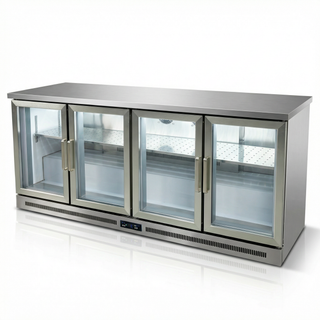
The under-counter option is a worktop chiller with glass doors, so the top becomes prep or glass space and the fridge hides in the bar front. Units in this format run from 80 to 260 L, which covers anything from a single-door bottle cooler to a run that fills the width of a station.
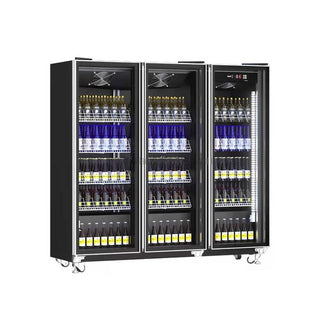
For the back wall, a three-door upright gives a bar a full-width bottle display with fan cooling, which matters more than the door count. Fan-forced air moves cold into the corners and recovers faster after the doors close. This one runs from 0 to 20 °C, so it can be set for lager at the bottom of the range or for wine and soft drinks higher up.
Check the depth of the back bar before falling for a full-height unit. A back wall fridge needs clear air around the condenser and room for the doors to open into an aisle that already carries two bartenders, so the plan should show the fridge with its doors open, not closed.
How many cases does a match day need?
Size a commercial beer fridge to the peak two hours of your busiest night, plus a buffer, and not to a weekly average. A fridge that holds the whole day's stock is too big for a Tuesday; one that holds a Tuesday runs warm on a Saturday.
The working method is simple enough to do on paper:
- Take the bottled drinks sold in the busiest two-hour window you expect. Till data from a comparable night beats a guess.
- Add a buffer of around a quarter, because stock at the back of a shelf is not reachable in a rush.
- Count bottles per shelf on the actual unit, then multiply by shelves. The liter figure on a spec sheet is gross volume, and it tells you very little about how many 330 ml bottles stand in a row.
- Plan where the next load of cold stock comes from, because it cannot come from the delivery pallet.
That last point decides more than capacity does. Beer loaded warm takes hours to reach serving temperature, and while it cools it drags the rest of the cabinet up with it. A bar with one fridge restocks from warm and serves warm by the second half. A bar with a back-wall unit feeding the under-counter coolers restocks cold to cold, which is the whole trick.
Rotation follows the same logic. New stock goes in at the back and on the bottom, and bottles already cold move to the front. It sounds like housekeeping, but it is what keeps the first bottle a bartender grabs at 3 °C instead of the one that went in twenty minutes ago.
If you pour most of your beer on draft, the fridge carries less, and it is worth deciding the split early. Our comparison of beer dispensing systems covers the draft side, including how many taps a busy room needs before bottles become the overflow rather than the main event.
Which doors should a bar display fridge have?
Hinged glass doors seal best and suit most back walls; sliding doors suit narrow bars where a swinging door would block the aisle. Solid doors hold temperature better than glass, and they belong where nobody needs to see inside.
| Door | Space in front | Cold kept in | Watch out for |
|---|---|---|---|
| Hinged glass | Needs the door's full swing | Good, with a magnetic gasket and self-closer | Doors left open in a rush; worn gaskets |
| Sliding glass | None beyond the cabinet | Fair; only one side opens at a time | Tracks that clog with sticky spills |
| Solid (insulated) | Needs the door's full swing | Best | Staff open it to look, which costs cold |
| No door (air curtain) | None | Weakest; fights the room all night | Drafts and heat from nearby equipment |
A sliding door only exposes half the cabinet at once, which is good for temperature and bad for speed at a station where two people reach in together. In a long, tight bar it is still often the right call, because a hinged door opened into a 90 cm aisle turns into a gate that one bartender holds while the other waits.
Condensation is the other glass-door issue. A humid bar full of people fogs cold glass, and a fogged door sells nothing. Double glazing helps, and on freezers a heated glass pane is normal. This slim upright holds −18 to −24 °C behind double-layer glass with electric heating and a self-closing door. It is a neat way to keep vodka bottles and shot glasses frozen and on show without giving up a full-size freezer.

Open-front multidecks, with no door at all, belong in self-service settings such as a stadium concourse counter or a hotel lobby shop, where guests pick their own drink. Behind a staffed bar they waste energy for no gain, since the bartender does the picking anyway.
Lighting that sells the drink
Light the bottles from the front and sides so labels read from across the room. A strip along the top of the cabinet mostly lights the tops of caps, and the bottom shelf, usually holding the best-margin products, sits in shadow.
LED is the only sensible choice inside a cabinet. It runs cool, so it adds very little heat load, and it holds its color for years. Aim for a neutral to slightly cool white on beer and cider, because warm yellow light makes pale lager look flat, and keep the back panel dark so the lit bottles stand out against it.
The layout inside the fridge is part of the lighting. Put two or three facings of each line side by side, label out, at the height where a standing guest's eyes land. A back bar fridge with one of everything scattered across four shelves reads as clutter, however well it is lit.
At the till, a countertop merchandiser takes this further. This one has a transparent display door that plays video and promotions while the drinks stay visible behind it, and at 435 mm wide it fits beside a card terminal. It holds 52 L at 0 to 10 °C, which suits a handful of premium lines rather than the whole range.
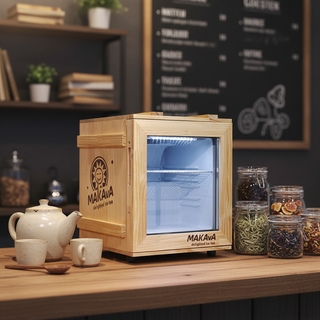
Brand-supplied fridges deserve a word here. A brewer may offer a branded cooler in exchange for exclusive shelf space, which saves a purchase and costs you control of what the guest sees. For a bar that wants to sell its own range, owning the display is the point.
Where bar display fridges go wrong
The failures are rarely about the fridge itself. They come from the room it stands in.
- No air for the condenser. A unit boxed into joinery with no ventilation gap recycles its own hot air. Under-counter models need front venting; uprights need clearance above and behind.
- The wrong climate class. Refrigeration is rated for the ambient temperature it can cope with. Class N units are rated to 32 °C and ST to 38 °C, and a back bar under spotlights with a crowd in front can pass the lower figure on a summer night.
- Using the display fridge as the stockroom. Display cold is built to sell what is on the shelf tonight. Bulk storage belongs in a reach-in or cold room, as our guide to commercial refrigeration explains.
- Setting the thermostat once. The display reads the air near the sensor, not the bottle by the door. A probe thermometer in a bottle of water on the top shelf tells the truth.
The full range is in our display fridges collection, and the back bar units and bottle shelving range covers the joinery around them.
Not sure how much cold your back bar needs? Send us your bar length, your busiest night's bottle count and a photo of the space, and we will size the under-counter and back-wall units together.


