


In short: most knife types exist because one cut is hard with a chef knife. Boning follows bone, fillet follows skin, a cleaver is a wedge, a santoku is a push-cutter. Buy the type for the cut you make hundreds of times a week — and never take a vegetable cleaver near a bone.
Open the knife roll in almost any professional kitchen and you will find eight blades, three of which get used. The chef knife is worn to a curve. The santoku somebody was given still has the sticker on it.
That is not carelessness. It is what happens when knife types are bought by name rather than by the cut they solve. Each shape below exists because one specific job is awkward with a chef knife — and outside that job, most of them are worse than the knife you already own.
Which knife types actually earn a place in a kitchen?
Five, for most kitchens: a chef knife, a boning knife, a serrated bread knife, a paring knife, and whichever specialist matches your menu. Everything else is a preference or a station-specific tool.
| Type | Blade | The job it exists for | What it is bad at |
|---|---|---|---|
| Boning | 12–15 cm, narrow, curved | Separating meat from bone and joints | Anything on a board that needs a straight edge |
| Fillet | 18–20 cm, very flexible | Skinning and filleting fish | Dense vegetables — it flexes away from the cut |
| Yanagiba | 24–30 cm, single-bevel | One-stroke slices of raw fish | Chopping of any kind; the edge chips |
| Vegetable cleaver | Wide, thin, light | Fast board work, scooping, crushing garlic | Bone — it is not a bone tool |
| Bone cleaver / butcher | Thick spine, heavy | Splitting bone and breaking down primals | Fine work; no control at the tip |
| Santoku | 16–18 cm, flat profile | Push-cutting vegetables, thin slices | Rock-chopping and detail work at the tip |
Steel, length and handle construction are a separate decision that applies to all of them — that is covered in our guide to choosing a chef knife for a professional kitchen.
Boning knives: stiff or flexible is the only real choice
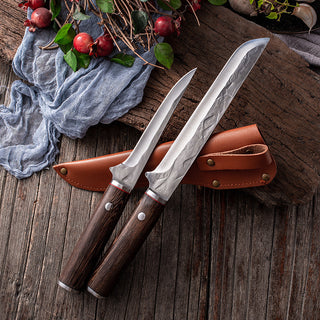
A boning knife is narrow so it can get between muscle and bone, and curved so the edge follows the shape it is tracing. The decision that matters is stiffness, and it comes down to what you break down.
A stiff blade is for beef and pork: it takes force against joints without bending, and it holds a line through connective tissue. Flexible blades are for poultry and fish, where the point is to ride along the bone rather than push through it.
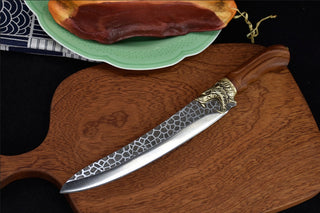
For a kitchen doing daily portioning rather than whole-carcass work, a shorter boning knife with a comfortable handle does more real work than anything dramatic. Wet hands are the failure mode here — grip matters more than the blade profile.
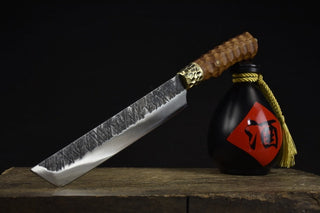
Where the job is genuinely heavy — splitting, jointing, working through cartilage all shift — a forged carbon-steel boning machete does what a slim blade cannot. It is a butcher's tool rather than a line cook's, and it wants drying and oiling after every use.
Fillet knives, yanagiba, and why fish gets two knives
A fillet knife is long and deliberately floppy. That flexibility is the feature: pressed flat against the skin, the blade bends into the contour of the fish instead of cutting through it, which is how a fillet comes off with nothing left behind.
Slicing raw fish for service is a different task entirely, and it wants a different geometry. A yanagiba is single-bevel and long enough to take a whole slice in one drawing pull, with no sawing — sawing is what tears the surface and dulls the appearance of sashimi. At 28 cm it looks excessive until you watch the alternative.
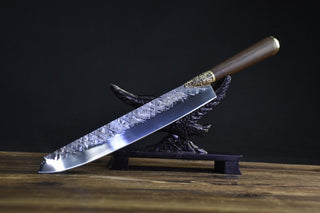
Single-bevel blades are ground for one hand, so buy them for the person who will use them. A left-handed cook with a right-handed yanagiba will fight the knife on every cut. Shellfish gets its own short, blunt-tipped seafood knife for the same reason — prying is a job no thin blade should be asked to do.
The cleaver mistake that chips blades in week one
Two completely different knives share the word. Getting them confused is the single most expensive knife error in a professional kitchen.
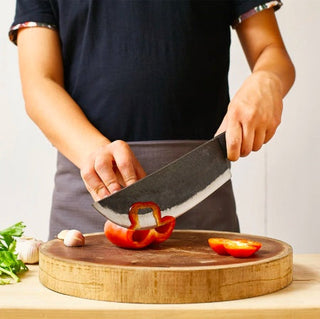
The Chinese vegetable cleaver is wide and thin, and lighter than its size suggests. It is a board knife: fast on vegetables, useful for scooping prep off the board with the flat, and excellent at crushing garlic. Its edge is thin. Bone will chip it, permanently, on the first strike.
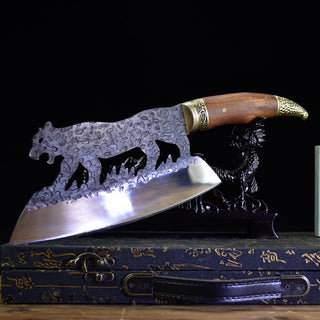
A bone cleaver is the opposite build — thick spine, blunt wedge geometry, weight doing the work rather than sharpness. It splits poultry and ribs, and it is meant to be swung rather than pressed.
The test before you buy: hold it up and look at the spine. Under about 3 mm, it is a vegetable knife whatever the listing says.
Santoku or chef knife?
A santoku is a push-cutter. The profile is flat, the tip drops to a sheepsfoot, and the cutting motion is straight down and slightly forward rather than the rocking motion a curved French chef knife invites. On vegetables, it is faster and neater. It cannot rock-chop herbs, and it has no fine point for detail work.
Which is why the honest answer for a professional line is: keep the chef knife as the primary and let the santoku be a personal preference rather than a purchase for the whole brigade. If your prep is mostly vegetables and your cooks push-cut anyway, buy them; if the brigade rocks, do not.
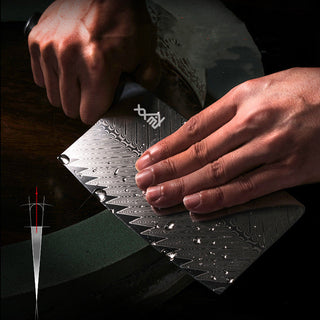
A hand-finished Damascus blade of that size gives the same geometry with a harder edge and a longer interval between sharpenings — worth it for the person who preps all day, hard to justify for the roll that lives in a drawer.
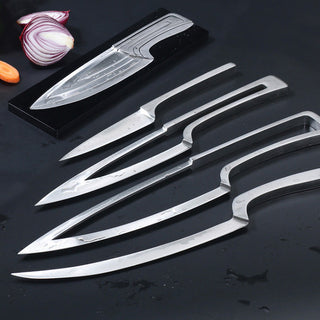
Where budget and space are both tight — food trucks, small kitchens, catering kits — a nesting set gets five profiles into the footprint of one knife.
The full specialty and fish knives range sits alongside chef knives and Damascus blades if you are building a roll rather than replacing one knife.
What a kitchen should own, by service
A café doing sandwiches and salads needs three knives and a spare: chef, serrated, paring. Adding a boning knife it never uses is money in a drawer.
A restaurant butchering in-house needs the boning knife in two stiffnesses, plus a heavy blade for anything with bone in it. That is where the specialist knives stop being optional.
A sushi counter needs the yanagiba, a deba for breaking down whole fish, and enough of a sharpening routine to keep single-bevel edges true. Nothing else in the kitchen touches those knives.
Banquet and catering kitchens buy for portability instead of coverage: fewer knives, sturdier profiles, sheaths or a nesting set, because the expensive failure is a blade travelling loose in a crate.
Where kitchens get knife types wrong
- A cleaver through bone that was never built for it. Check the spine thickness before the first cut, not after.
- Buying a santoku for a brigade that rock-chops. The technique decides the knife, not the other way round.
- One boning knife for beef and chicken. Stiff and flexible are different tools that look almost identical.
- Single-bevel knives given to the wrong hand. A right-ground yanagiba will never cut straight for a left-handed cook.
- Storing specialists loose in a drawer. Edge damage in storage kills more expensive blades than use does.
- Sharpening everything the same way. A single-bevel edge and a European double-bevel need different angles and different stones.
If you are equipping a kitchen from nothing, buy the chef knives properly, add one boning knife per person who breaks down protein, and let the menu tell you which specialist comes third.
Building a knife roll for a whole brigade? Tell us what you butcher in-house and how many cooks are on the line, and we will put a set together that matches the work rather than the catalog.


