

In short: where you park matters more than the menu. In how to open a food truck, pitches set the permits, a commissary sets the daily routine, and the vehicle's power and weight budget decides how much kitchen you can actually run.
A food truck earns only while it's parked with the hatch open. Every hour spent looking for a pitch, waiting for a council to reply or driving back to refill water is an hour with zero takings, so anyone working out how to open a food truck should plan the parking before the paint job.
That's the thread through this guide. Everything else, from the menu to the vehicle, follows from a short list of places where you're allowed to trade and where people are hungry at the same time.
Where will you park? Pitches come before the menu
Line up at least three pitch types before you buy anything, because one type alone rarely fills a week. Mobile food businesses that last usually mix them.
Street and lunch pitches. Office districts, business parks, university campuses. The trade is fast and short, roughly 11:30 to 2:00, and the permission comes from the council or city that controls the road or square. Some cities cap the number of mobile vendors or run waiting lists for the best spots.
Private land. A brewery taproom with no kitchen, a pub car park, a garden center, a car dealership on a Saturday. The landowner gives permission, often for a small fee or a share of takings, and in many areas you still need planning or trading consent for regular use of the same spot.
Markets and food halls. A weekly street-food market gives you a queue you didn't have to build. The organizer handles the site permit, and you pay a pitch fee or a percentage.
Festivals and events. The highest takings per day and the highest fees. Organizers ask for your food hygiene rating and gas certificate, plus proof of liability insurance, before they reply, and good festivals fill their food lists months ahead.
Private catering. Weddings, corporate days, film sets. The client pays a fixed fee or a minimum spend, which smooths out the weeks when weather ruins street trade. If this becomes the core of the business, our guide to starting a catering business covers the booking side.
Test a pitch before you rely on it. Stand there at the hour you'd trade, on two or three different days, and count who walks past, how many are carrying lunch from somewhere else, and what else sells within sight. A spot with lots of passers-by and no food is rare; a spot with a sandwich shop on the corner can still work if your menu is faster or different.
Once you know which of these you can actually get, the menu follows. An office lunch pitch needs food served in under a minute. A festival crowd will wait longer for something photogenic but expects a menu of four or five items, not twelve.
Truck, trailer or cart: which setup fits the business
The vehicle decides how many pitches you can work in a day and how big the crew has to be. Our comparison of food truck versus food trailer or cart goes deeper into weight and chassis limits; here is how the choice plays out on the business side.
| Food truck | Food trailer | Food cart | |
|---|---|---|---|
| Pitches per day | Two or three | One, or the same site for days | As many as you can walk to |
| Crew at the window | Two, three on a rush | Two to four | One |
| Menu | Cooked to order | Cooked to order, oven or bar | Poured, scooped, assembled |
| Commissary use | Daily | Before and after each event | Light, often a shared kitchen |
| Biggest start-up spend | The vehicle and conversion | The trailer build | The drinks or dessert equipment |
| Paperwork | Vehicle plus food plus trading | Trailer registration plus food plus trading | Food and trading, usually no vehicle layer |
A trailer suits the event-led business best, because a festival weekend needs a big kitchen that drives there once. The BBQ trailer below is built on a galvanized frame for exactly that kind of work, with room for a chargrill and flat-top next to the fryer, and a 1.5 to 30 kW power range depending on how it's fitted.

If the trailer is also the brand, a retro body gets photographed at every market and tells people what you are before they read the menu. The Airstream-style unit is four meters long, with a hydraulic serving hatch, and takes most of the same cook-line options.

A cart is how many operators test a concept before committing to a vehicle. Coffee, lemonade or a dessert counter can trade from a folding cart with an umbrella and an extendable top while you learn which pitches actually sell.

All the trailers and carts sit in our food trucks collection, and the food truck page walks through what fits inside each format.
What permits does a food truck need?
Every market stacks three layers of permission. You register the food business, you get permission to trade at each pitch, and anything with an engine or a tow bar needs vehicle paperwork on top. The trading layer is the one that multiplies, because it's granted place by place.
Order matters. Start the food business registration and the first trading applications while the vehicle is still being built, because councils can take weeks to reply and some only open applications for street pitches once or twice a year. Leave the vehicle inspection and the gas certificate until the build is finished, since they certify the actual unit.
United States
Food trucks are licensed city by city and county by county. Expect a mobile food vendor permit and a health permit from the local health department, food-handler cards for the crew and a business license with an EIN. Most jurisdictions also require a commissary agreement, a signed arrangement with a licensed base kitchen where you prep and restock, and where the waste water goes. Texas moved to a state DSHS license for mobile food units from July 1, 2026, which shows how quickly these rules shift. Fire marshals in many cities inspect the truck's fire suppression and gas setup too.
United Kingdom
Register as a food business once, with the council where the vehicle is kept, at least 28 days before you trade. Then apply for a street trading licence or consent from every council you want to trade in, since each runs its own scheme with its own fees and restricted streets. Organizers and councils will also expect a Level 2 Food Hygiene certificate for food handlers, a Gas Safe certificate if you cook on LPG and public liability cover in the region of £5–10 million. Your Food Hygiene Rating follows you from pitch to pitch, and event organizers check it.
Australia
Mobile food premises register with their principal council, usually where the vehicle is garaged, and are classed by the riskiest food they handle. Victoria runs this through the statewide FoodTrader portal (formerly Streatrader): once registered, you lodge a statement of trade with any other council before you trade in its area. Most states also expect a nominated Food Safety Supervisor on a cooking vehicle. Trading on a road, footpath or public reserve needs separate permission from the council or landowner. Gas and electrical work on the vehicle has to meet the relevant Australian standards.
Treat this as an overview, not legal advice. Mobile trading rules are some of the most local in hospitality, so confirm the details with each authority on your pitch list before you commit to a build.
Why does a food truck need a commissary kitchen?
Because a truck can't do its own bulk prep and deep cleaning on board, and in most US jurisdictions the permit depends on showing you have a base that can. Even where it isn't a legal requirement, the commissary is where the day actually starts and ends.
A typical day starts at the base, where stock comes out of the walk-in, proteins get portioned and sauces made while the fresh-water tank fills. The truck trades through lunch and comes back in the evening to empty the waste tank into an approved drain, wash down and restock, with the batteries charging overnight in a secure spot.
There are three common ways to get one:
- A shared commissary that rents prep time and cold storage to several trucks, often with secure overnight parking. The fastest route in US cities.
- An existing restaurant's kitchen in its off-hours, by agreement. Cheap if the owner is willing, fragile if they sell up.
- Your own small production kitchen, which becomes worth it once you run two units or add delivery. A delivery-only setup shares most of its requirements, and our guide to opening a ghost kitchen covers that build.
Distance matters more than the monthly rent. A commissary forty minutes from your best pitches costs two unpaid hours a day, every day you trade.
How much kitchen can a food truck power and carry?
Less than a restaurant kitchen of the same floor area, and the limit is usually electrical before it's physical. Add up what runs at the same time, then decide what cooks on gas.
Take a burger truck. A double-sided clamshell griddle cooks both faces of a patty at once and roughly halves cook time, but this one draws 12 kW on a 380 V supply. That single appliance is close to the whole output of a mid-size generator.

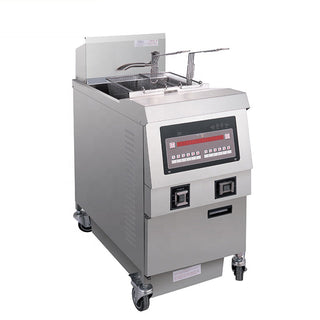
The fryer is the second big load, and it's where the gas-or-electric decision pays off. The double fryer below comes in both versions, with two 25-liter tanks; on a generator-powered vehicle the gas version keeps the electrical budget free for everything else. The full fryers and griddles and cooktops ranges cover smaller single-tank options.
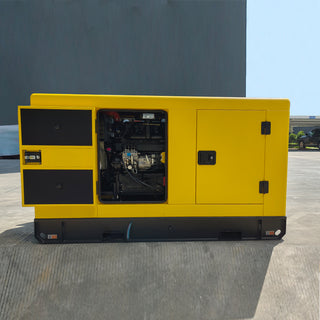
Then the power source. A diesel set of 10 to 15 kW covers a mixed gas-and-electric truck comfortably, but it runs at 70–90 dB, and more markets and residential streets now ban loud generators or restrict their hours.
A battery station is the quiet alternative for the low-draw loads: fridges, lights, the card reader, a coffee grinder. A 3,000 W unit with a 5,376 Wh lithium iron phosphate battery can run refrigeration through a lunch shift and recharge from shore power or solar overnight. More options are in our power systems range.

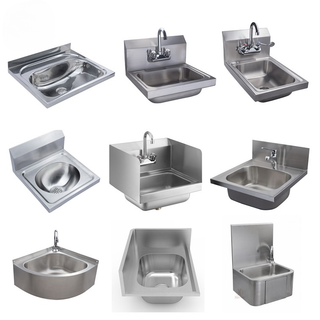
Water is the other budget. Health rules almost everywhere require a dedicated hand-wash sink separate from the prep sink, with hot water, and a waste tank at least as large as the fresh one. A compact wall-mounted basin in 304 stainless fits the narrow wall by the hatch; more sink configurations are in the sinks range.
Hot water on a vehicle usually comes from an instant heater, which saves the weight of a tank. The catch is its draw, since the unit below pulls up to 8,500 W while running, so on a generator it needs to be counted in the peak, or replaced with a gas heater. See the water heaters range for other ratings.

Heat and fire need the same attention as power. A griddle and a fryer in a two-meter aisle need an extraction canopy with grease filters over them, and most cities and event organizers expect a fire suppression system over the fryer plus a wet-chemical extinguisher for fat fires. Build these into the layout from the start, because moving a canopy after the fit-out means moving the appliances under it; a hot, smoky cabin also slows the crew at exactly the moment the queue is longest.
Weight closes the loop. Every tank of water, every stainless worktop and the generator itself count against the vehicle's payload or the trailer's axle rating, so ask for the empty weight of the build and add what you carry on a full day before signing off the layout.
A menu built for the serving hatch
A food truck sells speed. At a lunch pitch the queue decides in about thirty seconds whether to wait, so the useful number is plates per minute at the hatch, not dishes on the board.
The menus that work share a few habits. One main cooking method, so the cook isn't moving between four stations in a two-meter aisle. Components portioned at the commissary, so the truck assembles rather than preps. One hero item that makes up most of the orders and moves through the griddle or fryer in a single pass. And a price list short enough to read from the back of the queue.
Cold drinks are the easiest add-on margin a truck has, and they need no cooking at all. A glass-door fridge by the hatch sells cans and bottles by sight while the food is being made; the three-door unit below draws 420 W, which a battery station can carry.
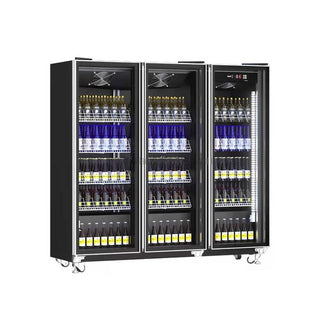
Plan the layout around the order path: cash or card at the hatch, cold components within one step of the cook, the hot line behind, the pass back at the hatch. The rest of the cold chain, including under-counter units and freezers, is in the refrigeration range.
What does it cost to open a food truck and keep it moving?
The vehicle and its conversion are usually the largest single spend, larger than the cooking equipment inside. The appliance list is the part owners research most and the part that matters least to the total, provided it's sized to the power supply.
The running costs are where food trucks surprise people. Pitch fees and event percentages come off the top of takings. Commissary rent is monthly whether you trade or not. Every council on your list charges its own trading fee. Insurance is split across several policies, with public liability on top of the vehicle cover. Fuel for both the engine and the generator adds up quickly. Downtime costs money too, because a truck in the workshop for a week earns nothing that week, which is one reason event caterers often prefer a trailer they can tow with a different vehicle.
Spend properly from day one on the cooking equipment your hero item depends on, on the water system and on the gas installation, because inspectors check those and those are what fail mid-service. Leave until later a second cooking appliance or anything the first season's sales don't clearly ask for.
Seasonality belongs in the budget too. In most of Europe and the UK, street trade drops sharply from November to March, so either plan private catering and Christmas markets for the winter or budget for three quiet months.
Mistakes that keep a food truck parked
| Mistake | What happens | Do this instead |
|---|---|---|
| Buying the vehicle before securing pitches | A finished truck sits idle while trading applications crawl through councils | Get at least two confirmed pitches or a market place before the build starts |
| Sizing power to the brochure, not the peak | Griddle and fryer plus the water heater trip the generator at the busiest moment | Add up everything that runs at once; move high-heat cooking to gas |
| A commissary far from the pitches | Two unpaid hours on the road every trading day | Choose the base by drive time to your best pitches, not by rent |
| A restaurant-length menu | Slow hatch, long queue, people walk away at lunch | Four or five items, one main cooking method, prep done at the base |
| Treating one trading permit as enough | Fines or being moved on the first time you cross a council boundary | List every council and landowner on your route and apply to each |
| Domestic appliances in the build | Home fridges and heaters fail under vibration and constant door opening | Commercial units rated for the load, fixed for travel |
Opening a fixed site as well, or instead? Our guide to opening a restaurant covers the full kitchen and dining room build.
Planning a truck, trailer or cart? Send us the menu, the pitches you're aiming for and how you'll power the kitchen, and we'll put together an equipment list that fits the vehicle and the supply.


