
Smoky air carries two loads, fine particles and odor gases. A commercial air purifier with HEPA or electrostatic stages catches the particles, activated carbon slows the odor, UV-C touches neither, and no unit stands in for code ventilation.
The opening manager unlocks at ten in the morning and smells last night before switching on a single light. Smoke from the table grills has settled into the banquettes, the curtains hold the cigar terrace from next door, and the smoked old fashioned that sold forty times on Friday has left its own trace. A commercial air purifier can help with some of that. Which part depends on what the smoke is made of, and on what the machine was built to catch.
Smoke is often part of the offer now: a cocktail finished under a cloche from the cocktail smokers range, a grill set into the table, a wood-fired oven in view of the dining room. Buying the right air treatment starts with separating what is in that air, because every technology on the market handles a different part of it and some handle none.
What does a commercial air purifier remove from smoke?
A commercial air purifier removes smoke particles if it has a HEPA or electrostatic stage, and reduces smell only if it also has enough activated carbon. Smoke carries two very different loads, and a filter built for one does little for the other.
Particles. The visible haze is made of very fine particles, most of them far smaller than dust. They stay airborne for a long time and settle on every soft surface in the room. HEPA filters and electrostatic precipitators (ESP) are built to catch them.
Gases. Much of what you smell is gas, not particles. These molecules pass straight through a HEPA filter. Activated carbon adsorbs some of them onto its surface until the carbon is saturated, at which point it stops working and has to be replaced.
Microorganisms are a third category and a separate question. They are what UV-C lamps are sold for, and they have nothing to do with haze or smell.
HEPA, activated carbon, electrostatic, UV-C and ozone side by side
Each technology does one job. The table shows what that job is and whether the unit can run with guests in the room.
| Technology | What it catches | What it misses | Can it run with people present? | Upkeep |
|---|---|---|---|---|
| HEPA filter | Fine smoke particles, dust | Odor gases | Yes | Filter replacement; a clogged filter moves less air |
| Activated carbon | Some odor gases, until saturated | Particles | Yes | Carbon replacement; the amount of carbon sets its life |
| Electrostatic precipitator (ESP) | Smoke and grease particles on charged plates | Odor gases | Yes, if the unit's ozone output is low | Washing the collector plates |
| UV-C lamp | Microorganisms in air passing the lamp | Smoke particles and odor | Depends on design: shielded, in-duct and upper-air units can; open lamps cannot | Lamp replacement at rated hours |
| Ozone generator | Reacts with odor molecules in an empty room | Particles | No, never | Airing out before anyone re-enters |
The practical answer for a smoky room is a combination: a particle stage (HEPA or ESP) plus a generous carbon stage. Units that list only one of them solve half the problem.
Ozone generators are a closed-room tool
Ozone generators must not run while anyone is in the room, guests or staff. Ozone is an irritant gas and a regulated pollutant in its own right, and a machine that makes enough of it to break down odor makes far more than is acceptable to breathe. Restoration crews use them after a fire in sealed, empty rooms, then air the space out before anyone goes back in.
The same caution applies to some ionizers and electrostatic units, which can produce a little ozone as a by-product. Before you buy any electronic air cleaner for an occupied room, ask the supplier for its ozone emission figure and the standard it was tested to.
Catch smoke where it starts, then clean what escapes
Capturing smoke at its source takes far less air than cleaning a whole room after it has spread. A hood over a grill or a downdraft in the table deals with the plume before it reaches the upholstery; a room purifier can only thin out what got away.
For a grill or teppanyaki station that cannot be ducted outside, a recirculating hood puts every filter type from the table above into one box. This one runs four stages in sequence (baffle, ESP, HEPA and activated carbon), and the manufacturer rates the ESP stage at 98% capture of fine smoke and grease mist. It is built for light to medium duty such as griddles, electric fryers and steamers, and runs at 65 to 70 dB.
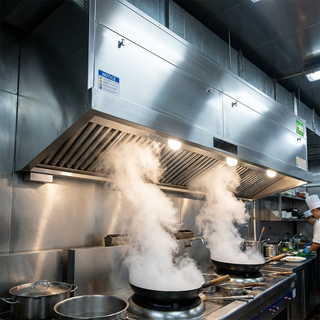
For heavier smoke, the ductless ESP fume purifier moves 3,000 m³/h through an electrostatic stage and a carbon filter, rated by its maker at 99% or better. Neither unit is an answer for charcoal or high-flame wok cooking, which produce combustion gases that must be exhausted outside. Our guide on how to size a kitchen exhaust hood covers ducted extraction.
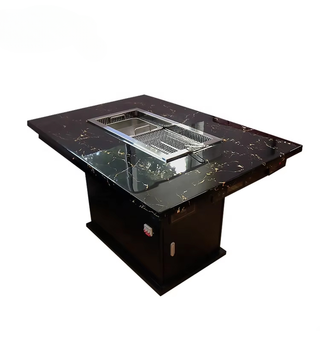
Where the smoke comes from the dining table itself, as in Korean barbecue or hot pot, the extraction can go into the table. This marble-topped table draws smoke and steam downward at the cooktop through a built-in channel, so the plume never rises to face height. It is built to order for your layout, and the channel still has to connect to the building's extraction, which the supplier confirms with you.
How many air changes should a commercial air purifier deliver?
For a smoky room, plan on a commercial air purifier, or several, that together clean the room's full volume around five times an hour or more. The arithmetic takes one line: clean air delivery rate divided by room volume gives air changes per hour.
Take a lounge 15 m by 10 m with a 3 m ceiling. That is 450 m³. A unit that delivers 1,000 m³/h of clean air gives just over two air changes an hour, so reaching five means about 2,250 m³/h, split across two or three units placed at different ends of the room rather than one big machine in a corner.
Two things make this harder than it looks on paper:
- Airflow is not clean air delivery. A fan rated at 1,500 m³/h pushes that much air, but if the filters catch only part of the smoke on each pass, the clean air delivered is lower. Ask for the clean air delivery rate (CADR) measured for smoke, not the fan figure.
- Filters load up. As HEPA filters fill, airflow drops; as carbon saturates, odor passes through. A unit sized with no margin falls short within weeks in a room with steady smoke.
Noise matters too. A purifier running at full speed in a quiet lounge is audible, so size it to reach your target at a middle fan setting and keep full speed for after close.
Where a UV sterilizer fits, and where it does not
A UV sterilizer fits a venue that wants germicidal treatment of its air or surfaces, and it does not fit a smoke problem. UV-C light acts on microorganisms that pass close to the lamp. It does not remove particles, and it does not remove smell.
If you want UV-C anyway, the installation type decides whether it can run during service. An in-duct unit sits inside the ventilation ductwork, where nobody can see the lamp. This one draws 40 W, shows UV intensity on an LED display and reminds staff when the lamp is due for replacement.

A stand-alone unit treats a room directly and is scheduled for the hours the room is empty. This 180 W model runs a 360-degree lamp, takes programmed schedules, logs its cycles to a USB drive and uses a radar sensor that responds to movement in the room.

Fixed upper-air units are the third format, mounted high on the wall so the lamp's light stays above head height. Our article on hotel supplies beyond the bed compares UV wavelengths in more detail. Whatever the format, ask what the unit is tested and certified for in your market and follow the manufacturer's rules for occupied rooms. We make no health claims for any of them, and they are not a reason to cut ventilation.
What no purifier replaces
No purifier replaces the mechanical ventilation your building code requires. A purifier recirculates the same air; ventilation brings in outdoor air and sends stale air out, and codes set that outdoor-air rate by the number of occupants and the floor area.
The difference is easy to show. People breathe out carbon dioxide all evening, and no filter, carbon bed or UV lamp removes it. In a full room with poor ventilation, carbon dioxide rises while the purifier runs happily beside it. Anything that burns fuel adds combustion gases as well, including carbon monoxide from charcoal and gas, and those leave the building only through a duct to outside. A room with open flame or charcoal also needs carbon monoxide detectors, whatever else is fitted.
Where indoor smoking is licensed at all, the license usually comes with its own ventilation standard on top of the general code. Ask your building control officer or local authority what applies to your premises before you buy any air treatment, and let a ventilation engineer size the system first. Purifiers and UV units are added after that, never in its place. The ventilation range covers hoods and extraction, and the sanitation range covers UV air and surface treatment.
Not sure which smoke you are dealing with? Send us the room size, the ceiling height and where the smoke comes from, whether grills, a cocktail station or a terrace door, and we will suggest source capture and room treatment that fit together.


