
Match a commercial deep fryer to the menu before the floor plan. One tank suits a single fried item, two tanks stop fries tasting of fish, and a pressure fryer only earns its keep when bone-in chicken is the product.
Eight o'clock on a Friday, and the third basket of frozen fries goes into oil that has not yet recovered from the second. The fries sit in the basket for their full three minutes and come out pale and heavy, because the oil spent most of that time well below frying heat. Nothing is broken. The commercial deep fryer was simply sized for a Tuesday lunch.
Most fryer problems start there, with oil volume and heating power set against the wrong hour of the week. The other decisions follow from the menu: how many different things go into the oil, whether anything needs to be kept apart, and whether the kitchen fries enough chicken to justify a sealed pressure pot. Fuel comes last, and usually the building settles it.
Single tank, twin tank or pressure: which commercial deep fryer fits the menu?
Buy one tank if the kitchen fries one family of food, two tanks as soon as fries share the oil with battered fish or breaded chicken, and a pressure fryer only when bone-in chicken is a headline item. The table sets the three side by side using the units we carry.
| Type | Oil in the tank | What it does well | Where it struggles | Supply |
|---|---|---|---|---|
| Single tank, countertop | 30 L | Donuts, dough, one fried side on a small menu | Rapid frozen loads; 4.5 kW recovers slowly on 30 L | 220–240 V single-phase |
| Twin tank, floor-standing | 2 × 25 L | Fries in one tank, fish or chicken in the other | Takes a meter of line under the hood | Gas or electric version |
| Pressure fryer with auto-lift | 55 L | Bone-in chicken in large racked batches | Useless for fries; needs training and three-phase power | 380 V or 220 V three-phase, 17 kW |
One tank for one job
A single tank is the right fryer when the menu fries one thing, or a few things that can share oil without harm. A café doing donuts in the morning, a bar kitchen with fries as its only fried side, a dessert counter doing churros. The countertop unit below holds 30 liters on a 4,500 W element and runs from an ordinary single-phase supply, which matters in a site with no three-phase connection.
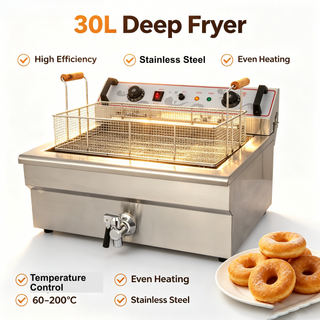
Be honest about its limit. Thirty liters is a generous volume for the heat behind it, so the oil holds temperature well through gentle loads such as proofed dough, and falls further than you would like when a basket of frozen fries lands in it. For a donut program that is the right trade; for a burger bar's fry station it is not. Our guide to opening a donut shop covers the rest of that line, and donut machines automate the dropping and turning.
Two tanks for flavor separation
Oil carries flavor from everything cooked in it. Fish batter leaves its taste in the fries that follow, and a single shared tank is also a problem for allergens: a guest avoiding fish or gluten cannot eat fries from oil that just cooked battered cod. Two independent tanks solve both, and they also double the number of baskets you can have in the oil at once.
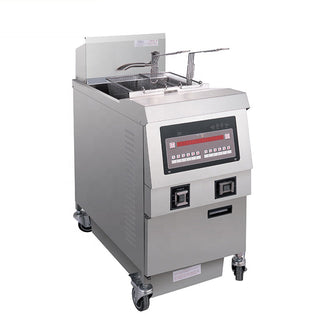
This twin model carries 25 liters per tank on a 304 stainless body 900 mm wide, and it comes as either a gas or an electric build. For a pub kitchen with fish and chips on the menu it is the default choice, and it is the fryer our pub launch guide points to.
Pressure for bone-in chicken
A pressure fryer seals the lid over the oil. Moisture from the chicken turns to steam, the steam raises the pressure in the pot, and the meat cooks through faster while the coating browns. Bone-in pieces that would dry out at the edges in an open fryer before the joint is cooked stay moist, which is why fried chicken chains built their menus on this method.
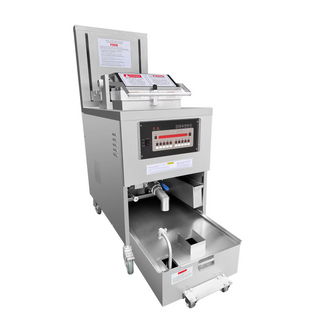
The unit we list is a 55-liter electric pressure fryer with a 17 kW heating load and a multi-tier rack that lowers a full batch into the oil and lifts it out when the program ends. It can be ordered with a built-in filter and pump. Two cautions come with it. It needs a three-phase supply at 380 V, or 220 V three-phase, and it is a machine for one product: fries, onion rings and anything that should end crisp belong in an open fryer next to it, not under a sealed lid. Staff need training on the lid and the pressure release before the first service, not after.
How many liters of oil does your fry volume need?
Size the oil to the busiest half-hour, not the daily total. Cooks traditionally load roughly one part food to six parts oil by weight, and a heavier drop pulls the temperature down further than the elements or burners can put it back before the food is done.
Work it forward from the menu. Count the fried portions in your peak half-hour, weigh one portion, and you know how much food has to pass through the oil in thirty minutes. Frozen fries take three to four minutes a drop, so each basket can go in roughly six to eight times in that window. If the arithmetic asks for more food per drop than the oil can take at that ratio, you need either more liters or a second tank. Most kitchens are better served by the second tank, since it also gives a spare if one side is being filtered or has a fault.
Heating power per liter is the second number to compare, because it tells you how quickly the oil comes back after a drop. It is easy to work out from the spec sheet:
- The 30 L countertop fryer: 4.5 kW, or about 0.15 kW per liter.
- The 55 L pressure fryer: 17 kW, or about 0.31 kW per liter.
A fryer with twice the power per liter recovers roughly twice as fast. That matters most with frozen product, which drops oil temperature far more than fresh-cut potatoes or dough. If a maker quotes an hourly output in kilograms of fries, ask whether it was measured with frozen or fresh product; the two figures are not comparable.
Oil filtration sets the running cost
Oil is the fryer's biggest running cost, and filtration decides how long each fill lasts. Crumbs and batter left in the tank keep burning, darken the oil and speed up its breakdown, and broken-down oil smokes at a lower temperature, soaks into the food and tastes of the previous night. Filtering every day, at the end of service, is what keeps a fill going for days rather than hours.
Most open fryers have a cold zone under the heating elements where debris settles instead of scorching. That buys time between filtrations; it does not replace them. There are three ways to do the filtering itself, and they suit different kitchens.
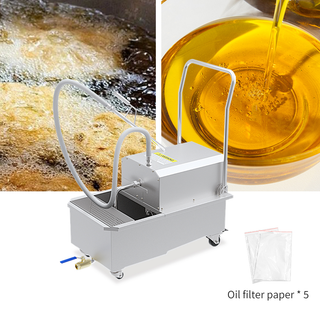
A mobile filtration cart rolls to the fryer, drains the hot oil, pumps it through a filter and returns it to the tank. The cart below handles an oil load of 36 to 48 liters, depending on the model, with a pump flow of 12 to 32 liters a minute on a 550 W single-phase motor, which covers one tank of either fryer above in a single pass.
A centrifugal filter spins particles out of the oil instead of catching them on paper or mesh, and it gets out the fine carbon that a basic mesh leaves behind. The unit here draws 200 W from a standard 220 V outlet and comes in 35 and 45 liters-per-minute versions, and its small body sits on a prep bench.
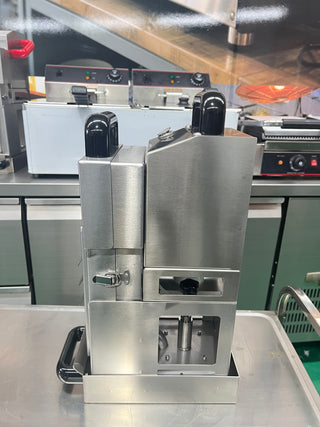
Built-in filtration, where a pump and filter sit inside the fryer cabinet, is the most convenient option because nobody has to move hot oil across the kitchen. The pressure fryer above offers it as an option. For busy lines it is worth the extra, because a filter step that takes one button press actually happens every night.
Whichever route you take, let the oil cool to the temperature the filter maker specifies before you start, and give staff gloves and an apron rated for hot oil. Filtration is the job where most fryer burns happen.
Gas or electric commercial deep fryer?
Choose gas if the line already has gas and you fry large frozen loads all day; choose electric if the site has no gas, the power supply has room, or you want the simplest installation. The food tastes the same either way.
Gas fryers heat the oil through tubes or the walls of the pot, and a good burner gives strong recovery on heavy loads. They need a gas connection, a flue path under the hood and, in most places, a certified gas installer to connect and commission them. Electric fryers put the elements directly in the oil, so more of the energy reaches it, and they tend to hold a set temperature more tightly. The catch is the supply: small countertop units run on a normal outlet, but a floor fryer or a pressure fryer at 17 kW needs a dedicated three-phase circuit.
Check the building before you pick the fuel. A kitchen that already has gas at the line and a flue-rated hood has half the gas installation paid for. A basement kitchen in an old pub with no gas and a heavy three-phase supply points the other way. The twin-tank fryer comes in both versions, which lets the site decide rather than the catalog.
Where does a fryer need to stand in the kitchen?
Under the hood, away from open flames, and with room to drain and filter it. Every commercial fryer needs extraction, because hot oil puts grease-laden vapor into the air all service. Our guide to sizing a kitchen exhaust hood covers the airflow math, and the ventilation range has the canopies.
Codes in many countries also require a fire suppression system over fryers, and an extinguisher rated for cooking oil within reach: Class K in the US, Class F in the UK and Europe. Water on burning oil turns into an explosion of steam and flame, so no other extinguisher type belongs next to the fryer.
Spacing matters too. US kitchens following NFPA 96 need 16 inches between a fryer and an open-flame appliance such as a charbroiler, or an 8-inch-high steel baffle between them, so that oil splash cannot reach a flame.Leave space in front for the filtration cart or the drain valve, and plan a clear route to wherever used oil is stored for collection.
Setups that look sensible and fail at service
A few purchases come up again and again when a fry line is not keeping up.
The single big tank. One large fryer looks simpler than two smaller ones, until fries and fish have to share it, or it goes down for filtering in the middle of the evening. Two tanks of 25 liters are more useful than one of 50.
The pressure fryer as a general fryer. Its sealed lid and racked batches make it excellent at chicken and poor at everything the menu wants crisp. Kitchens that buy one to do everything end up buying an open fryer as well.
Filtration left for later. A kitchen that plans to "sort the oil out" once the doors are open ends up changing oil far more often than it should and serving darker food in the meantime. Buy the cart or the built-in filter with the fryer.
Power checked after delivery. A 17 kW three-phase fryer arriving at a site with a single-phase supply is a very expensive piece of stainless steel until an electrician upgrades the board. Confirm voltage and phase on the order, not on the day of installation.
For the rest of the cooking line around the fryer, our overview of commercial kitchen equipment works through it station by station, and the full fryer range sits alongside the filtration units.
Frying more than one product, or on a supply you are not sure of? Send us the fried items on your menu, your peak portions and the gas and power your site has, and we will propose a fryer and filtration setup that matches them.


