

In short: the wok station shapes how to open a Chinese restaurant, because it sets three budgets at once: burner power, extraction and water. Dim sum adds a steam section and Cantonese roast meats add a drying and roasting corner, depending on the regional menu.
Between two plates of beef ho fun, a wok cook swings a tap over the pan, swirls the water, tips it into a trough at the front of the range and puts the wok straight back on the flame. On a busy night that rinse happens hundreds of times, and it tells you more about the kitchen than the menu does.
Most plans for how to open a Chinese restaurant begin with the dishes and the dining room. The build starts somewhere else. A wok range needs a bigger gas supply than most restaurant lines, a hood strong enough for its flame, and running water with a drain at every ring. Steamed dim sum and roast duck bring their own demands after that. Get those services right in the lease and the fit-out, and the equipment slots in around them.
Which Chinese kitchen are you building?
The regional menu decides which of those services carries the most load, so settle it before the lease. A Sichuan stir-fry house and a northern dumpling shop can share a word on the sign and very little in the kitchen.
| Regional menu | Signature cooking | Load on the line | Machines that define it |
|---|---|---|---|
| Cantonese | Dim sum, seafood stir-fry, siu mei roast meats, congee | Woks plus a heavy, all-day steam load | Wok range, dim sum steamers, duck drying cabinet, roasting oven, heated display |
| Sichuan and Hunan | Dry-fried dishes, mala, chili oil, twice-cooked pork | The hardest wok line; chili smoke tests the extraction | Multi-ring wok range, oversized hood, deep fryer |
| Northern noodle and dumpling | Cut and pulled noodles, jiaozi, baozi, braised beef soup | Boiling and steaming more than frying | Noodle machine, basket boiler, bun steamer, dough prep |
| Hot pot | Broth at the table, thin-sliced frozen meat | Light kitchen; slicing and freezer space | Tableside induction, frozen meat slicer, freezers |
Most restaurants outside China mix these, usually a Cantonese base with a few Sichuan dishes and a dumpling section. That works as long as each borrowed dish is costed against the station it needs. A single roast duck on the menu still needs somewhere to hang and dry.
How many wok burners does the opening menu need?
One ring per wok cook in the busiest hour, plus one for stock and blanching. Count the dishes that go through the wok, estimate how many of them leave the kitchen in the peak hour, and staff from that number. A small takeout counter runs on two rings, while a 120-seat Cantonese dining room with a full stir-fry menu usually needs four or more.
A proper Chinese wok range is a different appliance from a Western range with a wok balanced on top. The high-pressure burner sits under a recessed ring that holds the round-bottomed pan in the flame, and its output is several times that of the 6 kW burners on a standard commercial range. Ratings vary by model, so confirm the heat output and the tap and trough arrangement for the configuration you order.
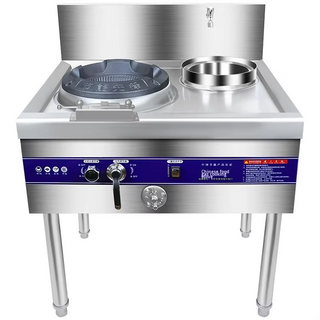
That output sets the size of the gas supply. Add up the rated consumption of every wok ring, the rice cooker and any gas steamers, assume they all run at once on a Saturday, and give the figure to a gas engineer before signing the lease. An older building may need a larger meter or a new service pipe, and that work sits on the critical path.
Induction appears in Chinese kitchens too, mostly away from the wok. Our comparison of induction and gas ranges explains why a flat hob struggles with a tossed wok and where induction does earn its place.
For fried rice and noodles repeated all night in batches, automatic wok machines take the tossing off a cook, and our guide to automatic cooking machines covers when that trade works.
Extraction sized from the burners up
A wok line produces more smoke and grease than almost any other restaurant station, and Sichuan cooking adds chili smoke that clears a dining room in seconds when the hood falls behind. The canopy is sized from the burners beneath it, with enough overhang on every side to catch a plume that leaves the wok sideways as it is tossed.
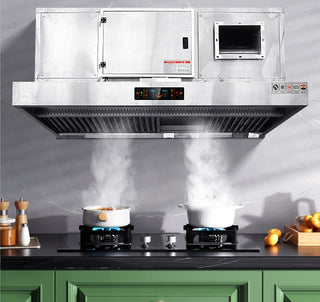
This wall-mounted canopy moves 6,000 m³/h across a 2,000 mm width, enough to cover a short wok range with a fryer beside it. Its aluminum mesh filters lift out for daily cleaning, which a wok line needs, because the grease load builds far faster than over a grill or a flat top.
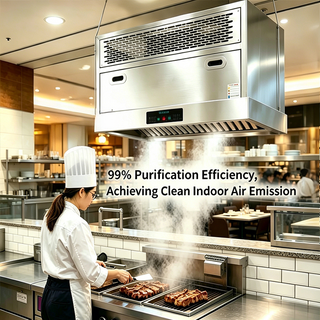
Sites in malls and basements often have no route for a duct to the outside. A recirculating unit cleans the air with an electrostatic precipitator and carbon instead. This one handles 3,000 m³/h at a rated purification efficiency of at least 99 percent, which suits steam and induction equipment. Many fire authorities will not accept recirculation over open gas wok burners, so a ductless site usually means a menu with little or no flame-tossed cooking. Ask before signing.
Make-up air matters as much as the fan, because a strong hood in a sealed kitchen pulls air back through the pass and the dining room door. The sizing method is in our guide to sizing a kitchen exhaust hood, and the ventilation range covers canopies for most line lengths.
Why does a wok kitchen use so much water?
Because the wok is rinsed between almost every dish, and the steamers boil off water from opening to close. Rice gets washed by the kilogram too. Treat water as a third utility alongside gas and power, and plan the plumbing with the same care as the gas.
At the range, each ring traditionally has its own swing tap and a trough along the front edge that drains the rinse water away. That means a cold feed to the range and a drain beneath it, both designed in before the floor is laid. The rinse water carries oil, so the drainage runs through a grease trap or interceptor sized for a wok kitchen. Most local authorities inspect this, and a trap that is too small blocks within weeks.
Steam is where water quality starts to cost money. Hard water scales up steamer elements, and scale slows the boil until the steamer can no longer keep pace with the dim sum orders. Where the local supply is hard, a treatment system on the steamer and tea feed pays for itself in fewer descaling shutdowns. This reverse osmosis unit produces 250 L/h of drinking-standard water from feed water up to 1,500 ppm TDS.
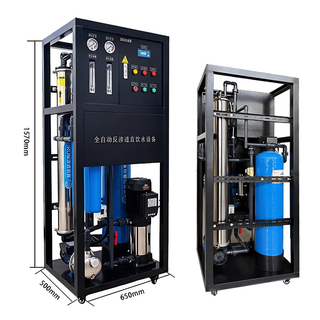
Guests notice the water in the tea first. Free-flowing jasmine or pu-erh is standard in many Cantonese rooms, and chlorinated water shows in the cup long before it shows in the food. The water treatment range covers smaller filters too.
A steam section that never borrows a burner
Dim sum and whole steamed fish depend on steam, and in a Cantonese kitchen the steam runs from before lunch until the last order. Cooking it on spare wok rings works for a week and then jams the line. The answer is a dedicated section with its own heat source.
For a dim sum counter, a countertop steamer base takes stacked bamboo or steel baskets directly. This one seats four stacks on a 5,000 W element with automatic temperature control between 30 and 110 °C, so trays can be held warm between orders without drying.
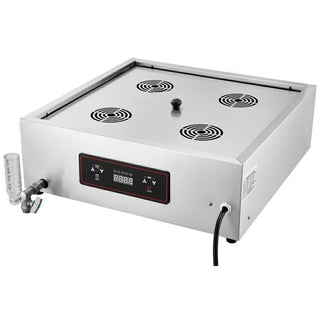
Volume changes the tool. A floor-standing induction bun steamer with seven steaming holes and an 18 kW element on three-phase power runs several drawer stacks at once and refills its 25 L tank directly from the mains. It is built for the morning bun and dumpling rush of a busy dim sum house.
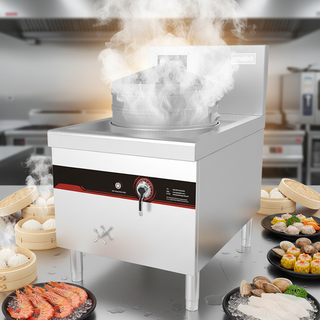
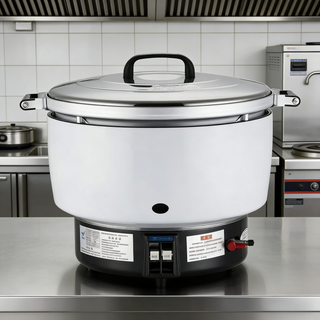
Larger kitchens often run a central steam generator instead of separate water tanks. A 12 kW generator produces about 17 kg of steam an hour from a mains feed, enough to drive steam cabinets and bun steamers from one source. Rice has its own station in most Chinese kitchens, and a gas rice cooker keeps it off the range entirely, which matters when every ring is booked.
The steamers range adds steam cabinets for larger lines.
Can a smaller restaurant run a roast meat counter?
Yes, if the menu treats siu mei as a feature rather than a sideline, because roast duck and char siu need their own corner of the kitchen for most of the day. The duck is glazed and dried for hours before it roasts, then it hangs in a heated window where guests see it. Each of those stages needs equipment, and none of it can share space with the wok line.
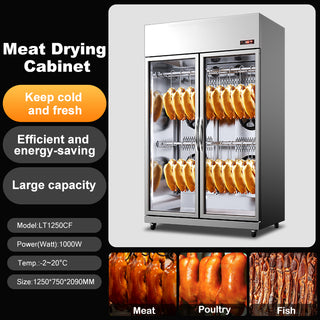
Drying comes first and is the stage kitchens most often improvise, usually with a fan and a spare shelf in the walk-in. A dedicated drying cabinet holds the birds between -2 and 20 °C with air cooling across both shelves, so the skin dries evenly and the walk-in stays free for everything else.
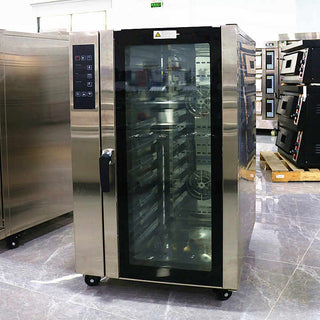
Traditional siu mei shops roast in a vertical hanging oven. Our catalog does not list one at the moment, and many restaurants roast on racks in a combi oven instead, which also takes char siu and pork belly, and steams fish when the roast counter is quiet. This gas combi runs eight trays from 0 to 350 °C in convection, steam or combined modes.
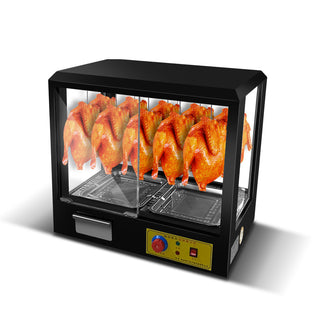
The last stage sells the product. A heated display in the front window or on the takeout counter keeps roasted meat at serving temperature, and it is the most effective sign a Cantonese restaurant can have. This countertop cabinet uses 1,200 W of fan-assisted heat to keep the skin crisp across every shelf. Our guide to hot holding equipment covers how long cooked meat can safely stay in one.
If the budget or the space will not stretch to all three, leave roast meats off the opening menu and add them in year two. A half-built siu mei corner produces a disappointing duck, and that is worse for a Cantonese room than having none.
Noodles and dumpling wrappers made on site
A northern-style menu lives on dough, and making it in-house is where the format earns its margin. Bought-in noodles and wrappers cost more per portion and taste like everyone else's.
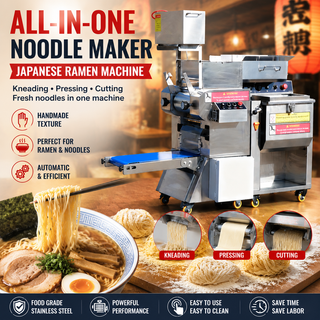
A combined noodle machine turns flour and water into finished noodles in one pass. This model rates 80 to 100 kg an hour and swaps forming parts to produce dumpling wrappers and wonton skins as well as ramen-style and alkaline noodles. That covers the dough needs of a busy noodle and dumpling shop from a single footprint.
Cooking is the other half of that station. A six-basket boiler lets one cook drop and lift separate orders of noodles or jiaozi from a 70 L or 107 L pot, so the queue at lunch moves in parallel rather than one pot at a time.
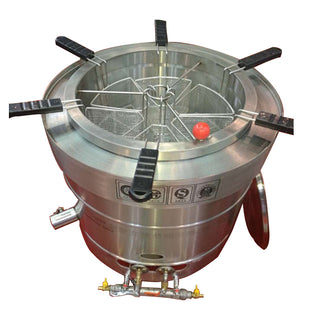
Hand-pulled noodles remain a skill rather than a machine, and some restaurants build the brand around a cook stretching dough in the window. The noodle machines range includes extruders and full production lines for central kitchens.
Cold storage for a menu of a hundred dishes
Chinese menus are long, and a long menu means many small containers of prepared ingredients within reach of every station. Plan cold storage in two layers. Bulk storage takes deliveries and prepared stocks, and line-side refrigeration holds the portions a cook grabs mid-service.
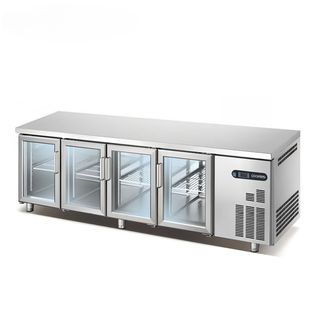
At the wok station, a refrigerated worktop puts the mise en place directly beside the range. This 2,250 mm prep table has four doors of storage below its work surface, long enough to serve two wok rings from one unit.
Behind it, an upright such as this double-door industrial refrigerator holds stocks and marinated proteins between deliveries. Our explainer on commercial refrigeration covers how much capacity a given menu needs.
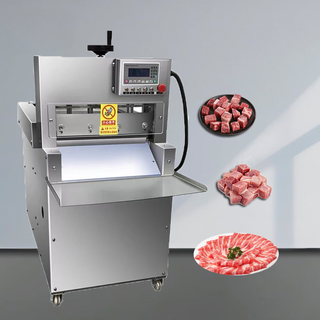
Hot pot changes the balance. The kitchen cooks little, but it slices large quantities of frozen beef and lamb into thin rolls, and that needs freezers plus a slicer built to cut meat straight from frozen. This one works at -18 °C without thawing, from slices of 0.1 mm.
Where the money goes when you open a Chinese restaurant
The services come before the machines. Gas capacity and extraction ductwork come first, followed by drainage with a grease trap and a three-phase supply for the steamers. These surprise first-time owners because they sit inside walls and under floors, and they cannot be fixed cheaply after opening, so they belong at the top of the budget.
Among the equipment, the wok range and its hood are the big-ticket pair, and neither is a place to save. A steam section and refrigeration come next, sized to the menu. Roast meat equipment and noodle machines are the optional layer, and the regional table at the top of this guide shows which of them your menu actually calls for.
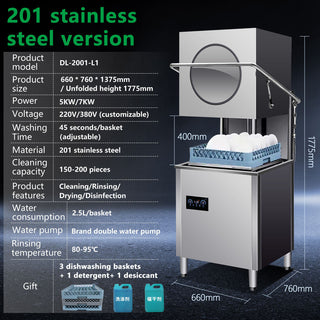
Warewashing is the line that tends to be underbought. A Chinese dining room sends back rice bowls and shared platters by the rack, and the greasy woks and trays come straight off the line. A hood-type machine that takes 16 dish sets per cycle keeps clean stock moving through a busy dinner, where an undercounter model falls behind.
Where to save is equally clear. Tableware for shared dishes is inexpensive per piece, though it breaks and needs replacing. Plain stainless tables and shelving are where a basic model does the job. A small opening menu, trimmed to the stations you can staff well, saves more than any discount on a single machine. Current prices for every item sit on the product pages.
Permits a wok kitchen has to clear
Every market asks for business registration and food-safety sign-off. Premises and fire approval come on top, plus an alcohol license if you serve drinks. A wok kitchen gets extra attention on the premises side, because inspectors look closely at the extraction and fire protection over a high-heat line. The detail varies by market.
| Market | Food business | Alcohol | Premises and late hours |
|---|---|---|---|
| United Kingdom | Register with the local council at least 28 days before opening; Food Hygiene Rating inspection by an Environmental Health Officer | Premises Licence from the council plus a Personal Licence holder as Designated Premises Supervisor | Fire risk assessment; hot food or drink sold between 11pm and 5am counts as late-night refreshment under the Premises Licence |
| Australia | Council premises approval and food business notification; some states require a Food Safety Supervisor | On-premises liquor licence from the state or territory regulator; every server holds a current RSA card | Fire safety statement for the premises |
| United States | Business license and EIN; health department permit with food-handler or ServSafe certification | State and often county liquor license through the ABC board; often the slowest step, and quota-capped in some states | Certificate of occupancy and fire-code sign-off, with the hood and fire suppression over the cooking line inspected |
| Singapore | Food Shop Licence from the Singapore Food Agency, with food-hygiene grading | Liquor Licence from the Police Licensing and Regulatory Department, classed by trading hours | Fire safety and kitchen exhaust approval as part of the fit-out |
The UK late-night refreshment rule matters more to Chinese restaurants than to most formats, because so many run a takeout trade past 11pm. Put the hours you actually intend to trade into the Premises Licence application from the start. Adding them later means a variation and another round of consultation.
Treat this table as an overview, not legal advice, and confirm the current requirements with your local council, state regulator or agency before committing to a lease. In every market, apply for the alcohol license first, because it has the longest lead time.
Where a new wok kitchen loses money in its first year
- A lease signed before the gas check. A unit without the gas capacity for a wok line, or without a route for a duct, forces a menu change or an expensive service upgrade. Check both before the heads of terms.
- A hood sized to the room. Extraction built for a general restaurant cannot clear a Sichuan wok line, and the smoke reaches the dining room on the first busy night.
- Steaming on the wok rings. Dim sum cooked on spare burners blocks the stir-fry orders behind it. A steam section of its own costs less than the covers lost at peak.
- An undersized grease trap. Wok rinse water carries oil into the drains all night. A trap sized for a sandwich shop blocks within weeks and brings the inspector back.
- Ignoring the water supply. Hard water scales steamers until they stop keeping pace. Treatment on the steam and tea feed is cheaper than repeated descaling shutdowns.
- A menu longer than the kitchen. A hundred dishes across four regional styles need more stations than most kitchens have. Open with the dishes your line can cook well and add the rest once service is steady.
- A roast corner without a drying stage. Duck roasted without proper drying comes out with soft skin, and in a Cantonese room that is the dish guests judge you by.
For the parts of the build every restaurant shares, from the dining room to staffing and service, our guide on how to open a restaurant covers the full picture beyond the wok.
Planning a Chinese kitchen around the wok? Tell us the regional menu, the seat count and the utilities on site, and we will put together a wok line and extraction that fit the building.


